Introduction
You wake up at 2 a.m. wheezing. The windows are closed. Nothing has changed — except your chest feels tight and your inhaler is on the nightstand again. Sound familiar?
For the nearly 25 million Americans and 3.8 million Canadians living with asthma, this scenario isn't unusual. And the culprit is often invisible: the air inside the home itself.
The EPA notes that indoor air can be more seriously polluted than outdoor air, with some organic compounds running 2–5 times higher inside than out. Tightly sealed, energy-efficient homes trap those pollutants longer than older, "leakier" construction ever did.
So: can an air filter actually reduce asthma symptoms, or is it just expensive marketing? The honest answer is it depends on the type, placement, and what else you're doing alongside it. This guide covers how filters work, which types have real evidence behind them, and what no filter can do on its own.
Key Takeaways
- HEPA room purifiers and high-performance HVAC filters (MERV 11–13+) measurably reduce airborne asthma triggers.
- Ozone-generating air cleaners must be avoided — ozone worsens asthma symptoms directly.
- Place a room air cleaner in the bedroom first — you spend more continuous hours there than anywhere else in your home.
- Filters reduce trigger concentration — they do not replace prescribed medication or address settled allergens.
Why Asthma Sufferers Need Cleaner Indoor Air
The Indoor Trigger Problem
The air inside a typical home contains a surprising roster of asthma triggers — many at higher concentrations than you'd find outdoors:
- Dust mite debris — droppings and body fragments that become airborne during disturbances
- Pet dander — microscopic skin flakes from cats, dogs, and other warm-blooded animals
- Mold spores — released continuously from damp surfaces, especially bathrooms and basements
- Pollen — tracked in on clothing, shoes, and through ventilation
- Combustion byproducts — from gas stoves, candles, and tobacco smoke
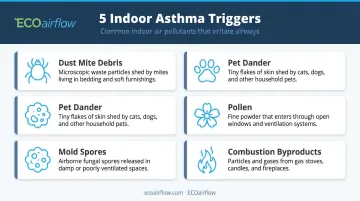
According to the Asthma and Allergy Foundation of America, 8 in 10 people in the U.S. are exposed to dust mites, and 6 in 10 to cat or dog dander — two of the most potent asthma triggers known.
What Happens Physiologically
When an asthmatic inhales these particles, the immune system overreacts. Airways narrow. Inflammatory cells flood the bronchial lining. The result: wheezing, chest tightness, coughing, and in severe cases, a full asthma attack. Reducing airborne particle concentration directly reduces how often these responses occur — basic respiratory physiology.
Tightly sealed homes make this worse. Weatherization measures designed to save energy also trap pollutants. In that context, filtration is a practical response to a real engineering trade-off.
How Air Filters Work for Asthma — And Where They Fall Short
The Basic Mechanism
Every air filter works on the same principle: move air through a medium that captures particles. The finer the medium, the smaller the particles it catches. No filter "purifies" air completely — it only captures what passes through it while the unit is running.
That last part matters more than most buyers realize.
Key Limitations to Know Before Buying
Room air cleaners cannot:
- Remove allergens already settled into carpet, bedding, or upholstery
- Instantly clear a fresh disturbance — expect 10–25 minutes after a pillow is flipped or a pet shakes off
- Protect rooms they're not running in
A 2022 bedroom study found that a purifier with a CADR of 500 m³/h brought PM2.5 down to stable low levels within 10 minutes after dust disturbance, and reduced airborne dust mite, cat, and dog allergens by 75–89% over one hour. Those results apply only to particles already airborne, and only in the room where the unit is running.
Understanding CADR — The Number That Actually Matters
CADR (Clean Air Delivery Rate) is the industry-standard metric published by AHAM (Association of Home Appliance Manufacturers). It measures the volume of filtered air a unit delivers per minute, with separate scores for smoke, dust, and pollen.
How to size a unit correctly:
- Measure your room's square footage
- The smoke CADR should be at least two-thirds of that number
- Running an undersized unit — say, one rated for 150 sq ft in a 300 sq ft room — means you won't reach rated filtration performance
HVAC Filtration vs. Room Air Cleaners
These are two different tools with different performance profiles:
| Feature | Room Air Cleaner | HVAC Filtration |
|---|---|---|
| Coverage | Single room | Whole home (air passing through system) |
| Runtime | Continuous | Only when HVAC fan runs |
| PM2.5 reduction (study) | 51% | 37% (at 15 min/hour runtime) |
| Best use | Bedroom, high-occupancy rooms | Baseline whole-home particle reduction |
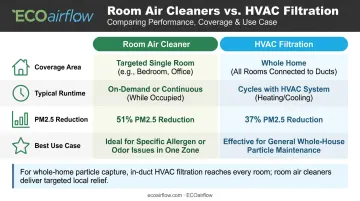
The EPA notes that residential HVAC systems may run less than 25% of the time during heating or cooling seasons — meaning HVAC-only filtration has real gaps that a room unit can fill.
Types of Air Filters for Asthma: What Helps, What Doesn't, and What to Avoid
True HEPA Filters
HEPA is the most-cited standard in asthma and allergy management — and for good reason. True HEPA filters capture at least 99.97% of particles at 0.3 microns or larger, which covers dust mite allergen, pet dander, pollen, and mold spores.
Critical warning: "HEPA-type," "HEPA-style," and "HEPA-like" labels are not the same as true HEPA. These marketing terms have no standardized performance requirement. If the product spec doesn't state 99.97% at 0.3 microns, treat the claim with skepticism.
MERV-Rated HVAC Filters
For whole-home HVAC filtration, MERV ratings tell you how effectively a filter captures particles across different size ranges:
| MERV Rating | 0.3–1.0 µm | 1.0–3.0 µm | 3.0–10 µm |
|---|---|---|---|
| MERV 11 | No minimum | ≥65% | ≥85% |
| MERV 12 | No minimum | ≥80% | ≥90% |
| MERV 13 | ≥50% | ≥85% | ≥90% |
MERV 11–13 is the general recommendation for asthma management — effective enough to capture fine particles, but not so restrictive that it strains most HVAC systems. Standard pleated filters at these ratings typically need replacement every 3 months.
Electronic Air Cleaners — With an Important Caveat
Most conventional electronic air cleaners produce ozone as a byproduct — and ozone is a direct airway irritant that worsens asthma. That's the critical distinction for asthma patients when evaluating electronic and electrostatic filters.
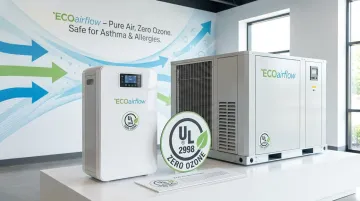
ECOairflow's Electronic Polarization Technology (EPT) works differently. Rather than relying on high-voltage ionization, EPT creates a polarized charge on the filter pad fibres, turning them into particle magnets. Charged particles are also attracted to each other — a process called agglomeration — forming larger clusters that are caught on subsequent passes. The result is capture of particles down to 0.001 microns, including ultrafine particles that HEPA-rated media cannot reach.
ECOairflow's residential and commercial models are certified by ETL (Intertek) to UL2998 Zero Ozone Verification:
- Residential: Dynamo, Model 1000, Model 1500
- Commercial: Model 2300 Dynamo, M-Series
Certified ozone output is below 0.0005 ppm (5 ppb) — one-tenth of the regulatory threshold set by UL867. That certification means the ozone exposure risk is effectively eliminated — a meaningful distinction for anyone with asthma who needs electronic filtration but can't tolerate ozone byproducts.
Ozone Generators — Avoid Completely
The EPA is unambiguous on this: ozone generators intentionally produce ozone, and even relatively low concentrations cause chest pain, coughing, shortness of breath, and throat irritation. They can worsen asthma directly. No asthma patient should use one.
UV and Activated Carbon — Supporting Roles Only
- Activated carbon filters adsorb gases and odours but don't capture allergen particles. No systematic evidence supports carbon-only filtration for improving asthma symptoms.
- UV germicidal (UVGI) systems target pathogens but evidence for home asthma benefit is mixed. A 12-month home RCT in 79 children showed no statistically significant primary outcome at 12 months.
Both are reasonable add-ons to particle filtration — not replacements for it.
What to Look for When Choosing an Air Filter for Asthma
Five Non-Negotiable Selection Criteria
1. Filtration rating
- Room purifiers: true HEPA (confirmed 99.97% at 0.3 µm)
- HVAC filters: MERV 13 minimum, or as high as your system can accommodate without restricting airflow
- For high-efficiency HVAC filtration without the pressure drop penalty, ECOairflow's M-Series MERV 13–16 filters are tested under the ASHRAE 52.2 Appendix J protocol and achieve MERV 16 performance at just 0.38 inches w.c. at 500 FPM. That's a fraction of the pressure drop produced by conventional high-MERV pleated media at comparable ratings.
2. CADR matched to room size
- Use AHAM's rule: smoke CADR ≥ two-thirds of room square footage
- Check CADR ratings at AHAM's verified directory before buying
3. Ozone output
- For any electronic or ionizing cleaner, confirm UL2998 Zero Ozone certification or equivalent
- Without that certification, assume the unit produces ozone — and ozone is a known asthma trigger
4. Maintenance schedule and cost
- Standard pleated HVAC filters: replace every 3 months
- ECOairflow's permanent-frame housing with replaceable pads: also every 3 months, but with lower HVAC operating stress and no airflow restriction penalty
- Replacement pads are available in all standard sizes and custom sizes directly through ECOairflow
5. System compatibility
- Higher MERV ratings can restrict airflow in systems not designed for them
- If your HVAC can't accommodate MERV 13+, you have two practical options: a portable room air cleaner with true HEPA, or an electronic HVAC filter (like ECOairflow's EPT-based units) that achieves high-efficiency particle capture at a low pressure drop — without stressing your existing system
Other Steps to Reduce Asthma Triggers at Home
Filtration handles airborne particles. These steps handle everything else.
Address Settled Allergens
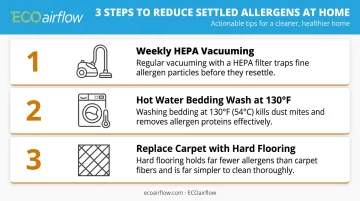
- Vacuum weekly with a HEPA-equipped vacuum cleaner — standard vacuums redistribute fine particles back into breathing air
- Wash bedding weekly in water at 130°F or hotter to kill dust mites
- Replace bedroom carpeting with hard flooring where possible — carpets act as allergen reservoirs that filtration cannot reach
Control Humidity
Keep indoor humidity between 30–50%. Above 50%, dust mite populations grow rapidly and mold establishes more easily — both are primary asthma triggers. A hygrometer costs less than $20 and tells you exactly where you stand.
Eliminate Pollution Sources
- No smoking indoors — ever
- Minimize spray-based cleaning products; research links household cleaning sprays to increased asthma risk across age groups
- Groom pets outside when possible
- During high pollen days, keep windows closed and rely on filtered HVAC air
Air filters work best when the volume of new pollutants entering the space is also reduced. Pairing good filtration with source control gives you the strongest defense against asthma triggers.
Frequently Asked Questions
Do air purifiers really work for asthma?
Yes, though they work best alongside medication, not instead of it. Evidence supports that air purifiers reduce airborne asthma triggers including dust, pet dander, pollen, and mold spores. They're most effective as part of a broader plan that includes medication adherence and source control.
Which air filter is best for asthma?
For HVAC systems, MERV 11–13 or higher is the standard recommendation — electronic air cleaners with low pressure drop are a strong alternative that won't strain your system. For portable room units, HEPA filtration is well-supported by evidence. Whatever you choose, avoid any ionizing air cleaner that lacks UL2998 Zero Ozone certification.
Do air purifiers dry indoor air?
No. Standard HEPA and electronic air purifiers filter particles without altering moisture content. Dry-air irritation in winter comes from heating systems, not air filtration.
Where should I place an air purifier if I have asthma?
Start with the bedroom, where most people spend 8 or more consecutive hours. Secondary placement in living rooms or home offices makes sense when significant allergen sources are present there — pets, carpeting, or high-traffic areas.
Can air filters replace asthma medication?
No. Air filters reduce trigger exposure and may lower symptom frequency over time, but they do not replace prescribed inhalers, corticosteroids, or other therapies. Always follow your physician's treatment plan.
How often should I change my air filter if I have asthma?
Standard pleated HVAC filters should be replaced every 3 months — more often in homes with pets or smokers. For electronic and HEPA room purifiers, follow the manufacturer's recommended schedule; a clogged filter loses effectiveness and raises operating costs.