Introduction
Most people assume outdoor air is the bigger concern when it comes to air pollution. The reality is quite different. According to the EPA, Americans spend approximately 90% of their time indoors, and indoor pollutant concentrations are often 2 to 5 times higher than outdoor levels — and even higher in homes with poor ventilation.
The furnace filter sits at the center of your home's air quality management, yet most homeowners understand it only as "the thing that catches dust." That undersells it significantly — and it misses a real risk: the wrong filter, or a neglected one, can actively worsen the air you breathe.
This guide covers how filters actually work, what MERV ratings mean in practice, which particle types different filters capture (and which they miss), and how to match filter choice and maintenance habits to your home's specific air quality needs.
Key Takeaways
- Furnace filters trap airborne particles — dust, pollen, dander, mold spores, bacteria, and fine particulates — as air cycles through your HVAC system
- MERV rating is the most important spec: higher ratings capture smaller, more harmful particles, but must suit your system's airflow capacity
- Fiberglass filters protect equipment; pleated and powered electronic filters actually improve air quality
- A clogged or poorly fitted filter worsens indoor air quality and raises energy costs
- Replacing or maintaining your filter on schedule is the highest-impact maintenance step you can take
What Is a Furnace Filter and What Does It Actually Do?
A furnace filter is a porous media component installed in the return air duct or air handler. As your HVAC system runs, it pulls air from the home through this filter before recirculating it through the living space.
ASHRAE identifies two distinct functions for particle filters in HVAC systems: protecting equipment and reducing occupant exposure to airborne particles. These are related goals — but they're not the same, and the filter type you choose determines which one it serves better.
What a Furnace Filter Is Not
This distinction trips up a lot of homeowners. A furnace filter is not:
- A standalone air purifier that works independently of your HVAC
- A solution for gaseous pollutants, VOCs, carbon monoxide, or radon gas (standard particle filters don't address these)
- A fix for mold or moisture problems at their source
- A substitute for ventilation
The EPA notes explicitly that most residential furnace and HVAC filters are designed to filter particles, not gases. Expecting a filter to handle VOCs or odors without an activated carbon layer leads to real disappointment.
The Main Filter Categories
| Filter Type | Mechanism | IAQ Benefit |
|---|---|---|
| Fiberglass (MERV 1–4) | Mechanical impaction | Minimal — equipment protection only |
| Pleated (MERV 8–13) | Mechanical + interception | Moderate — good for most homes |
| Passive electrostatic | Charged fibres | Better than basic pleated, degrades over time |
| Powered electronic (EPT) | Active electrical polarisation | High — captures ultrafine particles |
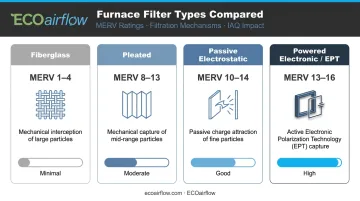
The mechanism behind each type determines its actual performance. MERV rating captures one dimension — particle size filtration — but not pressure drop, longevity, or ultrafine particle capture, all of which vary significantly across these categories.
How Furnace Filters Capture and Remove Airborne Contaminants
Filtration is a sequence of events, not a single action. Air must be drawn through the filter, particles must be intercepted by a specific physical or electrical mechanism, and that performance must hold under real operating conditions.
How Air Enters the Filter System
Filtration only happens when the HVAC blower is running. Air from the return ducts gets pulled through the filter before reaching the heat exchanger. This means filtration is intermittent — homes where the blower runs more frequently cycle more air through the filter each day and see greater IAQ benefit.
One dependency that most guides skip over: fit matters as much as rating. A filter that isn't snugly seated allows air to bypass around the edges entirely. Per EPA, ASHRAE, and CDC guidance, checking filter fit to minimize bypass is a fundamental requirement — a MERV 13 filter installed with gaps performs worse than a properly fitted MERV 8.
The Filtration Mechanism: How Particles Are Actually Trapped
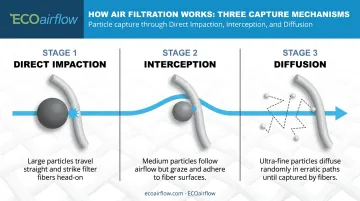
Mechanical filters use three physical processes to capture particles:
- Direct impaction — large particles collide with filter fibers and stick
- Interception — medium particles follow the airflow but graze fibers and are captured
- Diffusion — ultra-small particles move erratically and contact fibers by chance
Cheap fiberglass filters rely almost entirely on impaction. They catch larger debris but allow fine and ultrafine particles to pass through freely — which is exactly the size range most relevant to respiratory health.
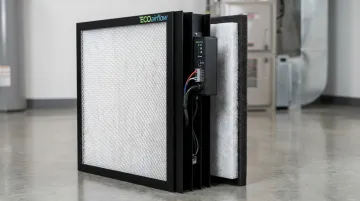
Powered electronic filters work differently. ECOairflow's Electronic Polarization Technology (EPT) uses a high-voltage, low-amperage corona field to actively charge incoming particles, causing them to be attracted to the polarized collector pad fibers — similar in principle to how a magnet attracts metal.
This allows the filter to capture particles as small as 0.001 microns using less dense media than high-MERV mechanical filters, which keeps pressure drop low. Independent lab testing has shown EPT performance to be up to 45 times more effective than non-powered filters in the 0.001–0.010 micron particle range.
Particle size matters for health outcomes. Fine particles (PM2.5 and smaller) penetrate deeper into the respiratory system and are linked to nonfatal heart attacks, aggravated asthma, decreased lung function, and premature death in people with existing cardiac or pulmonary conditions. Filters that only capture large particles leave the most clinically relevant pollutants circulating in the home.
How Filter Performance Holds Under Real Conditions
A filter's rated efficiency is established under controlled test conditions. In practice, three variables affect actual performance:
- Airflow speed — higher fan speeds push more air through but may reduce particle contact time
- Filter loading — a partially loaded filter can capture slightly more particles as fibers become coated; an overloaded filter restricts airflow and allows bypass
- Humidity — moisture can degrade some filter media, particularly passive electrostatic fibers
MERV ratings, tested under ASHRAE 52.2 protocol, provide a standardized basis for comparison across three particle size ranges: 0.3–1.0 µm, 1.0–3.0 µm, and 3.0–10.0 µm. Proprietary scales like MPR (Filtrete) and FPR (Home Depot) follow the same logic — higher means more efficient — but are manufacturer-specific rather than independently standardized.
What Better Filtration Actually Delivers
A well-chosen, properly maintained filter produces measurable reductions in airborne particulate matter circulating through the home. That translates to:
- Fewer allergy and asthma triggers in the breathing zone
- Lower concentrations of fine particles linked to cardiovascular and respiratory health impacts
- Protection of HVAC components from dust accumulation and stress
There's also a direct energy benefit. The Department of Energy reports that replacing a dirty, clogged filter with a clean one can lower energy consumption by 5% to 15%. A clean, appropriately rated filter maintains proper airflow, allowing the system to condition air without working harder than necessary. ECOairflow's residential models, with pressure drops ranging from 0.11 to 0.18 inches w.c. at 300 fpm, are specifically engineered to maintain this airflow efficiency while delivering electronic-grade filtration performance.
Types of Furnace Filters and Their IAQ Performance
Not all furnace filters do the same job. Choosing the right one starts with understanding where each type actually fits in the IAQ picture.
Fiberglass Filters (MERV 1–4)
Inexpensive and widely available. These capture large debris to protect HVAC equipment but allow fine particles, allergens, and pathogens to pass through freely. If IAQ is your goal, fiberglass alone is not the answer.
Pleated Filters (MERV 8–13)
The most practical upgrade for most homes. The accordion-style design increases surface area, improving capture across dust, pollen, and pet dander. The EPA recommends at least MERV 13 for meaningful fine-particle capture — at that level, a filter captures ≥50% of particles in the 0.3–1.0 µm range and ≥90% in the 3.0–10.0 µm range.
One caution: higher-MERV pleated filters create more airflow resistance. A MERV 13 mechanical filter can impose 2–4 times the pressure drop of a basic MERV 2 filter, which can strain systems not designed to handle it.
Passive Electrostatic Filters
These use electrostatically charged fibres to attract particles without electricity. Performance exceeds basic pleated filters for smaller particles, but the charge degrades over time as dust accumulates on the fibres — meaning efficiency decreases between replacements.
Powered Electronic Filters (EPT Technology)
Unlike passive electrostatic filters, ECOairflow's EPT-based filters actively generate and maintain an electrical charge through powered electronics — so performance stays consistent rather than declining as the filter loads up.
Key specs for ECOairflow's residential line:
- Power draw: 2 watts or less (Models Dynamo, 1000, 1500, 6000)
- Pressure drop: 0.11–0.18 inches w.c. at 300 fpm (residential models)
- MERV ratings: Model 1000 at MERV 11, Models 1500 and Dynamo at MERV 12; commercial Model 2300 achieves MERV 13–16
- Ozone emissions: Certified zero ozone compliant under UL2998 (verified by Intertek/ETL) — ozone levels below 0.0005 ppm, one-tenth of the standard required by UL867
- Particle capture floor: 0.001 microns, including virus-sized particles, radon daughter progeny, and fine carbon particles from wildfire smoke
Those specs are also backed by rigorous testing: ECOairflow's MERV certification uses ASHRAE certified test dust that includes a carbon component. Many electronic filter manufacturers test without carbon, which doesn't reflect real-world conditions where carbon-containing particulate from cooking, traffic pollution, and wildfire smoke is present.
Activated Carbon and HEPA Filters
Carbon layers address odours and some VOCs — useful as a supplementary measure. True HEPA filters achieve the highest particle capture rates but create significant airflow restriction that most residential HVAC systems can't handle without modification. They're typically reserved for standalone purifiers or commercial systems.
Keeping Your Filter Effective: Maintenance Best Practices
Even a high-performing filter fails to deliver if it's neglected or seated wrong. Consistent maintenance protects both your air quality and your HVAC system.
Replacement Schedule
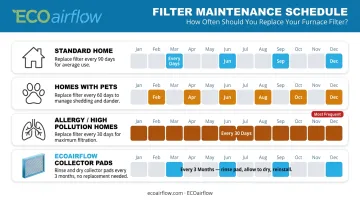
- Standard pleated filters: inspect monthly, replace every 60–90 days per EPA guidelines; ENERGY STAR recommends at minimum every 3 months
- Homes with pets, allergy sufferers, or high pollution: may need more frequent changes
- Visual check: visible grey/brown discoloration or inability to see light through the filter means replace immediately, regardless of schedule
- ECOairflow collector pads: replace every 3 months; discard pads rather than washing them — many municipalities accept them as post-consumer glass waste
Fit and Installation
A poor fit undermines even the highest MERV-rated filter:
- The filter must seat snugly in the slot — no bending, no gaps
- Follow the arrow printed on the filter frame; it should point toward the furnace or air handler
- An ill-fitting filter makes MERV rating irrelevant — bypassed air carries all the particles the filter was meant to catch
Electronic Component Checks
If you're running a powered filter like ECOairflow's residential units, the sealed electronics require no special maintenance. Pad swaps follow three steps:
- Open the filter housing
- Remove the used pad
- Drop in the new pad and close the housing
For questions about electronic component performance over time, ECOairflow's support team is reachable at 1-877-347-3569 or customerservice@ecoairflow.com.
Frequently Asked Questions
Does a furnace filter help air quality?
Yes. A properly rated and maintained furnace filter measurably reduces airborne particles — including dust, pollen, dander, mold spores, and at MERV 13+, bacteria and fine particulates — as air cycles through the HVAC system. The degree of improvement depends on filter rating, fit, and how often it's replaced or serviced.
What MERV rating is best for home indoor air quality?
Most homes benefit from MERV 8–13 as a practical range. The EPA recommends at least MERV 13 for capturing fine particles of greatest health concern. Your system's fan and filter slot must support the chosen rating without excessive airflow restriction. Confirm compatibility with your HVAC contractor before upgrading.
How often should I change my furnace filter to maintain good air quality?
Inspect monthly and replace every 60–90 days under typical conditions. Homes with pets, smokers, or allergy sufferers should replace more frequently. A visibly dirty or discolored filter should be replaced immediately . ECOairflow collector pads follow the same 3-month interval.
Can a furnace filter capture bacteria and viruses?
Standard pleated filters do not reliably capture pathogens. Higher-rated filters at MERV 13 and above — particularly powered electronic filters using polarisation technology — can capture virus- and bacteria-sized particles. No filter eliminates all biological contaminants. Filtration performs best alongside adequate ventilation and source control measures.
What can a furnace filter not remove from indoor air?
Most furnace filters do not address gaseous pollutants, VOCs, carbon monoxide, radon gas, or humidity-related issues. Activated carbon layers can help with odours and some VOCs, but source control and ventilation remain essential for gases and moisture problems.
Does a dirty furnace filter make indoor air quality worse?
Yes. A clogged filter restricts airflow, forcing the HVAC system to work harder while allowing particle bypass around the overloaded media. The result is degraded air quality and higher energy consumption. Replace filters on schedule — waiting too long costs you on both fronts.