Here's what most people get wrong: cat allergies aren't caused by fur. The real culprit is Fel d 1, a microscopic protein that floats in the air for hours and settles on every surface in your home. Visible hair is just the delivery vehicle.
A well-chosen air purifier with the right filtration stages can meaningfully reduce your airborne Fel d 1 exposure. The wrong one — undersized, ionizer-equipped, or missing a carbon layer — will barely move the needle. This guide covers what to look for and which five units perform best.
Key Takeaways
- Cat allergies are triggered by Fel d 1, a protein in cat saliva and skin — not fur itself — and it stays airborne for up to 14 days
- Look for: washable pre-filter (hair) + activated carbon (odours) + HEPA-grade particle filter (dander/Fel d 1)
- Match CADR to your room size; the industry benchmark is 4.8 air changes per hour (ACH)
- Avoid purifiers with ionizers you can't fully disable — ozone worsens allergy symptoms
- Top picks: Levoit EverestAir, Alen BreatheSmart 75i, Levoit Vital 200S, Winix 5510, Austin Air HealthMate
Why Cat Allergies Are Harder to Manage Than You Think
Fel d 1 is a protein produced in cats' sebaceous glands, saliva, skin, and lacrimal glands. When a cat grooms itself, Fel d 1-coated saliva dries on the fur and breaks into microscopic airborne fragments. Research published in PMC confirms that 80–95% of cat-allergic individuals carry Fel d 1-specific IgE antibodies, making it the dominant allergen in virtually every cat household.
The persistence of Fel d 1 is what defeats most household cleaning efforts:
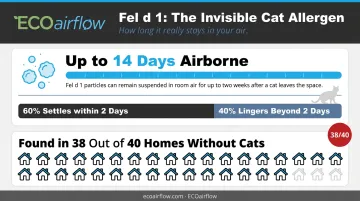
- Smaller particles stay airborne for up to 14 days after disturbance
- Approximately 60% of airborne Fel d 1 settles within two days, but the remainder lingers far longer
- Fel d 1 was detected in 38 out of 40 homes without cats in one study, and in 99.7–99.9% of all U.S. homes surveyed, transported in on clothing and shoes
Standard vacuuming actually makes things worse. Studies published on PubMed found that all vacuum cleaners tested increased airborne Fel d 1 levels during use by resuspending settled particles. Without continuous air filtration running, allergen levels bounce right back up after cleaning.
This is precisely what an air purifier addresses: not a one-time intervention, but a continuous filtration system that keeps pulling allergens out of the air before they resettle — and before they reach you.
The Best Air Purifiers for Cat Allergies, Hair & Dander
These five units were evaluated on particle filtration efficiency, activated carbon capacity, CADR relative to room size, pre-filter design for pet hair, noise levels, and ozone safety. Each was selected to avoid the three most common buyer mistakes: undersizing, weak filtration stages, and non-disableable ionizers.
Levoit EverestAir — Best for Large Spaces
Levoit's flagship large-room purifier suits open-plan living areas and great rooms. It features a washable pre-filter that catches cat hair before it reaches the main filter, a substantial activated carbon layer for odour control, and an AirSight Plus 2.0 laser dust sensor that drives an Auto Mode: it ramps up filtration automatically when Fel d 1 levels rise after your cat settles nearby.
No ionizer is built in, so there's zero ozone risk. App-based controls include scheduling and a display lock that stops curious cats from pawing the settings.
Note: Levoit's official sources show a slight discrepancy between the product page (354 CFM, 549 sq. ft. at 4.8 ACH) and the manual (360 CFM, 558 sq. ft. at 5 ACH). Both figures place it clearly in large-room territory.
| Spec | Details |
|---|---|
| Filtration stages | Washable pre-filter, particle filter, activated carbon filter |
| CADR / Coverage | ~354–360 CFM / ~549–558 sq. ft. at 4.8–5 ACH |
| Noise / Power | 24–56 dB (product page) / 24–52 dB (manual); 70 W rated |
Alen BreatheSmart 75i — Best for Odour + Allergen Control
The 75i is Alen's most powerful consumer unit, built around an H13 HEPA filter — the same grade used in hospital-grade equipment. The Fresh Filter option adds a dedicated pelleted activated carbon layer on top of the standard filtration stack, making it particularly strong in homes where litter box odour is as much a concern as airborne dander.
An airID optical particle sensor provides real-time air quality feedback. The ionizer is optional and can be switched fully off without affecting filtration; when disabled, ozone output is confirmed at 0 PPM. Alen's lifetime guarantee applies when the unit is registered and filters are purchased within 15-month intervals.
Note: Alen's own pages conflict slightly: the product page lists CADR 375 / 2,800 sq. ft./hr, while the support page states CADR 347 / 2,600 sq. ft./hr. Use the lower figure as the conservative benchmark.
| Spec | Details |
|---|---|
| Filtration stages | Removable pre-filter, H13 HEPA, pelleted activated carbon (Fresh Filter), optional ionizer |
| CADR / Coverage | 347–375 CFM / ~1,300–1,400 sq. ft. at 30 min (large open areas) |
| Noise / Power | 25–51 dBa (product page); 1.36–55 W |
Levoit Vital 200S — Best Overall Value
The Vital 200S consistently outperforms units at higher price points in independent head-to-head tests. It covers rooms up to ~388 sq. ft. at 4.8 ACH with a washable pre-filter, a combined particle and carbon filter, and an onboard air quality sensor driving Auto Mode. Levoit's official documentation confirms zero ozone emissions — no ionizer, no plasma technology.
The washable pre-filter is easy to maintain: a quick vacuum or rinse weekly keeps it clear of cat hair without special tools. Replacement filters are widely available from multiple suppliers, which keeps long-term running costs competitive.
| Spec | Details |
|---|---|
| Filtration stages | Washable pre-filter, particle filter with activated carbon layer |
| CADR / Coverage | 250 CFM / ~388 sq. ft. at 4.8 ACH |
| Noise / Power | 23–54 dB; 50 W rated |
Winix 5510 — Best for Dedicated Allergy Sufferers
The 5510 is the successor to the discontinued 5500-2, and it brings a cleaner spec sheet. Its True HEPA filter captures 99.97% of particles at 0.3 microns — the standard definition from the U.S. EPA — alongside a washable pre-filter and an activated carbon filter. The PlasmaWave feature can be toggled off independently; when used, it holds CARB certification under Executive Order G-24-234 as an ozone-safe electronic air cleaner.
Winix provides some of the most transparent CADR data in this roundup, publishing dust, pollen, and smoke figures separately. That makes room-sizing calculations more reliable than units that report a single blended number.
| Spec | Details |
|---|---|
| Filtration stages | Washable pre-filter, activated carbon filter, True HEPA, PlasmaWave (disableable) |
| CADR / Coverage | Dust 252 / Pollen 247 / Smoke 253 CFM; AHAM-verified 392 sq. ft. at 4.8 ACH |
| Noise / Power | Not officially published by Winix; 65 W rated per manual |
Austin Air HealthMate — Best for Homes with Multiple Cats
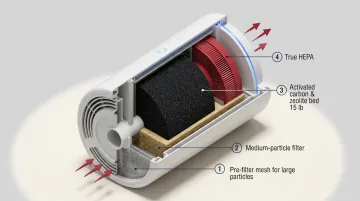
The HealthMate is a different category of machine. Made in the USA with a solid steel housing (cats can rest on it without issue), it targets households where odour control is the primary battle: multiple cats, persistent smells, or both. Its 15 lb activated carbon and zeolite blend dwarfs the 1–2 lb carbon loads typical of comparable units, giving it a meaningful edge for gas and VOC adsorption. The four-stage system runs from a large-particle pre-filter through to medical-grade True HEPA. Wheels make repositioning between rooms easy, and the filter lasts up to five years with a matching 5-year manufacturer warranty.
One honest caveat: Austin Air does not publish an official CADR figure. The company claims coverage up to 1,500 sq. ft., but without a verified number, particle removal speed can't be confirmed to the same standard as the other units here. This is a machine for persistent odour elimination and long-cycle filtration, not rapid allergen knockdown.
| Spec | Details |
|---|---|
| Filtration stages | Large-particle pre-filter, medium-particle pre-filter, 15 lb carbon/zeolite gas filter, True HEPA |
| CADR / Coverage | Official CADR not published; stated coverage up to 1,500 sq. ft. |
| Noise / Power | Varies by fan speed; official wattage not consistently published |
Key Features to Look for in an Air Purifier for Cat Allergies
The Three-Stage Filtration Hierarchy
Cat allergy households have three distinct problems — and each requires its own filtration stage:
- Pre-filter — catches visible cat hair before it clogs the main filter. Should be washable; clean weekly in heavy cat households
- Activated carbon layer — adsorbs odor molecules and VOCs from litter boxes and cat skin. Units with more carbon by weight perform better on persistent smells
- HEPA-grade particle filter — captures fine dander particles and the Fel d 1-carrying aerosols that pass through everything else
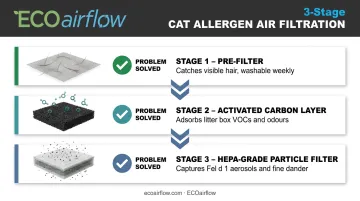
Skip any stage and you're only solving two of the three problems.
CADR and Room Sizing
CADR (Clean Air Delivery Rate) measures how fast a purifier cleans a given volume of air. AHAM's standard sizes rooms at 4.8 air changes per hour (ACH), which is the benchmark used for all AHAM-verified CADR ratings.
To calculate ACH for your room:
ACH = (Smoke CADR × 60) ÷ Room volume in cubic feet
Example: A 15 × 20 ft room with 9 ft ceilings = 2,700 cu. ft. A purifier with 200 CFM CADR delivers (200 × 60) ÷ 2,700 = 4.4 ACH — just under the AHAM benchmark.
For the room where your cat spends the most time, aim for a unit whose CADR meets or exceeds the AHAM room-size recommendation for that square footage.
Ozone and Ionizer Risk
The U.S. EPA warns that inhaled ozone can cause chest pain, coughing, shortness of breath, and throat irritation — all of which overlap with and worsen allergy and asthma symptoms. For allergy sufferers, an air purifier that generates ozone is counterproductive.
Look for:
- Units with no ionizer (Levoit EverestAir, Levoit Vital 200S)
- Units where the ionizer can be fully disabled without affecting filtration (Alen 75i, Winix 5510)
- Units with CARB or UL2998 Zero Ozone certification if you want verified compliance
Whole-Home HVAC Filtration as a Complement
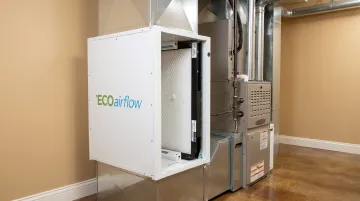
Portable air purifiers handle the room they're in. For whole-home cat allergen control — including every room, hallway, and duct run — upgrading your HVAC system's air filter is the most effective complement.
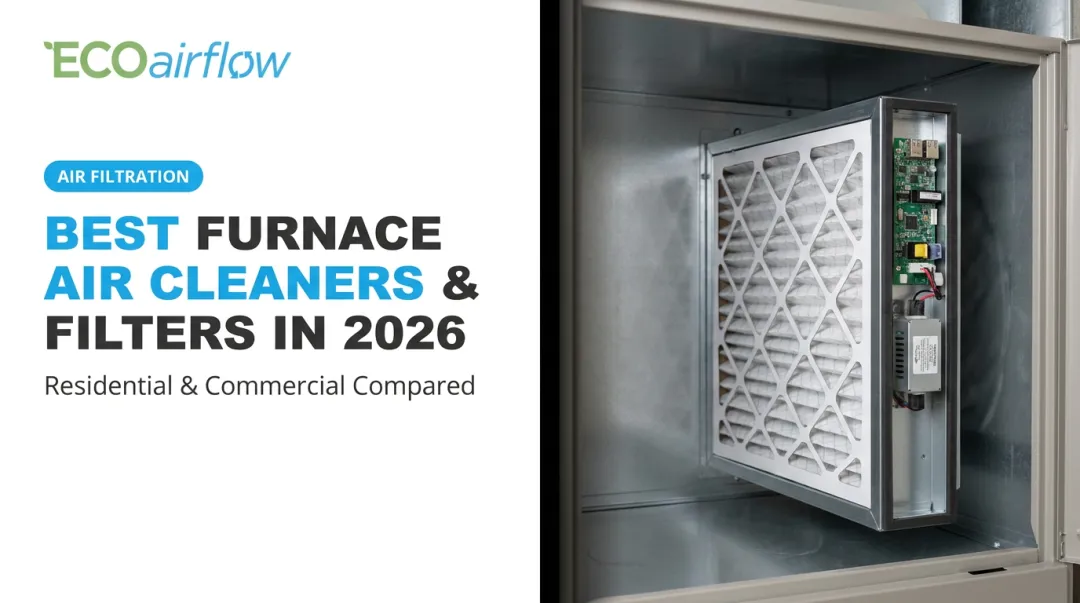
Standard high-MERV passive pleated filters rely on tight weave density to achieve MERV 13+, which increases airflow resistance and puts stress on HVAC equipment over time. ECOairflow's electronic air filtration systems take a different approach: Electronic Polarization Technology (EPT) applies a polarized charge to the filter pads, actively attracting particles down to 0.001 microns rather than waiting for physical collision alone.
ECOairflow's M-Series™ commercial filters achieve MERV 13–16 (ASHRAE 52.2 certified, Appendix J compliant) with a pressure drop of just 0.09–0.38 inches w.c., cutting HVAC operating costs by up to 15% compared to dense pleated alternatives.
Residential models (Dynamo™, Model 1000) capture particles as small as 0.001 microns, well within the size range of Fel d 1 carriers, and carry UL2998 Zero Ozone Verification by ETL (Intertek).
Filter Maintenance Schedule
| Component | Cat Household Frequency |
|---|---|
| Pre-filter (washable) | Weekly vacuum or rinse; twice weekly for 2+ cats |
| Main HEPA/carbon filter | Every 6–12 months depending on cat load |
| Check after filter change | Run on high speed for 30 min to confirm airflow is restored |
A clogged pre-filter reduces CADR and can cause the main filter to load faster with hair — the opposite of what you want.
Frequently Asked Questions
Do air purifiers actually help with cat allergies?
Yes. A 2020 review in PubMed confirmed that portable HEPA air cleaners reduce airborne Fel d 1 in most studies, with significant reductions in early and late asthmatic responses documented in controlled exposure trials. Effectiveness depends on matching the unit's CADR to room size and maintaining the filter on schedule.
What MERV rating is best for filtering cat dander from HVAC systems?
MERV 13 and above is the standard recommended by ASHRAE for capturing fine particles like cat dander and Fel d 1 carriers. Electronic air filters certified to MERV 13–16 — such as ECOairflow's M-Series™ — can reach this level while keeping pressure drop low enough to protect HVAC equipment.
How many air changes per hour do I need for cat allergy relief?
AHAM's verified benchmark for portable air purifier room sizing is 4.8 ACH. Verify a unit meets this for your room by using the formula: (Smoke CADR × 60) ÷ room volume in cubic feet. Prioritize the room your cat occupies most.
Where should I place an air purifier for cat allergies?
Place it in the room where your cat spends the most time — typically the living area or bedroom. Keep it away from walls, corners, and doorways so intake vents have clear airflow on all sides.
How often should I clean or replace filters if I have a cat?
Clean washable pre-filters weekly (twice weekly in multi-cat homes) to prevent hair buildup from blocking airflow. Main HEPA and carbon filters last 6–12 months — check closer to the 6-month mark if you have heavy shedders.
Can an air purifier eliminate cat odours as well as allergens?
Particle filters alone don't touch odours — that requires an activated carbon filter to adsorb VOC and odour molecules. Units with more carbon by weight (such as the Alen 75i's Fresh Filter or the Austin Air HealthMate's 15 lb carbon/zeolite blend) handle persistent litter box and pet smells far better than units with thin carbon layers.
Conclusion
Managing cat allergies effectively requires thinking in layers. A portable air purifier handles the room it's running in — provided it's properly sized, has all three filtration stages, and you clean its pre-filter weekly. For the rest of the house, those portable units can't help.
If cat dander is showing up in every room, that's a whole-home problem — and whole-home HVAC filtration is where portable units fall short. ECOairflow's electronic air filtration systems are UL2998 Zero Ozone Verified, capable of capturing particles down to 0.001 microns, and available in configurations rated MERV 13–16 for higher-demand applications. They work through every room simultaneously, with a low-pressure-drop design that won't stress your HVAC equipment.
If you're ready to go beyond portable units and want a tailored recommendation for your home's HVAC system, contact the ECOairflow team directly:
- Email: customerservice@ecoairflow.com
- Phone: 1-877-347-3569 (toll-free)