The honest answer is more specific than a yes or no. Air purifiers don't kill dust mites or reach the ones burrowed into your bedding. What they do — when chosen and used correctly — is capture the airborne allergen particles that actually trigger your symptoms. That distinction shapes everything about how you should approach dust mite management.
This guide explains what air purifiers can and can't do, which filtration technologies perform best, and how to build a strategy that actually reduces your symptoms.
Key Takeaways
- Air purifiers do not kill dust mites living in your mattress, pillows, or carpet
- They do capture airborne allergen particles (mite feces and shed skins) — which are the actual cause of symptoms
- MERV 13+ or equivalent filtration is the minimum standard for meaningful allergen capture
- The bedroom is your top priority — 84.2% of U.S. homes have detectable dust mite allergen in beds
- Filtration works best combined with hot washing, allergen-proof covers, humidity control, and HEPA vacuuming
What Are Dust Mites and Why Are They a Problem?
Dust mites are microscopic arachnids — roughly 0.25–0.3 mm long, related to spiders, invisible to the naked eye. They feed on shed human and animal skin cells and thrive in warm, humid environments (around 70°F and above, with humidity above 50%).
They don't float around the room. They live in mattresses, pillows, upholstered furniture, carpets, and stuffed toys — deep in fabric fibers, well out of reach by any air purifier.
The Real Culprit: Airborne Allergen Proteins
The mites themselves aren't what makes you sneeze. The problem is what they leave behind.
Each dust mite produces roughly 20 fecal pellets per day, sized 20–40 microns. These pellets — along with shed mite skin — contain proteins called Der p 1 and Der f 1. When disturbed by activity like making a bed or vacuuming, these particles become airborne and get inhaled, triggering an allergic immune response.
For people sensitive to dust mites, that response can range from mild irritation to significant asthma flare-ups.
Common symptoms include:
- Sneezing and runny or stuffy nose
- Itchy, red, or watery eyes
- Coughing and congestion
- In people with asthma: chest tightness, wheezing, shortness of breath, and nighttime waking
This distinction matters: it's the airborne allergen particles you inhale, not the mites themselves. That's what determines where air filtration fits into the solution — and where it falls short.
Do Air Purifiers Kill Dust Mites? The Direct Answer
No. Air purifiers do not kill dust mites.
Dust mites live in surfaces. No air purifier can reach inside a mattress or carpet pile to eliminate an infestation. The EPA is direct on this point: mechanical filters can capture airborne dust mite allergens, but these larger particles settle quickly and filters are not very effective at removing them completely from indoor spaces.
What Air Purifiers Actually Do
A purifier continuously draws room air through a filter, capturing particles — including the allergen proteins that become airborne when you make your bed, walk across carpet, or vacuum. Once those particles are trapped in the filter, they can't be inhaled.
That's genuinely useful. The trigger for your symptoms is inhaled allergen exposure. Reducing the airborne concentration of Der p 1 and Der f 1 proteins reduces the dose you're breathing — which reduces symptom severity.
That's genuinely useful. The trigger for your symptoms is inhaled allergen exposure. Reducing the airborne concentration of Der p 1 and Der f 1 proteins reduces the dose you're breathing — which reduces symptom severity.
In practice, an air purifier contributes by:
- Capturing allergen proteins before they're inhaled
- Reducing airborne particle load during high-disturbance activities (vacuuming, bed-making)
- Providing continuous filtration so concentrations stay lower over time
Watch Out for Misleading Marketing
Some product marketing implies air purifiers "eliminate" or "remove" dust mites entirely. This is inaccurate. No purifier addresses the reservoir problem — the millions of mites living in your bedding right now.
Anyone relying solely on an air purifier will still wake up to a mattress full of mites and a room that refills with allergens every time the bedding moves. Setting that expectation clearly matters.
Air purifiers are a valuable tool for reducing your airborne allergen load — but they work best as part of a layered approach, not as a standalone solution.
How Air Purifiers Capture Dust Mite Allergens
Particle Size and Airborne Behaviour
Dust mite fecal pellets (20–40 microns) are relatively large as airborne particles go — they settle quickly, within roughly 20–30 minutes of disturbance, according to StatPearls. Smaller allergen-carrying particles (in the 1–5 micron range) can stay suspended longer.
Disturbance events drive exposure spikes:
- Making or turning over a bed
- Walking on carpeted floors
- Vacuuming without a HEPA filter
- Children playing on carpet or upholstered furniture
A purifier running during and after these events captures the most allergen.
How the Filtration Cycle Works
- A fan draws room air into the unit
- A pre-filter captures larger particles (hair, lint, visible dust)
- The main filter captures fine allergen particles
- Cleaner air is returned to the room
- The cycle repeats continuously
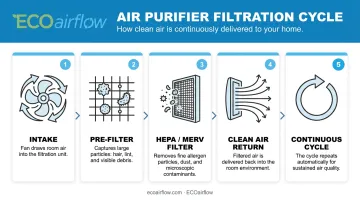
The key word is continuously. Allergens are resuspended from surfaces throughout the day. Running a purifier for a few hours in the morning won't hold down allergen levels through an evening of activity. Consistent operation, particularly in bedrooms overnight, is what keeps airborne concentrations low.
Sizing Matters: CADR and Air Changes Per Hour
Matching purifier capacity to room size is critical. AHAM recommends a CADR (Clean Air Delivery Rate) of at least two-thirds of the room's square footage. For allergy sufferers, targeting approximately 5 air changes per hour is a practical benchmark.
A 200 sq ft bedroom, for example, needs a CADR of at least 133. When comparing any filtration unit — portable or whole-home — check the tobacco smoke CADR rating, as it best reflects fine-particle performance relevant to allergen capture.
What Type of Air Filtration Works Best for Dust Mites
Not all filters are equal. Here's how the main options compare:
| Filter Type | Performance | Best For | Watch Out For |
|---|---|---|---|
| True HEPA | 99.97% capture at 0.3 microns | Portable room purifiers | Doesn't address surface reservoirs |
| MERV 13+ (HVAC) | 50%+ capture at 0.3–1.0 µm; 90%+ at 3–10 µm | Whole-home forced-air systems | Must match system airflow capacity |
| Electronic polarization (EPT) | Captures ultrafine particles to 0.001 microns | HVAC-integrated whole-home filtration | Verify zero-ozone certification |
| Ionizers/ozone generators | Variable; often poor for allergens | Not recommended | Ozone output is a health hazard |
Mechanical HEPA Filtration
True HEPA filters remove at least 99.97% of airborne particles at 0.3 microns, and dust mite allergen particles fall within a size range HEPA handles well. This is the baseline minimum for any portable purifier marketed for allergy relief.
For central HVAC systems, the EPA recommends MERV 13 or higher — capturing at least 50% of particles in the 0.3–1.0 micron range and 90%+ of coarse particles (3–10 microns). Check system compatibility before upgrading, since higher MERV filters increase pressure drop (airflow resistance) and can strain some older HVAC equipment.
Electronic Polarization Filtration
For whole-home HVAC-integrated filtration, electronic air cleaners using polarization technology go further than standard mechanical filters. Rather than relying purely on physical interception, polarization electrostatically charges particles, so they bind to the collection media even at very fine particle sizes.
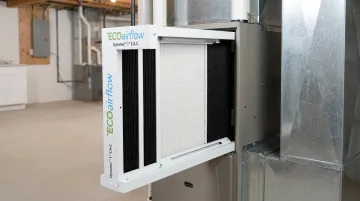
ECOairflow's Electronic Polarization Technology (EPT), certified to MERV 13–16 under ASHRAE 52.2, captures particles down to 0.001 microns. That range covers not just the coarse fecal pellets but also the smaller allergen-carrying fragments that a standard HEPA filter may let pass.
ECOairflow's residential and commercial models carry UL2998 Zero Ozone Verification (certified by Intertek/ETL) — which matters because some electronic air cleaners produce ozone as a byproduct, a legitimate health concern.
The residential Dynamo™ 1" E.A.C. and commercial M-Series™ filters (MERV 13–16) are designed to install directly into existing HVAC filter slots, with no rewiring or modifications required for most homes.
Avoid entirely: ionizers without ozone certification, ozone generators, and UV-only systems. The EPA states ozone generators sold as air cleaners are generally ineffective at safe concentration levels and can cause respiratory harm.
Placement and Usage Tips to Maximise Dust Mite Allergy Relief
Start With the Bedroom
A national study of 831 U.S. homes found 84.2% had detectable dust mite allergen in beds, with nearly a quarter exceeding high-exposure thresholds. People also spend 7–9 hours per night in direct contact with that reservoir. No other room combines this level of allergen load with this much exposure time.
That concentration makes bedroom placement the obvious starting point. Keep your purifier where airflow is unobstructed — not tucked in a corner or behind furniture — and position it close to where you sleep.
Run It Consistently
- Set to medium or auto mode and leave it running around the clock
- Use quiet/sleep mode overnight — most modern units are unobtrusive at lower fan speeds
- Avoid short high-speed bursts — steady, continuous operation captures more allergens over time
Keep Up With Filter Maintenance
A clogged or expired filter loses efficiency and can backflow particles. Most portable air purifier manufacturers recommend replacing HEPA filters every 6–12 months, depending on usage and air quality conditions. Whatever unit you use, follow the manufacturer's replacement schedule — allergen capture performance drops measurably as filter media reaches capacity.
Other Essential Steps to Control Dust Mites
Air filtration handles the airborne phase. These steps target the reservoir itself, where mite populations actually live and breed.
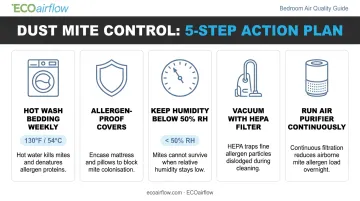
Bedding hygiene:
- Wash all bedding (sheets, pillowcases, duvet covers) weekly in water at or above 130°F / 54°C — hot water kills mites directly
- Dry thoroughly on high heat
Allergen-proof covers:
- Encase mattresses, box springs, and pillows in covers with pores smaller than 10 microns — research confirms these block Der f 1 and Der p 1 below detectable limits
- This ranks among the highest-impact interventions for dust mite control
Humidity control:
- Keep indoor humidity below 50% — dust mites begin losing moisture below 55% RH and struggle to reproduce below 50%
- Target 35–50% RH; a dedicated dehumidifier is the right tool for this, not an air purifier
Vacuuming:
- Use a vacuum with a HEPA filter — standard vacuums can re-release captured allergens back into the air
- Vacuum carpets, upholstery, and curtains regularly
Reduce clutter: Fewer soft surfaces means fewer mite habitats. Hard floors and washable rugs are preferable to wall-to-wall carpet in bedrooms.
Together, these steps and proper air filtration give you the most complete defence against dust mite allergens — no single measure works as well in isolation.
Frequently Asked Questions
Do air filters help with dust mites?
Air filters don't eliminate dust mites from surfaces, but they do reduce the concentration of airborne allergen proteins (from mite feces and shed skins) — which are the actual cause of symptoms. Used continuously alongside bedding hygiene and other controls, they're a meaningful part of reducing your daily allergen exposure.
Do air purifiers get rid of dust mite allergens?
Purifiers and whole-home air cleaners with MERV 13+ filtration can significantly reduce airborne dust mite allergen particles. They don't touch allergens already embedded in mattresses, carpets, or upholstery — those require hot washing, allergen-proof covers, and thorough vacuuming to address.
Where should I place an air purifier to help with dust mites?
The bedroom is the clear priority — that's where dust mite concentrations are highest and where you spend the most time breathing. Place it with clear airflow near the head of the bed and run it continuously, especially overnight.
Can air purifiers help people with COPD?
Yes. For COPD sufferers, reducing airborne fine particles and allergens (including dust mite proteins) is especially important. A 2022 clinical trial found that air cleaners reduced indoor PM2.5 by 61% in former smokers with COPD. Prioritize units with certified filtration and zero ozone output, and consult your physician for personalized guidance.
Do air purifiers dry indoor air?
No. Standard air purifiers filter particles and don't remove moisture. Only dehumidifiers reduce humidity. For dust mite control, a dehumidifier is actually a useful complement to your purifier, since mites can't thrive below 50% relative humidity.