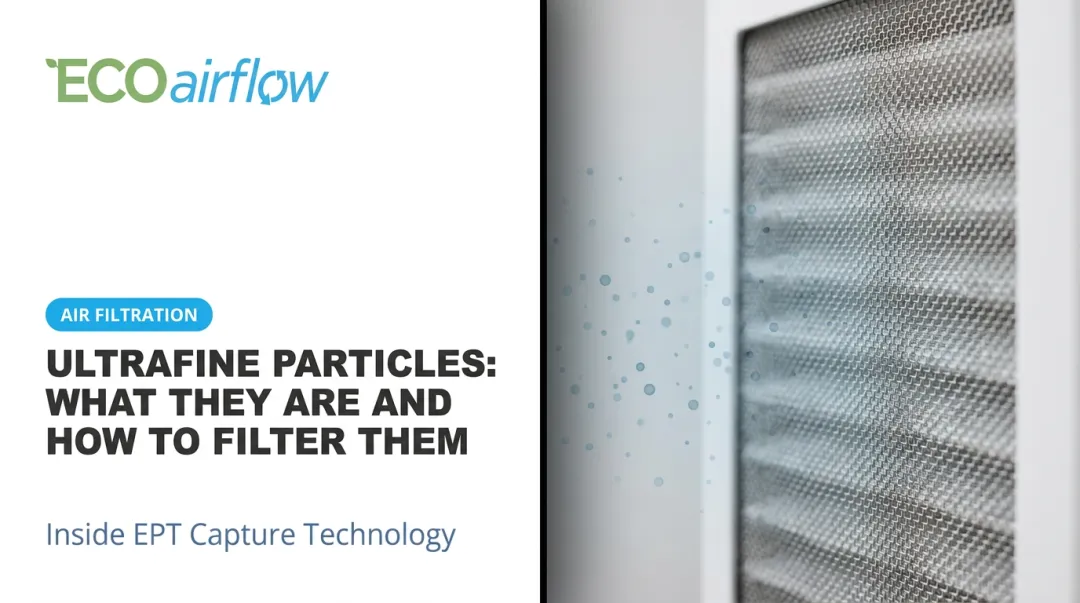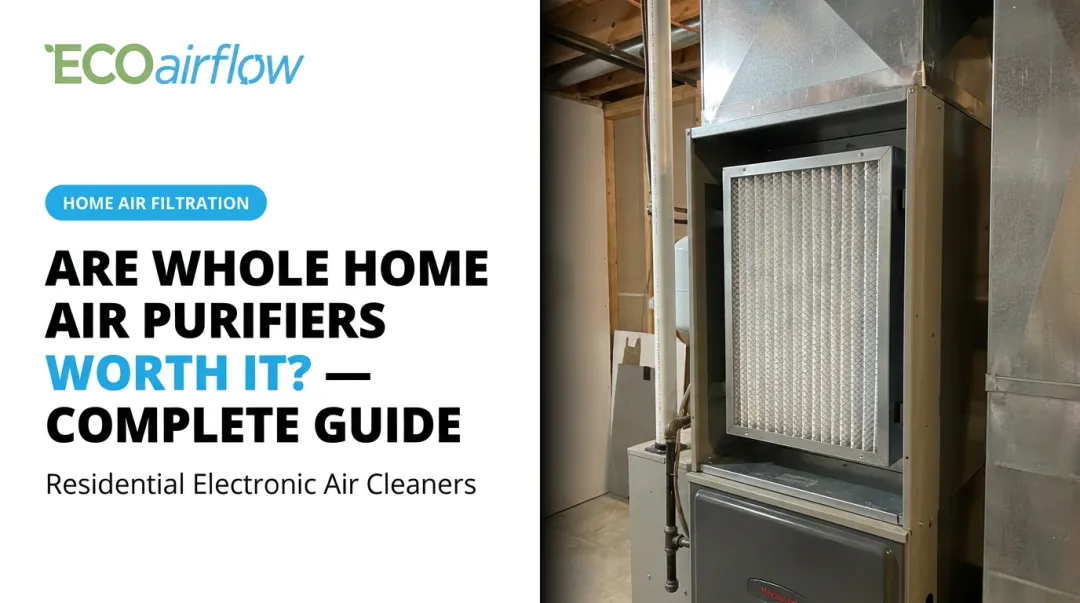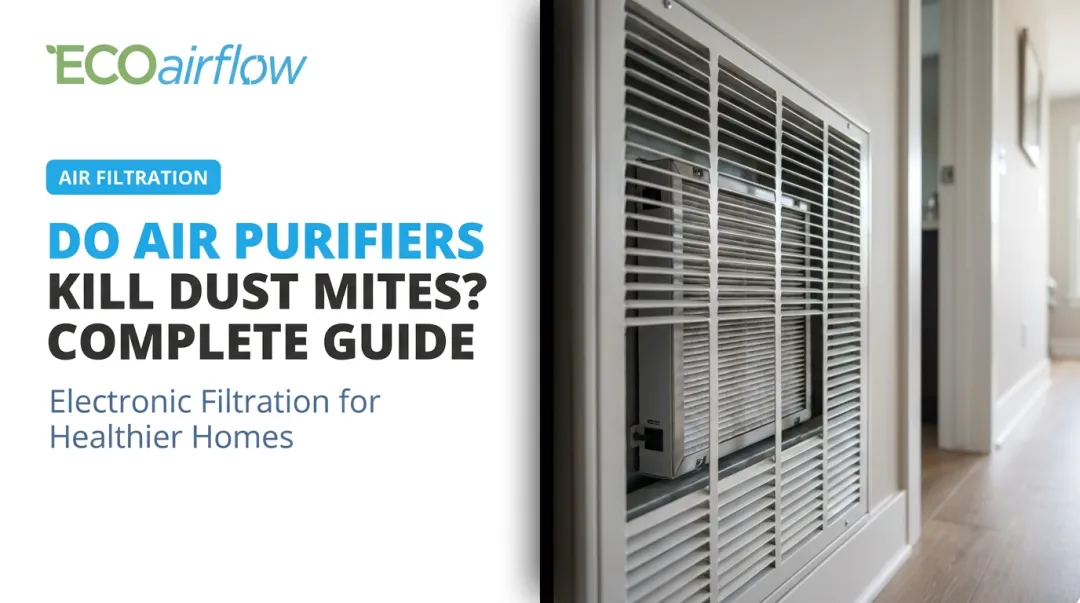
PM1.0 particles are under 1 micron in diameter. That's roughly 70 times smaller than a human hair, making them invisible without instrumentation and impossible to filter out with most standard air purifiers. Unlike PM10 particles that get caught in your nose and throat, PM1.0 particles travel deep into the lungs and can cross into the bloodstream, reaching the heart and brain.
Not all air purifiers are built to address this. A unit marketed for "fine particle" removal may perform well against PM2.5 while still allowing ultrafine PM1.0 particles to pass through uncaptured. Understanding what PM1.0 is, what technologies actually capture it, and which certifications to look for will save you from buying a filter that leaves the most hazardous particles behind.
This guide covers: the definition and size context of PM1.0, its health risks, the filtration technologies that address it, key specifications and certifications, testing standards, and common misconceptions.
Key Takeaways
- PM1.0 = particles under 1 micron — the smallest and most hazardous PM category, capable of entering the bloodstream
- Sources include tobacco smoke, cooking fumes, soot, candles, and radon daughter progeny (RDP) — a radioactive byproduct of radon gas
- Standard HEPA is rated at 0.3 microns; full PM1.0 protection requires MERV 13+ or active electronic filtration
- Certifications to verify: MERV 13–16 (ASHRAE 52.2 with carbon test dust), UL2998 Zero Ozone Verification, and Appendix J protocol
- HVAC-integrated whole-home systems deliver sustained PM1.0 capture in every room — something portable units can't replicate
What PM1.0 Means in Air Filtration
PM stands for "particulate matter," and the number indicates the maximum aerodynamic diameter — in microns — that a particle classification covers. PM10 captures particles at or below 10 microns, PM2.5 covers those at or below 2.5 microns, and PM1.0 covers particles at or below 1 micron.
These are cumulative thresholds, not discrete bins. PM1.0 is always a subset of PM2.5, which is always a subset of PM10. On any air quality monitor, your PM1.0 reading will always be lower than your PM2.5 reading — it's measuring a narrower slice of the same particle population.
For size context: the average human hair is about 70 microns in diameter. PM1.0 particles are 70 times smaller than that — completely invisible without instrumentation.
What "PM1.0 Capable" Actually Means on a Spec Sheet
When an air purifier is labeled "PM1.0 capable," it means the unit has been tested and rated to capture particles down to sub-micron sizes. This requires substantially higher-grade filtration than units rated only to PM2.5 or PM10 — either through higher-grade filter media, active electronic filtration, or both.
A purifier marketed for fine particle removal may still miss PM1.0 entirely if its filter isn't rated sub-micron. That gap matters: PM1.0 is where the most biologically harmful particles sit — including viruses, combustion byproducts, and ultrafine carbon particles from traffic and wildfire smoke.
Why PM1.0 Is Harder to Capture Than Larger Particles
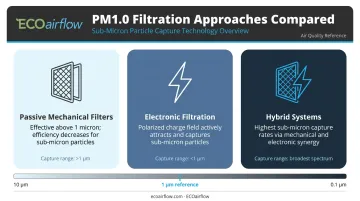
Sub-micron particles are actually harder to capture mechanically than larger ones. They're light enough to follow airflow paths around filter fibers rather than impacting them — a behavior called diffusion bypass. This is why filter technology matters when evaluating PM1.0 capability:
- Passive mechanical filters (standard pleated media) rely on physical interception, which loses effectiveness below 1 micron
- Electronic filtration uses a polarized charge field to attract and trap sub-micron particles before they reach the media
- Hybrid systems combine both methods, which is why they typically achieve the highest sub-micron capture rates
Why PM1.0 Is the Most Hazardous Particulate Size
The size of a particle determines where it deposits in the body — and PM1.0 goes further than any other PM category.
- PM10 — mostly trapped in the nose, throat, and upper airways
- PM2.5 — can penetrate deep into the alveoli (lung air sacs)
- PM1.0 and below — small enough to cross the alveolar membrane and enter the bloodstream, where they can travel to the heart, brain, and other organs
According to the WHO, ambient air pollution from fine particulate matter caused an estimated 4.2 million premature deaths worldwide in 2019, with roughly 68% attributable to ischemic heart disease and stroke. A 2023 systematic review confirmed that long-term PM1 exposure is independently associated with cardiovascular and respiratory disease.
There is currently no established safe exposure threshold for PM1.0 — no EPA NAAQS standard and no WHO quantitative guideline exists for this particle size. Without a regulatory floor, there is no official "acceptable" level to stay under — any reduction in exposure counts.
Common PM1.0 Sources Indoors and Outdoors
You don't need to live near a highway to have a PM1.0 problem. Most of it is generated inside your own home:
- Cooking — pan-frying and stir-frying can spike ultrafine particle concentrations to over 1,000,000 particles/cm³
- Tobacco and wood smoke — PM1 comprises 86–94% of second-hand cigarette smoke by particle count
- Candles — a 2025 study found PM1 concentrations peaked at 28.8 µg/m³ at 3 metres from a scented candle
- Printer emissions — particle fractions from 0.23–20 microns are released during normal printing
- Radon daughter progeny (RDP) — ultrafine radioactive particles as small as 0.001 microns
- Outdoor infiltration — black carbon, sulfates, nitrates, and secondary aerosols that penetrate building envelopes
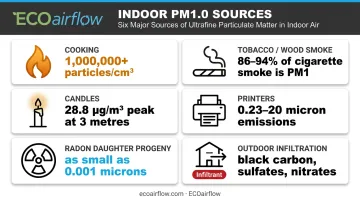
These sources are continuous and often overlap — cooking, candles, and outdoor infiltration can all occur within the same hour. Effective PM1.0 filtration needs to operate on the same schedule: continuously, through your HVAC system, not intermittently.
How Air Purifiers Capture PM1.0: Filtration Technologies
Passive Mechanical Filtration: HEPA and High-MERV Filters
True HEPA filters are rated to capture 99.97% of particles at 0.3 microns — which is the "most penetrating particle size" (MPPS) for standard fibrous media. The physics favours capture at both ends of the size spectrum: particles larger than 0.3 microns are caught by impaction and interception; particles smaller than 0.3 microns are captured through diffusion (Brownian motion).
So standard HEPA does capture some PM1.0 particles. The issue is that sub-0.3 micron efficiency varies across different HEPA media grades, and standard HEPA isn't tested or certified for performance in the 0.003–0.1 micron ultrafine range specifically.
MERV ratings under ASHRAE 52.2 provide more granular guidance:
| MERV Rating | E1 Efficiency (0.3–1.0 µm) | Notes |
|---|---|---|
| MERV 13 | ≥50% | Minimum for meaningful PM1.0 capture |
| MERV 14 | ≥75% | Good general PM1.0 filtration |
| MERV 15 | ≥85% | Near-HEPA in sub-micron range |
| MERV 16 | ≥95% | Near-HEPA performance across all size bins |
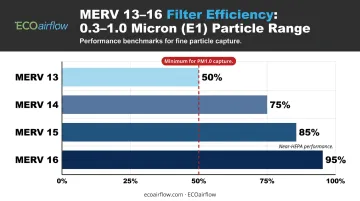
One important note: MERV ratings are only valid when testing uses ASHRAE-certified test dust containing a carbon component. Without carbon in the test dust, a filter's rated efficiency against black carbon and organic particulates — both major PM1.0 contributors — goes unverified.
Active Electronic Filtration: Electronic Polarization Technology
Passive filtration has a ceiling. Pushing sub-micron efficiency higher through denser filter media creates a trade-off: increased pressure drop that forces your HVAC system to work harder and drives up energy costs.
Active electronic filtration solves this differently. Electronic Polarization Technology (EPT), used in ECOairflow's product line, creates a corona field that imparts an electrical charge to particles passing through the airstream. Those charged particles are then attracted to oppositely-charged collector pad fibres (similar in principle to magnetism) regardless of particle size.
The result is that even particles far below 0.3 microns get captured through electromagnetic attraction rather than physical interception. ECOairflow's EPT is documented to capture particles as small as 0.001 microns, covering RDP, viruses, and ultrafine combustion soot that passive filters cannot address.
Independent lab testing at Blue Heaven Technologies found the technology up to 45 times more effective than passive pleated filters in the 0.001–0.010 micron range.
EPT also produces a secondary effect called agglomeration: charged particles attract each other, forming larger clusters that are caught on subsequent passes. Key performance outcomes include:
- Captures particles down to 0.001 microns (RDP, viruses, combustion soot)
- Up to 45x more effective than passive pleated filters in the ultrafine range
- Low pressure drop of 0.09 to 0.38 inches w.c. versus significantly higher resistance in high-MERV passive media
- Up to 15% reduction in HVAC energy consumption
Ionization and Electrostatic Precipitators
Electrostatic precipitators (ESPs) use a two-stage process: an ionising section charges particles, then collecting plates capture them. Single-pass efficiencies for particles under 0.1 microns can reach 60–98% depending on design.
The concern with some ESP and ioniser designs is ozone generation. Measured ozone output from ESP devices ranges from below detection to 162 mg/h depending on design. This is why UL2998 Zero Ozone Verification matters: units certified under this standard produce ozone below 0.005 ppm (5 ppb) — the most stringent threshold available, and the level required by ASHRAE 62.1-2019. ECOairflow's entire product line carries this certification, with measured emissions below 0.0005 ppm (10 times lower than the UL2998 threshold).
Key Specifications to Look for in a PM1.0 Air Purifier
MERV Rating
MERV 13 is the practical minimum for meaningful PM1.0 capture. MERV 16 approaches HEPA-level performance in the 0.3–1.0 micron range.
Two things to verify before trusting a MERV claim:
- Was testing performed at a certified lab using ASHRAE 52.2 with carbon-containing test dust? Without the carbon component, results won't reflect real-world performance against combustion particles.
- Does the rating hold under Appendix J conditioning? Appendix J tests filters after KCl particle conditioning to reveal efficiency losses that standard testing may not catch. A unit that holds its MERV rating both with and without Appendix J conditioning has proven it performs under real-world conditions — not just in a lab.
As an example of what rigorous certification looks like in practice, ECOairflow's M-Series achieves MERV 13, 14, 15, or 16 ratings — with power on, power off, and under Appendix J — all tested with proper ASHRAE carbon-containing test dust.
ISO 16890 Classification
ISO 16890 replaced the older EN779 standard and classifies filters specifically by PM1, PM2.5, and PM10 efficiency. A filter rated ePM1 under ISO 16890 is explicitly tested for sub-micron particle capture, requiring a minimum efficiency of 50% in the 0.3–1.0 micron range. This is the most directly relevant certification for PM1.0 performance, particularly in European markets.
Certifications and Compliance Markers
When evaluating any air purifier for PM1.0 protection, check for:
- ETL/Intertek listing — confirms the unit meets applicable electrical safety standards
- Ozone output below 0.005 ppm, verified by UL2998 Zero Ozone Verification — essential for any electronic unit
- MERV 13–16 per ASHRAE 52.2 with carbon test dust documentation
- MERV-A ratings (e.g., MERV 13-A) — the "A" designation confirms Appendix J-verified performance under real-world conditioning
- Qualification under LEED, WELL Building, or NGBS — independent green building standards that vet filtration performance (ECOairflow's Dynamo and M-Series lines meet all three)
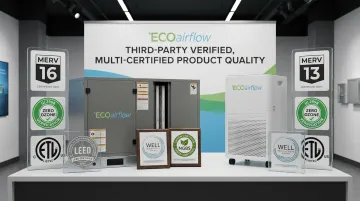
Avoid relying on manufacturer-only claims without independent third-party test documentation. Ask for the test report.
Common Misconceptions About PM1.0 Air Purifiers
"HEPA means it captures PM1.0"
HEPA certification (99.97% at 0.3 microns) covers much of the PM1.0 range but isn't specifically rated for ultrafine particles below 0.1 microns. For confirmed sub-micron performance, look for MERV 13+ certification or units with active electronic filtration rated below 0.3 microns.
"PM2.5 ratings cover PM1.0 protection"
PM2.5 efficiency values are averages across a broad 0.3–2.5 micron range. A filter rated at 85% PM2.5 efficiency might perform at lower efficiency specifically for 0.3–1.0 micron particles. The PM2.5 rating doesn't confirm PM1.0-specific performance.
"All electronic air purifiers produce harmful ozone"
Well-designed electronic purifiers with UL2998 Zero Ozone Verification produce no measurable ozone at harmful levels. The ozone concern applies to poorly designed units — it's not inherent to electronic filtration technology. Before ruling out electronic purifiers, check for these:
- UL2998 Zero Ozone Verification (confirms no harmful ozone output)
- ETL or equivalent third-party listing for safety compliance
- Active electronic filtration rated below 0.3 microns for true PM1.0 capture
Electronic filtration consistently outperforms passive filters for ultrafine particles — the key is choosing a certified unit.
Frequently Asked Questions
What do PM1.0, PM2.5, and PM10 mean on an air purifier?
These numbers indicate the maximum particle diameter (in microns) that the purifier is rated to capture. PM10 targets larger particles like dust and pollen, PM2.5 targets fine combustion particles and smoke, and PM1.0 targets the smallest ultrafine particles — including bacteria, soot, and smog components — that can enter the bloodstream.
Which is better: PM1.0, PM2.5, or PM10 filtration?
PM1.0-rated filtration offers the broadest protection, capturing the full particle spectrum from large down to ultrafine. PM2.5 filtration suits most general-purpose applications. PM10-only filtration leaves the most biologically damaging particles completely unaddressed.
What is a safe PM10 level?
The EPA's current NAAQS sets a 24-hour PM10 standard at 150 µg/m³, not to be exceeded more than once per year on average. No equivalent standard exists for PM1.0 — no safe threshold has been established — making continuous air purification the recommended approach.
Can standard HEPA filters capture PM1.0 particles?
Standard HEPA filters perform well at 0.3 microns but vary in efficiency for ultrafine particles below 0.1 microns, depending on media grade. For reliable PM1.0 capture across the full sub-micron range, MERV 13–16 or EPT-based electronic filtration — which uses an electrostatic charge to attract and trap particles as small as 0.001 microns — provides more consistent and verifiable results.
What are the main indoor sources of PM1.0?
Cooking fumes, tobacco and wood smoke, candles, printer emissions, and radon daughter progeny (RDP) are the primary indoor sources. Because these sources are ongoing, continuous filtration is required rather than a one-time treatment.
How do I know if my air purifier is actually capturing PM1.0?
Check for third-party certifications — specifically MERV 13–16 per ASHRAE 52.2 (using carbon test dust), Appendix J protocol results, and UL2998 Zero Ozone Verification. ECOairflow's electronic air filters carry all three. Use a PM1.0-capable air quality monitor to compare particle concentrations before and after installation, and don't rely on manufacturer claims without independent test documentation.