Yet most homeowners either rely on a basic $10 fiberglass filter or drop $300 on a portable unit for one room. Neither approach addresses the whole home. Whole-home air purifiers do — but they cost significantly more, require professional installation, and vary widely in effectiveness depending on the technology used.
This guide answers the core question directly: is that investment actually justified? We'll cover how these systems work, what they can and can't remove, who genuinely benefits, and what you should expect to pay.
TL;DR — Quick Answer
- Whole-home air purifiers reduce allergens, pathogens, VOCs, and fine particulate matter across an entire home — not just one room
- They require HVAC integration and cost more upfront than portable units — effectiveness depends on the technology and MERV rating
- Worth it for households with allergy sufferers, asthma, pets, immunocompromised members, or wildfire smoke exposure
- Not the right fit for renters, homes without central HVAC, or cases where only one or two rooms are the concern
- Systems using Electronic Polarization Technology (EPT) can cut HVAC operating costs by up to 15%, helping offset the upfront investment
What Is a Whole-Home Air Purifier and How Does It Work?
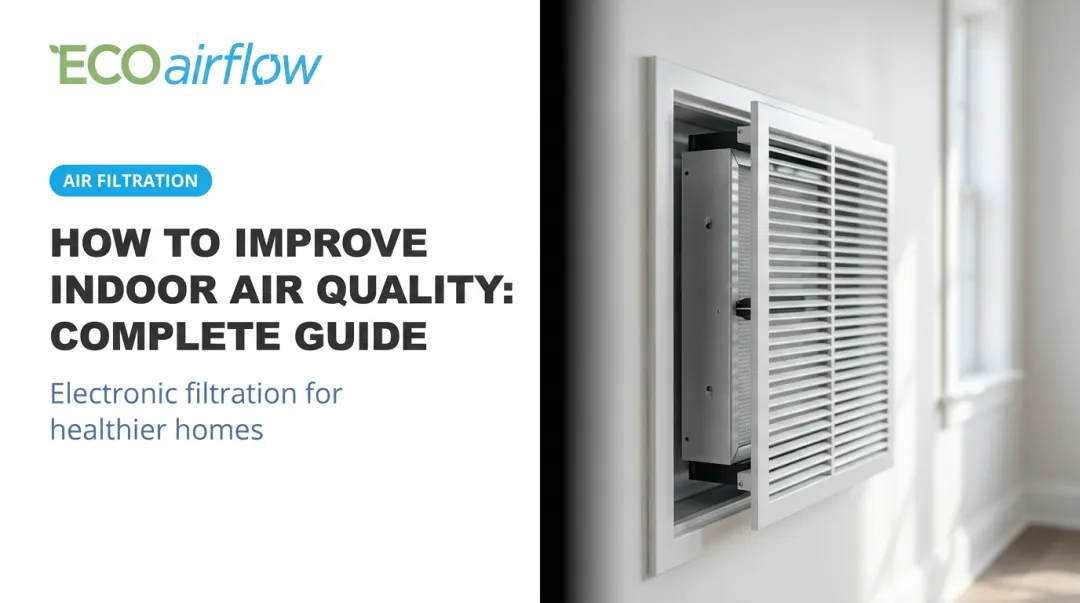
Unlike portable units that clean air in a single room, whole-home air purifiers integrate directly into your HVAC ductwork — filtering all air that passes through the central system. Every room served by your heating and cooling gets treated air, without a visible unit on the floor or a power cord running across the room.
The Main Technology Categories
| Technology | How It Works | Key Consideration |
|---|---|---|
| MERV-rated media filters | Physical barrier — particles collide with dense fibrous media | Higher MERV = more resistance to airflow |
| Electronic/electrostatic precipitators | High-voltage charge attracts particles to collector plates | Low pressure drop; requires regular plate cleaning |
| UV germicidal irradiation | UV light deactivates microorganisms in the airstream | Targets pathogens, not particles; ozone risk with some units |
| Hybrid EPT systems | Combines polarized charge with filter media for sub-micron capture | Low pressure drop + broad particle range |
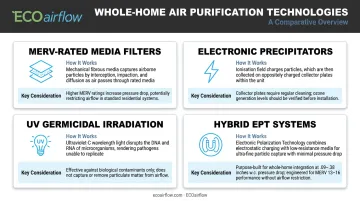
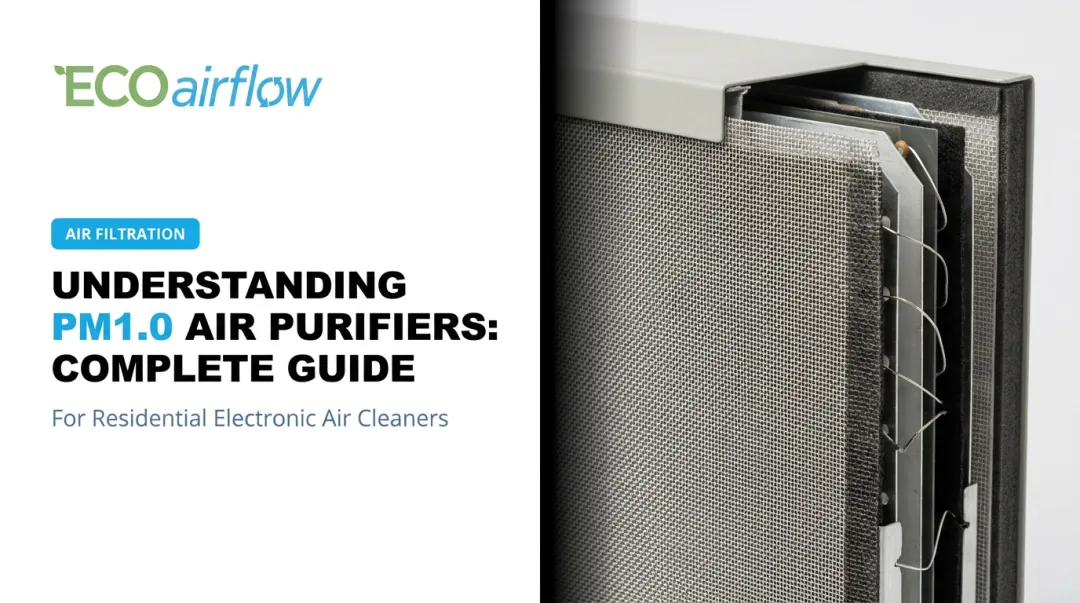
Hybrid EPT systems — like those ECOairflow manufactures — take this a step further. The unit generates an electronic corona field that gives airborne particles a polarized charge, which draws them toward the collector pad fibers much the way opposite magnetic poles attract. Charged particles also clump together through agglomeration, forming larger clusters that are captured more efficiently on subsequent passes through the system.
One Critical Limitation
According to the EPA's Residential Air Cleaners technical summary, HVAC-integrated systems only clean air when the fan is actively running. If your system cycles infrequently, or if parts of your home have poor ductwork coverage, some areas will receive less benefit. This is why both technology choice and system design matter.
What Can a Whole-Home Air Purifier Actually Remove?
Common Allergens and Fine Particles
Systems rated MERV 13 or higher capture the allergens that drive most indoor allergy symptoms:
- Dust mite particles — mite fecal matter ranges from 10–35 microns, with a smaller fraction under 4.7 microns
- Pet dander — cat Fel d 1 and dog Can f 1 are primarily associated with particles in the 2.5–10+ micron range
- Pollen — typically 17–58 microns; captured effectively when airborne and passing through the filter
- Mold spores — 1–30 microns depending on species
MERV 13 captures at least 50% of particles in the 0.3–1.0 micron range, 85% in the 1.0–3.0 micron range, and 90% of particles between 3.0–10.0 microns. MERV 16 pushes all three categories to 95%+.
Pathogens and Ultrafine Particles
Standard passive HEPA filters capture particles down to 0.3 microns — the average gap size in their weave. Anything smaller passes through, which is where electronic filtration takes over.
ECOairflow's EPT technology captures particles as small as 0.001 microns, verified through third-party testing by certified radon professionals. That range includes:
- Viruses and bacteria
- Radon daughter progeny (RDP) — radioactive particles as small as 1–200 nm that standard MERV filters do not reliably address
- Black carbon from wildfire smoke and traffic-related air pollution (TRAP)
What Whole-Home Systems Handle Less Well
- Heavy surface-settling particles — pet hair, large dust, and debris that falls before reaching the HVAC return
- Gases and VOCs — require activated carbon components; not all systems include them
- Radon gas itself — filtration can capture radon progeny, but it does not remove radon gas; dedicated mitigation is still required
A Note on Ozone Risk
Some air purification technologies — ionic, UV-PCO, and certain plasma systems — can generate ozone as a byproduct. Ozone is a lung irritant, and both the EPA and CARB advise against using devices that produce it in occupied spaces.
Before purchasing any electronic air cleaner, look for UL 2998 Zero Ozone Verification. ECOairflow's certified units maintain ozone emissions below 0.0005 ppm — one-tenth of the UL 2998 threshold.
The Benefits Worth Knowing
One integrated system protects every room without asking anything of the people living there. For families with children, elderly members, or immunocompromised individuals, that matters — they shouldn't be confined to a single purified space.
Respiratory and allergy relief backed by research. Peer-reviewed studies support air filtration as a meaningful intervention for asthma and allergic rhinitis (hay fever). One study found clinical benefit in asthma patients following HVAC maintenance combined with a high-efficiency MERV 12 filter. Homeowners with pets or high pollen exposure tend to notice the most significant symptom relief.
The mechanical benefits are just as real. Dust and debris buildup on HVAC coils is a slow, expensive problem most homeowners don't see coming. LBNL/ACEEE engineering modeling found that upgrading filtration from MERV 2 to MERV 12 extended modeled coil fouling time approximately seven times. That protects fans, heat exchangers, and evaporator coils from premature wear — a long-term value point that rarely shows up in consumer comparisons.
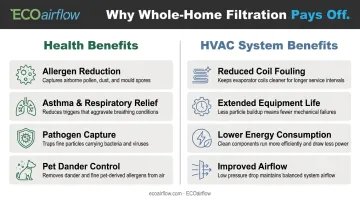
Beyond health and equipment, whole-home systems also win on everyday livability:
- No floor space consumed — purification happens inside the ductwork
- No fan noise competing with conversation or sleep
- No portable units to reposition, refill, or trip over
- Single system covers open-plan layouts that multiple portables struggle to reach
The Real Drawbacks and Costs You Should Weigh
Upfront Installation Cost
According to Angi's 2026 cost guide, whole-home air purifier installation ranges from $59 to $12,000, with a typical spend around $2,610. Here's what drives that range:
- Basic HVAC filter upgrade: $100–$250
- Extended media filter (installed): $500–$1,000
- Electronic filter system: $600–$2,400
- UV light system: $750–$3,500
- Whole-home HEPA-style system: $2,000–$5,000+
ECOairflow's residential units are sold through HVAC contractors, with pricing available on request depending on your home's specific filter sizes and installation requirements.
Ongoing Maintenance Costs
ECOairflow's residential replacement pads follow a quarterly replacement schedule — every 3 months. The pad replacement process is simple: open the filter, swap the pad set, done. Used glass fiber pads are accepted as post-consumer glass waste in many municipalities.
For comparison, a MERV 13 disposable filter like the AprilAire 213 runs approximately $65 and lasts 6–12 months. That works out to roughly $65–$130 per year — so replacement frequency and pad cost both matter when calculating true cost of ownership.
Energy Consumption — But Not Always a Problem
A common objection to whole-home filtration is increased energy draw. For traditional high-MERV media filters, this concern is valid — DOE Building America data shows that high-resistance filters can reduce PSC motor airflow or increase ECM fan energy consumption.
EPT-based units like ECOairflow's achieve filtration through polarization rather than dense media, requiring far less airflow resistance to capture fine particles. All ECOairflow residential models consume 2 watts or less of electricity, with pressure drops as low as 0.11 in. w.c. at 300 FPM (the Dynamo model). That low resistance means the HVAC fan works less hard — ECOairflow's internal testing shows this can reduce heating and cooling operating costs by up to 15%.
Ductwork and Runtime Limitations
Homes with leaky ducts, uneven duct coverage, or HVAC systems that cycle infrequently will see reduced benefit. This is a limitation worth acknowledging honestly. If your system runs rarely — say, in a mild climate where heating and cooling demands are minimal — airflow through the filter is limited, and so is purification.
So, Are Whole-Home Air Purifiers Worth It?
The Yes Case
For these households, whole-home purification delivers consistent, comprehensive protection that portable units simply cannot replicate at scale:
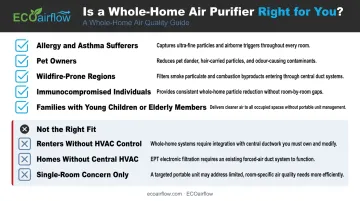
- Allergy and asthma sufferers — whole-home coverage means every room is treated, not just the bedroom
- Pet owners — dander circulates through ductwork; room-by-room units can't keep up
- Wildfire-prone regions — EPA guidance supports MERV 13+ central filtration during smoke events
- Immunocompromised individuals — including chemotherapy patients and post-surgical recovery; CDC/NIOSH recommends MERV 13 or better for these households where HVAC-compatible
- Families with young children or elderly members — consistent exposure reduction across all living spaces
A 2015 peer-reviewed study found that widespread higher-efficiency central residential filtration could produce annual health benefits valued at $1–$1,348 per person, depending on filter efficiency and home characteristics. A 2015 peer-reviewed study found that widespread higher-efficiency central residential filtration could produce annual health benefits valued at $1–$1,348 per person, depending on filter efficiency and home characteristics.
When It's Not Worth the Investment
Whole-home purification probably isn't the right investment if:
- You rent and can't modify the HVAC system
- Your home has no central HVAC (this rules out duct integration entirely)
- Your concern is limited to one or two rooms — a quality portable HEPA or high-MERV unit may deliver better cost-per-benefit value
- Your ductwork is in poor condition — air bypass around the filter will undercut performance
A Decision Framework
Before purchasing, evaluate your situation against four factors:
- Household health needs — are there chronic respiratory conditions, allergies, or immunocompromised individuals at home?
- Home size and ductwork quality — does your HVAC effectively reach all occupied spaces?
- Budget structure — can you absorb higher upfront costs in exchange for lower ongoing per-filter costs?
- Primary concern — particles, gases, pathogens, or odors? Different technologies address different pollutants.
If you're unsure which system fits your home, ECOairflow offers direct consultation — reach out to the team to discuss your specific HVAC setup and air quality concerns.
Frequently Asked Questions
Are whole-home air purifiers effective?
Yes — whole-home air purifiers effectively reduce airborne allergens, fine particulate matter, pathogens, and VOCs throughout an entire home. Effectiveness depends on the technology used, MERV rating, and how well the system matches your HVAC setup. Note that these systems only filter air while the HVAC fan is running.
What is the best air purifier for chemo patients?
Chemotherapy patients need filtration capable of capturing viruses, bacteria, and ultrafine particles due to severely compromised immunity. Systems with MERV 13–16 ratings or advanced electronic polarization technology — such as ECOairflow's M-Series, which maintains rated MERV performance under all operating conditions — are the most appropriate. Always consult the patient's care team before making changes to their environment.
Do air purifiers help with norovirus?
Norovirus spreads primarily through contaminated surfaces, food, water, and direct contact — not airborne transmission. Air purifiers offer limited protection against norovirus specifically. High-performance whole-home systems can reduce any airborne viral particles that exist, but filtration should be one layer of a broader hygiene approach, not the primary defense.
Can an air purifier help with post-nasal drip?
Post-nasal drip is frequently triggered by airborne allergens — dust mites, pet dander, mold spores, and pollen. A whole-home air purifier that consistently removes these particles can reduce allergen exposure and symptom frequency over time.
How much does a whole-home air purifier cost?
Installation ranges from roughly $100–$250 for a basic filter upgrade to $2,000–$5,000+ for a full integrated system, with a typical spend around $2,610 according to Angi's 2026 data. Factor in filter or pad replacements and energy use — some systems offset these costs through improved HVAC efficiency.
Do whole-home air purifiers protect HVAC systems?
Yes. Quality whole-home filtration reduces dust and particulate buildup on coils, fans, and internal components — extending equipment lifespan and reducing maintenance calls. Engineering modeling suggests upgrading from low-efficiency to mid-high MERV filtration can extend coil fouling time significantly. Systems with low pressure drop design may also lower overall fan energy consumption.