Choosing the wrong one isn't just an academic mistake. Install a HEPA-grade filter in a standard residential HVAC system and you risk starving the blower of airflow, potentially burning out the motor. Stick with a lower-rated filter when your space actually needs MERV 13 performance, and you're recirculating fine particulates, allergens, and bacteria every time the system cycles.
This guide breaks down exactly what each filter type does, where each belongs, and how to decide which is right for your space and system.
Key Takeaways
- MERV 13 captures at least 50% of fine particles (0.3–1.0 microns) and 90%+ of larger particles; works in most standard HVAC systems
- HEPA filters capture 99.97% of 0.3-micron particles but cannot be dropped into standard residential or commercial ductwork
- HEPA roughly corresponds to MERV 17–20 — far beyond what a standard HVAC fan can push air through
- For whole-building filtration, MERV 13 is the practical ceiling; HEPA is reserved for hospitals, cleanrooms, and dedicated portable room units
- Combining MERV 13 in the central system with a room-level HEPA unit outperforms either option on its own
MERV 13 vs HEPA: Quick Comparison
| Feature | MERV 13 | HEPA |
|---|---|---|
| Filtration efficiency (0.3–1.0 µm) | ≥50% | 99.97% |
| Filtration efficiency (1.0–3.0 µm) | ≥85% | 99.97%+ |
| Filtration efficiency (3.0–10 µm) | ≥90% | 99.97%+ |
| HVAC compatibility | Most residential & commercial systems | Incompatible with standard ductwork |
| Approximate MERV equivalent | MERV 13 | MERV 17–20 |
| Upfront cost | Lower | Higher |
| Replacement interval | Every 3 months minimum | Per manufacturer; varies widely |
| Best use | Whole-building HVAC filtration | Hospitals, cleanrooms, standalone purifiers |
What Is a MERV 13 Filter?
MERV stands for Minimum Efficiency Reporting Value — a standardized scale developed by ASHRAE (Standard 52.2) that measures how effectively a filter captures particles across specific size ranges. Ratings run from 1 to 16 for standard residential and commercial use, with higher numbers indicating better filtration.
MERV 13 sits at the high end of that practical range. According to the EPA, a MERV 13 filter captures:
- ≥50% of particles in the 0.3–1.0 micron range (fine combustion particles, bacteria, tobacco smoke)
- ≥85% of particles in the 1.0–3.0 micron range
- ≥90% of particles in the 3.0–10 micron range (dust, pollen, mold spores, pet dander)
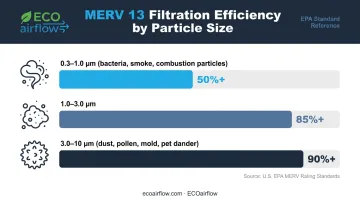
Both the EPA and CDC recommend upgrading to MERV 13 or the highest rating the system can handle without detrimental effects on HVAC performance. That last phrase matters. Denser filter media creates more resistance to airflow — called pressure drop — and standard HVAC fans have limits.
DOE/PNNL data shows MERV 7–14 filters typically create pressure drops of 0.05 to 0.30 in. w.c., depending on filter thickness and air velocity.
Filter design matters as much as the MERV rating itself. A well-engineered MERV 13 filter maintains high capture efficiency with minimal airflow restriction; a poorly designed one may strain the blower while delivering the same nominal rating.
ECOairflow's Model 2300 M-Series filters illustrate this point. Certified MERV 13–16 under ASHRAE 52.2 and Appendix J protocol, the M-Series achieves pressure drops as low as 0.09 in. w.c. at 300 FPM using Electronic Polarization Technology (EPT) rather than dense mechanical media — keeping airflow resistance well within range for commercial HVAC systems.
Use Cases for MERV 13
MERV 13 is effective across a wide range of environments:
- Residential homes with allergy or asthma sufferers, particularly where pets, smoking, or wildfire smoke are factors
- Commercial office buildings and schools — ASHRAE's school reopening guidance specifically targets MERV 13 or higher for educational facilities
- Healthcare common areas — lobbies, hallways, and waiting rooms where sterile-grade filtration isn't required
- Hospitality and multi-family housing — hotels, casinos, and apartment buildings where whole-building baseline filtration is the priority
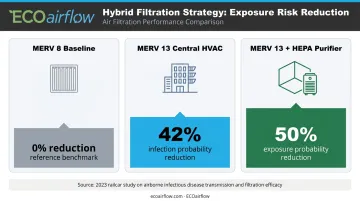
Real-world data backs this up. A 2021 study of 37 urban office buildings published in Building and Environment found that buildings using MERV 13–14 filters had approximately 30.9% lower indoor PM2.5 levels during work hours compared to buildings using MERV 7–12 filters. A separate 2023 railcar study found upgrading from MERV 8 to MERV 13 reduced modeled infection probability by 42%.
What Is a HEPA Filter?
HEPA is a performance standard set by the U.S. Department of Energy, not a rating scale. To qualify as true HEPA, a filter must remove at least 99.97% of airborne particles at 0.3 microns in a single pass.
Why 0.3 microns specifically? It's the most penetrating particle size (MPPS) — the point where neither impaction/interception (for larger particles) nor diffusion (for smaller particles) is fully effective.
HEPA filters are tested at this worst-case performance point, so they actually perform better on particles both smaller and larger than 0.3 microns.
On the MERV scale, HEPA performance maps to approximately MERV 17–20 — significantly beyond the 1–16 range used for standard residential and commercial HVAC filters.
Why HEPA and Standard HVAC Don't Mix
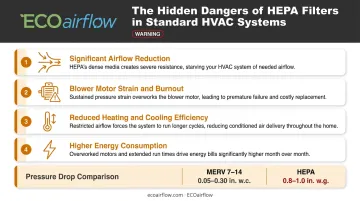
The density of HEPA filter media creates extreme airflow resistance. ACCA engineering guidance indicates clean HEPA filters can produce pressure drops of 0.8 to 1.0 in. w.g. — compare that to the 0.05–0.30 in. w.c. range typical of MERV 7–14 filters. Standard residential and commercial HVAC blowers simply cannot push adequate airflow through that resistance.
Installing HEPA directly into standard ductwork typically causes:
- Significant airflow reduction throughout the building
- Increased blower motor strain and potential burnout
- Reduced heating and cooling efficiency
- Higher energy consumption as motors work harder to compensate
For most buildings, achieving high-efficiency filtration means choosing a filter technology compatible with the HVAC system's existing static pressure limits — which is why high-performance MERV-rated filters are the standard solution for central air systems.
Use Cases for HEPA
HEPA filtration is mandatory or standard in environments that require near-sterile air:
- Hospital operating rooms and isolation rooms — CDC guidance specifies HEPA filters at 99.97% efficiency for 0.3-micron particles in supply airstreams for protective environment rooms
- Pharmaceutical manufacturing cleanrooms — FDA aseptic processing guidance identifies critical areas as ISO Class 5, requiring HEPA-filtered unidirectional airflow
- Semiconductor fabrication labs and forensic facilities
- Residential standalone purifiers — effective for targeted room-level protection, particularly for immunocompromised individuals
A 2021 hospital-ward study found that two portable HEPA air cleaners in a single patient room cleared 99% of aerosols within 5.5 minutes — a result that underscores why the technology remains the benchmark for clinical air quality.
MERV 13 vs HEPA: Which Is Right for Your Needs?
The decision comes down to five factors: what particles you need to capture, whether your HVAC system can handle the filter, your budget, whether you need whole-building or room-level coverage, and whether sterile-grade air is actually required.
Choose MERV 13 When:
- You need whole-building filtration for a standard residential or commercial HVAC system
- Your primary concerns are dust, pollen, pet dander, mold spores, smoke, and bacteria
- You want the highest-performing option that doesn't require equipment modifications
- You're managing an office building, school, hotel, or healthcare common area
Choose HEPA When:
- The environment genuinely demands near-sterile air — operating rooms, cleanrooms, pharmaceutical labs
- You're adding room-level supplemental protection via a standalone air purifier
- An immunocompromised individual needs maximum airborne particle reduction in a specific space
Consider the Hybrid Approach
Many buildings benefit from combining both. Run MERV 13 through the central HVAC system for whole-building baseline filtration, then add a standalone HEPA air purifier in high-priority rooms — bedrooms, patient rooms, home offices.
The 2023 railcar study quantifies this well: MERV 13 alone reduced modelled infection probability by 42% versus MERV 8. Adding HEPA air cleaning on top reduced modelled exposure probability by 50%. The layered approach consistently outperforms either filter type in isolation.
One practical consideration for commercial buildings pursuing that layered strategy: pressure drop. High-efficiency pleated filters at MERV 13+ can strain HVAC systems and increase operating costs. ECOairflow's electronic filters use patented EPT technology to achieve MERV 13–16 ratings with less dense media, which keeps pressure drop low and reduces the energy penalty typically associated with high-efficiency filtration — certified under both ASHRAE 52.2 and Appendix J protocol.
Conclusion
MERV 13 and HEPA filters serve distinct purposes. MERV 13 is the practical, system-compatible choice for whole-building HVAC filtration in residential and commercial spaces. HEPA delivers maximum particle capture for specialized environments that genuinely require it, or as supplemental room-level protection through standalone units.
Better filter selection produces real outcomes: improved indoor air quality, protected HVAC equipment, lower energy costs, and healthier occupants. Before upgrading, take a few practical steps:
- Check your system's specifications for maximum filter resistance ratings
- Consult an HVAC technician if you're jumping from MERV 8 to MERV 13
- Get a system assessment before installing any high-efficiency filter in an older unit
Frequently Asked Questions
Are HEPA filters better than MERV 13?
HEPA filters capture a higher percentage of fine particles (99.97% vs. at least 50% at 0.3 microns), but "better" depends entirely on the application. For whole-building HVAC filtration, MERV 13 is the superior practical choice. HEPA filters cannot be installed in standard systems without restricting airflow and stressing the equipment.
Do air filters cause dryness?
No. Air filters target particulates, not moisture, and have no mechanism for removing humidity. Indoor dryness stems from heating systems, cold weather, or low outdoor humidity. Address it with a humidifier, not a filter change.
What MERV rating is equivalent to HEPA?
HEPA performance maps to approximately MERV 17–20, well beyond the standard 1–16 scale used for residential and commercial HVAC filters. That gap explains why true HEPA requires dedicated equipment — standard HVAC fans simply cannot generate enough airflow to overcome that resistance.
Can I use a MERV 13 filter in my home HVAC system?
Most modern HVAC systems can accommodate MERV 13 filters, but older or lower-powered systems may experience reduced airflow. Always check your manufacturer's specifications before upgrading. Electronic air filters with a low pressure drop — like ECOairflow's EPT-based units — are worth considering if airflow restriction is a concern.
Which filter is better for allergies and asthma?
A compatible MERV 13 filter in your central HVAC system provides strong whole-home protection by capturing pollen, pet dander, dust mites, mold spores, and fine smoke particles. For severe cases, adding a standalone HEPA purifier in the bedroom offers an extra layer of room-level coverage.
How often should MERV 13 and HEPA filters be replaced?
ENERGY STAR recommends checking HVAC filters monthly and replacing them at least every three months. For HEPA filters in standalone units, replacement schedules vary significantly by manufacturer and usage — follow the specific instructions provided with your unit.