Introduction
Most homeowners choosing a MERV 13 filter focus entirely on the efficiency rating — and completely overlook the pressure drop. That oversight can cost you money, stress your HVAC equipment, and in some systems, cause real mechanical damage.
Pressure drop is not a secondary concern. It directly governs how hard your blower works, how much energy your system consumes, and whether your HVAC equipment lasts its expected service life. Most pressure drop problems trace back to three misunderstandings:
- What the rated value actually means in practice
- How real-world conditions shift that number in the field
- What your specific system can safely handle
This guide covers all three. You'll find the technical definition of pressure drop, real-world ranges by filter size, the variables that shift those numbers in the field, how to measure it yourself, and what happens when it's ignored.
Key Takeaways
- Clean MERV 13 filters have an initial pressure drop of roughly 0.17–0.31" w.c. for 1" and 2" configurations at standard face velocities
- That value rises as the filter loads; the pressure drop at end of service life strains your system far more than the clean rating does
- Most residential systems are designed for ≤ 0.5" w.c. total external static pressure (TESP); your filter is just one part of that budget
- Filter depth matters more than MERV rating alone: a 4" MERV 13 often outperforms a 1" MERV 8 on pressure drop
- ECOairflow's Electronic Polarization Technology (EPT) delivers MERV 13–16 capture at pressure drops as low as 0.09" w.c. — a viable option when conventional pleated MERV 13 is too restrictive
What Pressure Drop Represents in a MERV 13 Filter
The Technical Definition
Pressure drop is the difference in static pressure measured immediately upstream versus downstream of a filter, expressed in inches of water gauge (in. w.g.). It measures the resistance a filter imposes on airflow, and the higher that resistance, the harder your blower must work to push air through the system.
Per ASHRAE Standard 52.2, initial resistance is the pressure loss at a specified airflow rate with no dust load. Final resistance is the resistance at which the test terminates. Critically, the standard requires final resistance to be at least twice the initial value. This means a filter rated at 0.20" w.g. clean could reach 0.40" w.g. or higher by end of service life.
Manufacturers almost always publish the initial value. Your system experiences the final one.
Pressure Drop as a System Constraint
The same MERV 13 filter installed in two different systems produces two different outcomes. A high-capacity blower with ample static pressure budget handles it fine. An older system with undersized return ducts may struggle immediately.
This is why Total External Static Pressure (TESP) matters. TESP represents the total resistance your air handler fan must overcome, including:
- Ductwork friction
- Evaporator coils
- Registers and grilles
- Dampers
- The filter itself
Industry trade sources cite a common residential design target of ≤ 0.5" w.g. TESP. Your filter's pressure drop is one line item in that budget. A 1" MERV 13 filter drawing 0.30" w.g. already consumes 60% of a 0.5" budget before the rest of the system is even counted.
Knowing your remaining static pressure margin — how much headroom is left after ductwork and coils are accounted for — tells you whether your system can actually support a MERV 13 filter without strain.
The Pressure Drop Range for MERV 13 Filters
MERV 13 pressure drop does not have a single fixed value. Filter geometry, media construction, and airflow conditions produce a range.
Nominal Operating Range
Published test data from Tex-Air Filters shows the following initial (clean filter) pressure drop values:
| Filter Thickness | Pressure Drop at 300 fpm | Pressure Drop at 500 fpm |
|---|---|---|
| 1" MERV 13 | 0.19–0.21" w.g. | 0.29–0.31" w.g. |
| 2" MERV 13 | 0.17" w.g. | 0.27" w.g. |
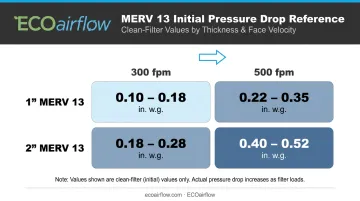
Camfil product data adds important context for higher-velocity configurations. Their AP-Thirteen SC and AQ13 MERV 13 filters show initial values ranging from 0.37–0.51" w.g. at 500 fpm depending on thickness, with a final resistance of 1.0" w.g. across all configurations. The Lennox Healthy Climate HCF series lists initial pressure drops of 0.21–0.26" w.c. with a final value of 0.40" w.c.
Clean-filter values are best-case. That gap between initial and final resistance — sometimes 2–4× — is what determines whether a system can sustain adequate airflow through the full service life of the filter.
Boundary Limits and System Compatibility
ASHRAE guidance is direct on this point: when upgrading filters, verify the system can accommodate the pressure drop increase, or choose a filter with similar resistance to what it replaces.
Practical compatibility guidelines:
- Modern systems (variable-speed blowers): Generally handle MERV 13 in any thickness if the initial pressure drop stays below 0.30" w.g.
- Older systems with single-speed blowers: May struggle with 1" MERV 13 configurations, particularly if return ductwork is undersized
- Safe operating margin principle: Specify filters with pressure drops well below system maximum to leave headroom for dust loading, seasonal variation, and component wear
Key Factors That Drive MERV 13 Pressure Drop
Airflow Face Velocity
Face velocity has a non-linear relationship with pressure drop. The Tex-Air data above illustrates this clearly: moving from 300 fpm to 500 fpm increases pressure drop by roughly 50–63% on the same filter. Peer-reviewed modelling research confirms filtration velocity has the strongest contributing effect on initial pressure drop, with a quadratic relationship — meaning small velocity increases produce disproportionately large resistance increases.
ASHRAE 52.2 uses 492 fpm (2.5 m/s) as the standard test velocity when no application velocity is specified. If your return grille operates at a lower face velocity, your actual pressure drop will be noticeably below the published rating.
Filter Depth and Surface Area
A thicker filter distributes the same airflow volume across a larger media area, reducing local air velocity through the media and lowering resistance. Tex-Air's data confirms that a 2" MERV 13 filter at 300 fpm (0.17" w.g.) produces lower pressure drop than a 1" MERV 10 filter at the same velocity (0.19" w.g.) — despite the higher efficiency rating.
More media surface area means lower velocity through any single point in the media, which means less resistance. A 4" MERV 13 filter carries this principle further still.
Media Type and Filtration Mechanism
Media type produces the widest pressure drop variation among filters with identical MERV ratings.
Mechanical/dense fiber media captures particles through physical interception. Fine particles must collide with tightly packed fibers, and the tight weave needed to catch particles in the 0.3–1.0 micron range inherently creates high resistance.
**Electrostatically enhanced or electronically polarized media** attracts particles using an applied charge at much lower media density. ECOairflow's Electronic Polarization Technology (EPT) creates a corona field that polarizes airborne particles, making the filter media an active attractor rather than a passive barrier. This delivers MERV 13–16 performance with a fraction of the media density required by pleated filters.
ECOairflow's certified pressure drop values under ASHRAE 52.2 Appendix J protocol (powered, unpowered, and KCl conditioned) reflect this difference:
- Model 2300 M-Series: 0.09" w.c. at 300 fpm / 0.18" w.c. at 500 fpm
- Residential Dynamo: 0.11" w.c. at 300 fpm
- Model 1500: 0.13" w.c. at 300 fpm
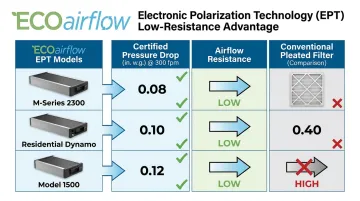
These values sit substantially below any comparably-rated mechanical filter.
Dust-Holding Capacity and Loading Rate
A filter's initial pressure drop matters less than how quickly that value rises. Filters with high dust-holding capacity maintain acceptable resistance longer before requiring replacement, which reduces emergency pressure spikes between service intervals.
In high-particulate environments (wildfire smoke, urban traffic pollution, construction dust), 1" MERV 13 pleated filters can load rapidly. ECOairflow recommends a standard 3-month replacement interval for its pads, though actual intervals in high-particulate conditions may warrant shortening.
How MERV 13 Pressure Drop Is Measured and Validated
ASHRAE 52.2 Testing Context
MERV 13 pressure drop ratings are established in a laboratory setting per ASHRAE 52.2, using a standardized test duct at defined face velocities and controlled temperature and humidity conditions (50°F–100°F, 45% ± 10% RH). The "rated" pressure drop on a datasheet represents this controlled initial condition. It will not match field measurements taken at different face velocities, partial dust loads, or varied ambient conditions.
For electrostatically enhanced filters, Appendix J protocol uses fine KCl particles to condition the filter and demonstrate efficiency stability, producing MERV-A ratings. ECOairflow's M-Series commercial filters carry MERV 13-A through 16-A ratings under this protocol.
Field Measurement Method
Measuring pressure drop in the field requires a digital manometer or magnehelic gauge — two pressure ports, one upstream and one downstream of the filter. The difference is the current filter pressure drop. HVAC technicians perform this as part of routine static pressure diagnostics.
Homeowners can also purchase tools for this purpose. Retail manometers suitable for filter pressure drop measurement range from roughly $155–$220 USD for professional wireless units (Fieldpiece JL3MN, Testo 510i). Basic manometers are available at lower price points.
Once you have a reading, interpreting it correctly is straightforward.
Interpreting Field Measurements
If your field reading is higher than the manufacturer's rated initial value, the cause is usually a partially loaded filter, an incorrect face velocity, or a size mismatch between the filter and duct opening.
Observable warning signs that don't require instrumentation:
- Whistling or hissing from return vents
- Uneven temperatures across rooms
- System running continuously without reaching setpoint
- Unexplained increase in energy bills
Any of these warrants a static pressure check before the problem escalates.
Implications of Operating Outside the Recommended Range
Energy and Performance Consequences
When a MERV 13 filter's pressure drop consumes too much of the system's available static pressure margin, blower airflow drops. The system runs longer cycles to reach setpoint, heat transfer efficiency falls, and evaporator coil temperatures can shift toward freeze-up risk.
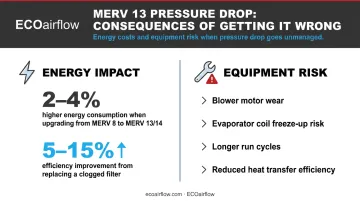
Two data points put the stakes in perspective:
- A peer-reviewed study indexed by the EPA found that upgrading from MERV 8 to MERV 13/14 filters produced 2–4% higher energy consumption during cooling mode — modest in a properly specified system, but compounding when filters are over-specified or left loaded too long.
- Carrier cites DOE guidance indicating that replacing a dirty, clogged filter can improve system efficiency by 5–15%, underscoring the cost of running degraded filtration.
Equipment Damage
Sustained high static pressure accelerates blower motor wear. In severe cases (filter bypass from collapse, or ongoing operation with a fully loaded filter), unfiltered air coats coils and internal components with debris. ACHR News has documented evaporator coil freeze-up directly attributed to restricted airflow from clogged filters. Coil replacements carry significant costs; routine filter replacement is the straightforward way to avoid them.
Three Common Errors to Avoid
Treating the initial rating as the operating value. It isn't — pressure drop rises continuously until replacement. Specify for the loaded value, not the clean one.
Assuming higher MERV always means higher pressure drop. Filter depth and media design are often more significant than MERV rating alone. A 4" MERV 13 can carry less resistance than a 1" MERV 11 of the same media type.
Installing MERV 13 without checking TESP capacity. Particularly in older systems or those with undersized return ducts, this is a common path to blower strain and equipment problems. For systems where conventional MERV 13 creates real compatibility concerns, electronic polarization technology — such as ECOairflow's EPT-based filters, rated at 0.09–0.38 inches w.c. — can deliver MERV 13–16 particle capture at significantly lower pressure drop, resolving the compatibility issue without compromising air quality.
Frequently Asked Questions
What is the pressure drop across a MERV 13 filter?
A clean 1" MERV 13 filter typically measures 0.19–0.31" w.g. at face velocities between 300 and 500 fpm; 2" configurations run slightly lower. This value rises as the filter loads with particles — by end of service life, pressure drop can reach twice the initial value or more.
Is MERV 13 too high for home use?
MERV 13 works well in most modern homes with adequate TESP capacity. Systems with single-speed blowers, undersized return ducts, or limited static pressure budgets may struggle with standard 1" pleated configurations. Electronic filters using low-resistance media — such as ECOairflow's EPT technology, rated at 0.09–0.38" w.c. — are designed specifically to resolve these compatibility issues without sacrificing filtration performance.
What MERV filter for a Lennox furnace?
Check your furnace's rated TESP in the equipment documentation, then match it to a filter whose loaded pressure drop stays within that limit. Lennox's own MERV 13 box filters list final pressure drops of 0.40" w.c. — that's the number to compare against your system's available static pressure margin.
How does filter thickness affect MERV 13 pressure drop?
A thicker filter (2" or 4") distributes airflow across a larger media surface area, reducing face velocity through the media and lowering resistance. At 300 fpm, a 2" MERV 13 filter shows measurably lower pressure drop than a 1" version made of identical media. The 4" configuration extends this advantage further.
How do I know if my MERV 13 filter is causing too much pressure drop?
Observable signs include whistling from return vents, uneven heating or cooling across rooms, the system running continuously without reaching setpoint, or a noticeable rise in energy bills. Have an HVAC technician measure static pressure with a manometer to confirm; a manometer reading takes minutes and gives you a definitive answer.
Does a dirty MERV 13 filter increase pressure drop?
Yes — pressure drop rises continuously as particles accumulate on the media. A filter within acceptable range at installation can exceed safe static pressure limits well before its scheduled replacement date in high-particulate environments like wildfire smoke zones or urban areas with heavy traffic. Shorten replacement intervals or run periodic pressure checks in those conditions.