The consequences are more serious than most people realize. Short-term, poor indoor air quality (IAQ) causes headaches, fatigue, coughing, and eye irritation. Long-term, it contributes to respiratory disease, cardiovascular problems, and even lung cancer. Yet most households never address it.
This guide covers the three proven strategies for meaningful IAQ improvement — source control, ventilation, and filtration — with practical steps for both homeowners and commercial facility operators.
TLDR: Key Takeaways
- Indoor air is often more polluted than outdoor air, triggering allergies, asthma, and long-term respiratory conditions
- Improve IAQ with three core strategies: eliminate pollution sources, increase ventilation, and filter the air effectively
- MERV 13 is the minimum recommended filter rating for capturing fine particles, bacteria, and some viruses
- Regular vacuuming, humidity control (30–50%), and avoiding chemical sprays amplify filtration results
- Electronic air filtration using polarization technology captures ultrafine particles that standard filters miss
Common Indoor Air Pollutants and Their Health Effects
Indoor air pollution rarely comes from a single source. More often, it's an overlapping mix of particles, gases, and biological contaminants. Identifying what's present in your specific space is the necessary first step.
Particulate Matter and Allergens
Particulate matter (PM) includes dust, pet dander, mold spores, pollen, and smoke particles. Fine particles — particularly PM2.5 — are the most dangerous because they penetrate deep into the lungs and can reach the bloodstream. The WHO links PM exposure to cardiovascular disease, respiratory illness, adverse perinatal outcomes, and lung cancer.
Common indoor allergens compound the problem:
- Dust mites — detectable in 84% of U.S. homes
- Pet dander — cat allergen appears in 95% of homes without cats
- Mold — species like Penicillium and Aspergillus increase asthma risk
- Mouse allergen — found in 82% of U.S. homes overall, and 95–100% of inner-city homes
For the roughly 25 million Americans with asthma (about 7.7% of the population, per CDC), these allergens are direct triggers.
Volatile Organic Compounds (VOCs)
VOCs off-gas from everyday household products: paints, varnishes, cleaning sprays, air fresheners, furniture adhesives, and dry-cleaned clothing. The EPA reports that VOC concentrations indoors average 2–5 times higher than outdoors — and during activities like paint stripping, can reach up to 1,000 times background outdoor levels.
Health effects range from eye, nose, and throat irritation to nausea, central nervous system damage, and — with prolonged exposure — elevated cancer risk. There are no federally enforceable VOC standards for residential settings, so choosing low-VOC products and improving ventilation are the primary defenses.
Radon and Carbon Monoxide
These two invisible gases carry the most serious acute and chronic risks in homes. Both are odorless and colorless, making routine awareness — and mitigation — the only real protection.
Key risks at a glance:
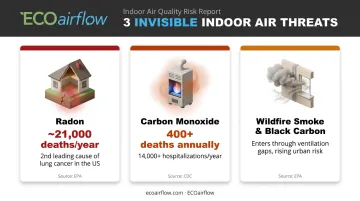
- Radon — seeps through foundation cracks; the second leading cause of lung cancer in the U.S., responsible for ~21,000 deaths per year (EPA)
- Carbon monoxide — from gas appliances and fuel-burning heaters; kills more than 400 Americans annually and hospitalizes over 14,000 (CDC)
- Wildfire smoke and black carbon — increasingly entering homes through ventilation gaps, especially in urban and fire-prone regions
Signs Your Home Has Poor Air Quality
IAQ problems often masquerade as ordinary illness. A key indicator: symptoms that ease when you leave the building.
Physical symptoms to watch for:
- Persistent headaches or unusual fatigue
- Coughing, sneezing, or congestion that doesn't resolve
- Itchy or watery eyes, throat irritation
- Skin irritation with no obvious cause
Environmental clues in your space:
- Visible mold or mildew on walls, ceilings, or around windows
- Musty or chemical odors that linger
- Excessive dust accumulation on surfaces within days of cleaning
- Condensation on windows, suggesting high humidity
These warning signs hit hardest for certain groups. Young children, older adults, and anyone with asthma, COPD, or cardiovascular disease tend to show symptoms faster and more severely — making air quality an urgent health concern, not just a comfort issue.
Strategy 1: Control Pollution at the Source
Source control is the EPA's recommended first-line IAQ strategy — and the most cost-effective one. Reducing or eliminating a pollutant at its origin is always more efficient than trying to clean it out of the air afterward.
Reduce Chemical Pollutants
Many standard household products release VOCs that linger in the air well after use. Practical swaps include:
- Replace aerosol sprays, scented air fresheners, and conventional cleaners with fragrance-free or non-toxic alternatives
- Choose solid wood furniture over composite wood products, which off-gas formaldehyde
- Ventilate thoroughly when painting, staining, or using adhesives
- Keep tobacco smoke entirely out of the building — it's among the most concentrated indoor PM sources
Not all indoor pollutants come from products you can see or smell. Radon and carbon monoxide are invisible and odourless — and both require active testing to detect.
Test for Radon and Carbon Monoxide
Testing is the only way to know your exposure level.
- Use a certified radon test kit; if levels are elevated, sealing foundation cracks is the primary mitigation approach
- Install functioning carbon monoxide detectors on every floor
- Inspect gas appliances and heating systems annually to confirm proper exterior venting
Strategy 2: Improve Ventilation and Control Moisture
Ventilation dilutes indoor pollutants by bringing in outdoor air. The timing matters — on high-pollen days, wildfire smoke events, or near heavy traffic, opening windows can make IAQ worse. Check AirNow.gov for real-time outdoor air quality before ventilating.
Mechanical Ventilation Options
Mechanical ventilation options:
- Kitchen and bathroom exhaust fans — use them consistently during and after cooking or showering
- HVAC fresh air intakes — confirm your system is drawing in outdoor air, not just recirculating
- Heat Recovery Ventilators (HRVs) — the most energy-efficient option for well-sealed homes, replacing stale indoor air without losing significant heating or cooling energy
Moisture Control
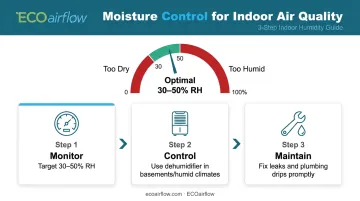
Humidity above 60% promotes mold growth and accelerates VOC off-gassing from furniture and building materials. Humidity below 30% irritates airways. The EPA and ASHRAE both recommend keeping indoor relative humidity between 30–50%.
Practical steps:
- Use a dehumidifier in basements or humid climates
- Fix leaks and plumbing drips promptly
- Monitor humidity with an inexpensive hygrometer and adjust ventilation or dehumidification accordingly
Strategy 3: Choose the Right Air Filtration System
Filtration is the third pillar of IAQ improvement — essential when source control and ventilation alone aren't sufficient. This is especially true in urban environments, wildfire-prone areas, or homes with occupants who have respiratory conditions.
Understanding MERV Ratings
MERV (Minimum Efficiency Reporting Value) measures a filter's ability to capture particles between 0.3 and 10 microns. Higher numbers mean finer particle capture.
| MERV Rating | What It Captures | Best For |
|---|---|---|
| 8–10 | Dust, pollen, mould spores | Basic residential |
| 11–12 | Pet dander, fine dust | Homes with pets/allergies |
| 13+ | Bacteria, smoke, some viruses | Recommended by EPA & ALA |
| 16 | Ultrafine particles, pathogens | High-sensitivity environments |
Both the EPA and the American Lung Association recommend MERV 13 as the minimum for effectively capturing fine particles, bacteria, and some viruses. One caveat: higher-rated filters increase resistance to airflow. Always confirm compatibility with your HVAC system before upgrading, or consult an HVAC professional.
True MERV certification requires testing under ASHRAE 52.2 protocols using ASHRAE-certified test dust with a carbon component. Not all filters claiming high MERV ratings have undergone this verified testing.
Electronic Air Filtration: Beyond Standard Filters
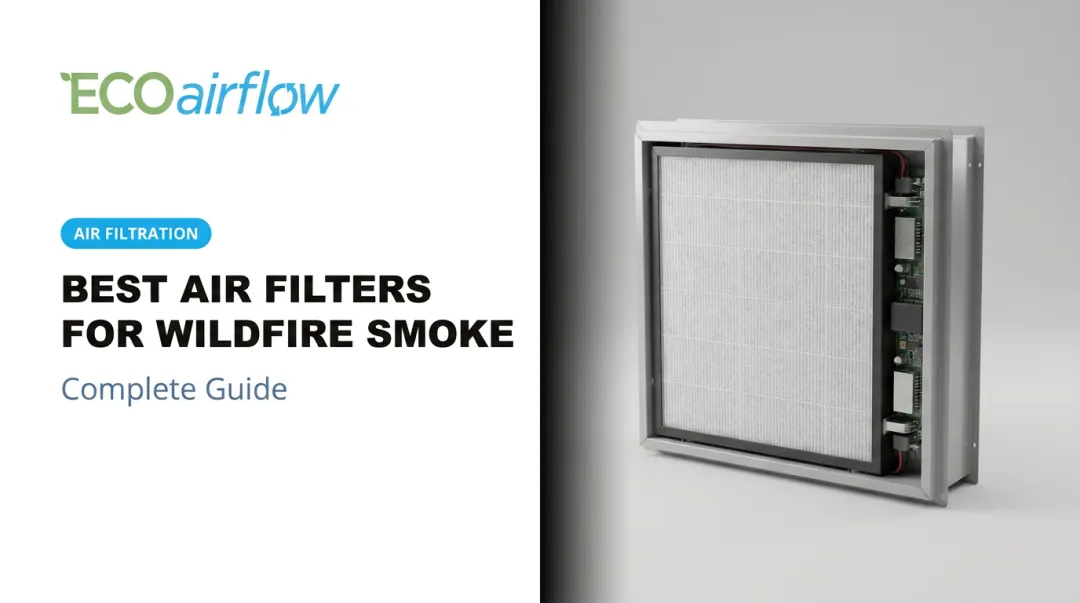
Standard filters work passively: particles either hit a fibre or pass through. Electronic air filtration uses a different approach, actively charging particles so they're attracted to and captured by the filter media.
ECOairflow's patented Electronic Polarization Technology (EPT) operates through three mechanisms:
- Collision — larger particles are trapped directly by filter media
- Polarization — a high-voltage, low-amperage corona field charges ultrafine particles, making them actively seek out and adhere to collector pad fibres
- Agglomeration — charged particles attract nearby particles, forming larger clusters that are easier to capture on subsequent passes

This process enables capture of particles as small as 0.001 microns, including viruses, bacteria, radon daughter progeny (RDP), and black carbon from wildfire smoke and traffic pollution. Standard filters, including HEPA, do not reach this size range.
ECOairflow's commercial M-Series filters achieve MERV 13–16 ratings tested with ASHRAE-certified carbon-component dust, maintaining those ratings whether powered or unpowered and under ASHRAE Appendix J field-condition protocols. Residential models (Dynamo, Model 1000, Model 1500) fit standard 1-inch HVAC slots and are certified to MERV 11–12.
All models operate at 2 watts or less. Their low pressure drop design (0.09–0.38 inches w.c. depending on model) means the HVAC system works less hard per cycle, translating to potential reductions in heating and cooling costs of up to 15% compared to conventional filters.
Performance specs matter, but safety certification matters equally. On ozone: some electronic air cleaners (including certain ionizers and electrostatic precipitators) generate ozone as a byproduct, which is itself a harmful indoor pollutant.
Look for UL2998 Zero Ozone certification when evaluating any electronic air cleaner. ECOairflow's systems are ETL-certified to meet UL2998, verifying ozone emissions below 0.0005 ppm, ten times stricter than the UL867 threshold. This standard is required under ASHRAE 62.1-2019 and recommended by both the CDC and EPA.
Simple Habits That Make a Real Difference
Good filtration equipment needs good habits behind it. How you vacuum, dust, and manage your space affects how much airborne particulate actually gets captured — and how often.
For vacuuming and dusting, a few specifics matter:
- Use a HEPA-equipped vacuum — one study found HEPA vacuuming reduced dust mite allergen loading by 80.8% in carpets
- Use damp or microfibre cloths for dusting; dry dusting redistributes fine particles back into the air
- Standard vacuums without sealed filtration can emit ultrafine particles during operation
One common misconception worth addressing: potted plants do not meaningfully reduce VOCs in real buildings. A 2019 review published in Nature found that VOC removal rates measured in lab chambers are far too small relative to normal building air exchange. Overwatered plants also promote mould growth. Ventilation and filtration deliver far greater, measurable results.
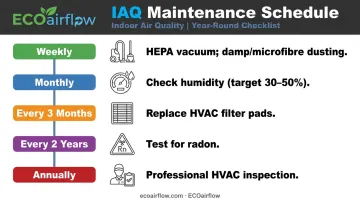
Basic IAQ maintenance schedule:
- Weekly: Vacuum with HEPA vacuum; dust with damp/microfibre cloth
- Monthly: Check indoor humidity (target 30–50%)
- Every 3 months: Replace HVAC filter pads (or per manufacturer guidance)
- Every 2 years: Test for radon
- Annually: Schedule professional HVAC system inspection
Frequently Asked Questions
What are the symptoms of poor air quality in your home?
The most common signs include persistent headaches, fatigue, coughing, sneezing, and eye or throat irritation. A reliable indicator: symptoms that improve when you leave the home suggest the building itself is the source, rather than an underlying illness.
Would an air purifier help my COPD?
Filtration systems rated MERV 13 or higher can reduce airborne irritants — dust, smoke, and allergens — that commonly trigger COPD symptoms. They should complement medical treatment and a physician's guidance, not replace either.
What is a good MERV rating for home air filters?
MERV 13 is the recommended minimum for capturing fine particles including bacteria and some viruses. Before upgrading, verify compatibility with your HVAC system — higher-rated filters increase airflow resistance and may require system modifications.
How can I improve indoor air quality without opening windows?
Several strategies work independently of outdoor air access:
- Use mechanical ventilation such as exhaust fans or HVAC fresh air intakes
- Install an effective air filtration system rated for your space
- Reduce indoor sources like chemical cleaning products and smoking
- Manage humidity levels with a dehumidifier
Does humidity affect indoor air quality?
Yes. Humidity above 60% encourages mould growth and accelerates VOC off-gassing from furniture and building materials. Below 30%, airways can become irritated. The target range — supported by both the EPA and ASHRAE — is 30–50%.
How often should I change my HVAC air filter?
Standard filters typically need replacement every 1–3 months, depending on filter type, household conditions (pets, dust, occupant sensitivities), and manufacturer guidelines. ENERGY STAR recommends changing at minimum every 3 months. ECOairflow's electronic filter pads follow a similar 3-month schedule, though their high dust-holding capacity — a result of the patented Electronic Polarization Technology — means filtration performance stays consistent throughout that interval.