Introduction
Cigarette and cigar smoke is one of the hardest indoor air quality problems to solve because it combines two distinct challenges in one. The solid particles (ranging from 0.1 to 1.0 microns) require mechanical filtration, while the gaseous volatile organic compounds (VOCs) and odours pass straight through any particle filter untouched.
The health stakes are real. According to the CDC, secondhand smoke exposure contributes to over 40,000 deaths among non-smoking adults every year in the US alone. In Canada, Health Canada estimates that 22% of non-smokers are exposed to secondhand smoke daily or near-daily.
This guide covers the best air purifiers for cigarette and cigar smoke — evaluated on filter technology, activated carbon volume, CADR, room coverage, and certifications. It also covers HVAC-integrated options for commercial spaces, smoking lounges, and whole-home applications where a single portable unit can't address air volume at scale — including electronic air filtration systems that work directly within your HVAC to clean air throughout the entire building.
Key Takeaways
- Smoke requires two-stage filtration: HEPA-grade for particles + substantial pellet-based activated carbon for VOCs and odors
- Carbon volume matters most — pellet-based filters need at least 1–2 lbs for light smoke or 5+ lbs for heavy smokers
- CADR and ACH must match your room — target 4.8–5 air changes per hour for smoke environments
- Avoid ozone-based units and ionizers — they react with smoke compounds and create harmful byproducts
- For whole-home or heavy commercial use, HVAC-integrated filtration systems outperform what any portable unit can handle
What Makes Cigarette and Cigar Smoke So Difficult to Filter
The Two-Component Problem
Smoke contains two distinct components — particles and gases — that require completely different removal mechanisms to address effectively.
Research published in peer-reviewed literature confirms that tobacco smoke particles are predominantly in the 0.1–1.0 micron range, with the PM1 fraction accounting for 86–94% of total particulate matter depending on cigarette type. A HEPA-grade filter handles these particles well.
The problem: the gaseous component — VOCs, aldehydes, acrolein, and hundreds of other compounds — passes straight through any particle filter. The EPA is explicit on this point: CADR ratings don't apply to gases, and particle filtration alone leaves the odor and chemical load completely unaddressed. Gas removal requires activated carbon (a sorbent), and effectiveness scales directly with the amount and thickness of carbon media used.
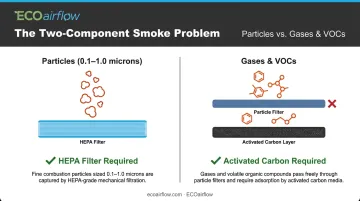
Single-filter solutions fail here reliably. A unit with only a thin carbon coating will saturate quickly under real smoke load and stop adsorbing VOCs long before its scheduled replacement date.
Thirdhand Smoke Complicates Everything
There's a third layer most buyers overlook: thirdhand smoke. Peer-reviewed research describes thirdhand smoke as toxic residue that embeds in surfaces, fabrics, and dust — then re-emits back into the air over time, sometimes reacting with ozone or nitrous acid to form new harmful compounds like tobacco-specific nitrosamines.
Occasional purification isn't enough to manage this. Continuous air filtration is required to address the ongoing re-release of surface-bound residue — particularly in rooms where smoking has occurred regularly over months or years.
Why Cigar Smoke Is Harder to Filter
Cigar smoke demands more from any filtration system. The NCI reports that a single large cigar can contain 5–20 grams of tobacco, compared to less than 1 gram in a cigarette. That difference matters for filtration:
- Generates significantly more respirable suspended particles and polycyclic aromatic hydrocarbons per session
- Produces a heavier VOC load that saturates carbon media faster
- Requires higher air exchange rates and larger carbon volume to compensate
For cigar lounges or regular cigar smokers, room sizing, filter capacity, and carbon volume all need to be assessed at the upper end of recommendations.
Best Air Purifiers for Cigarette and Cigar Smoke
Units below were selected based on verified filter technology, activated carbon volume (pellet-based preferred), CADR, room size coverage, certifications, and smoke removal performance.
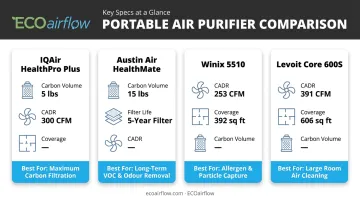
IQAir HealthPro Plus
A Swiss-engineered unit widely regarded as the benchmark for residential smoke and VOC filtration. Each unit is individually factory-tested and shipped with a certificate of performance.
Its HyperHEPA filter is certified to capture 99.5% of particles down to 0.003 microns, far beyond standard H13 HEPA. Paired with the V5-Cell Gas & Odour filter containing 5 lbs of activated carbon and chemisorbent media, it offers one of the largest carbon capacities in any portable unit.
The 10-year warranty (with registration and genuine filter use) adds meaningful long-term value.
| Spec | Detail |
|---|---|
| Filter Technology | HyperHEPA + V5-Cell carbon/zeolite blend (~5 lbs activated carbon) |
| Airflow | 40–300 CFM (official IQAir specification) |
| Coverage | Up to 1,125 sq ft per IQAir |
| Best For | Residential use where both particle removal and heavy VOC control are priorities |
Austin Air HealthMate
Made in the USA, the HealthMate takes a different approach: maximum carbon volume above almost everything else. It contains up to 15 lbs of activated carbon and zeolite — the most of any consumer air purifier — spread across over 780 cubic inches of filter media.
The four-stage system uses two pre-filter stages to catch large particles before they reach the carbon or HEPA layers, significantly extending filter life. At a stated 5-year filter lifespan under normal conditions, it's also among the most cost-effective long-term options for chronic smoke environments. Austin Air confirms it produces no ozone or ionization.
| Spec | Detail |
|---|---|
| Filter Technology | True medical-grade HEPA (60 sq ft) + activated carbon/zeolite blend (up to 15 lbs) |
| Filter Life | Up to 5 years |
| Best For | Heavy smokers, cigar lounges, or any space where odour and VOC adsorption is the top priority |
Winix 5510
The Winix 5510 punches above its price point. Its AOC Carbon Filter uses pellet-based carbon (the critical distinction for smoke — not a fibrous mat), and the built-in air quality sensor adjusts fan speed automatically in response to detected pollutants.
AHAM-verified CADR ratings of Dust 252 / Pollen 247 / Smoke 253 CFM with a verified room size of 392 sq ft give this unit real credibility. The PlasmaWave feature can be disabled from the control panel — worth doing, as its ozone output (measured at 0.22 ppbv in a 30 m³ chamber) is minimal but unnecessary for smoke filtration. Priced at $259.99 USD on Winix's official site.
| Spec | Detail |
|---|---|
| Filter Technology | Pre-filter + pellet-based AOC Carbon + True HEPA + PlasmaWave (optional, can be disabled) |
| CADR | Smoke: 253 CFM (AHAM Verified) |
| Coverage | 392 sq ft (AHAM Verified) |
| Filter Life | Up to 12 months |
| Best For | Budget-conscious buyers needing reliable everyday smoke control in mid-size rooms |
Levoit Core 600S
Levoit's largest Core-series unit leads this list on raw CADR. With 391 CFM (AHAM verified), it moves more air per minute than any other unit here — making it the right choice when fast air turnover in a large open space is the priority.
One critical note: for smoke specifically, you must select the Smoke Remover filter variant, not the standard replacement. Only the Smoke Remover filter includes a pellet-based activated carbon layer to address VOCs and odours. The standard filter handles particles but leaves the gas-phase problem unresolved. The unit also includes AirSight Plus laser particle sensing and smart control via the VeSync app.
| Spec | Detail |
|---|---|
| Filter Technology | Pre-filter + HEPA + pellet-based activated carbon (Smoke Remover filter required) |
| CADR | 391 CFM (AHAM Verified); 606 sq ft at 4.8 ACH |
| Filter Life | 6–12 months |
| Best For | Large open-plan rooms, apartments with ambient smoke infiltration, spaces requiring fast air turnover |
ECOairflow Electronic Air Filtration System
The four units above are all portable — they treat one room at a time. ECOairflow takes a different approach entirely: HVAC integration.
Manufactured in Oshawa, Ontario, ECOairflow's systems use patented Electronic Polarization Technology (EPT) to capture ultrafine particles as small as 0.001 microns. The technology has been independently tested to perform at MERV 13–16 levels (ASHRAE 52.2).
The entire product line carries UL2998 Zero Ozone Verification, certified by ETL (Intertek) to emit ozone below 0.0005 ppm. That meets EPA, CARB, FDA, and NIOSH standards simultaneously.
Because ECOairflow filters install directly into existing HVAC systems, every cubic foot of conditioned air passes through filtration continuously, not just air that happens to cycle through a portable unit's intake. The low pressure drop design (as low as 0.09 in. w.c. for MERV 13 configurations) means HVAC systems work less hard, cutting heating and cooling operating costs by up to 15%.
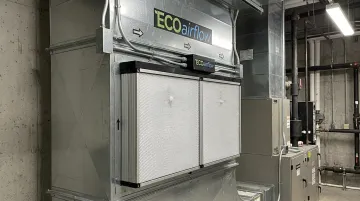
The commercial Model 2300 M-Series (available in MERV 13–16 configurations) is built for high-smoke environments. ECOairflow's commercial technology is deployed in casinos across North America, where smoke particulate control runs around the clock.
| Spec | Detail |
|---|---|
| Filter Technology | Patented EPT; MERV 13–16 (ASHRAE 52.2); captures particles to 0.001 microns |
| Ozone Status | UL2998 Zero Ozone Verified (ETL/Intertek certified) |
| Power Usage | 2 watts or less |
| Installation | HVAC-integrated (residential 1-inch and 2-inch; commercial Model 2300) |
| Best For | Whole-home filtration, casinos, smoking lounges, hospitality, or any space where portable units aren't scalable |
How to Choose the Best Air Purifier for Cigarette and Cigar Smoke
Filter Type Is Non-Negotiable
Any air purifier targeting smoke must combine two distinct filter types:
- HEPA-grade mechanical filter (H13 or better, verified by third-party testing) for solid particles
- Substantial pellet-based activated carbon filter for gases, VOCs, and odors
Thin carbon-coated fibrous filters saturate quickly under real smoke load. The EPA's own guidance states that gas-removal filters are only effective when a large amount of material is used, with thicker media performing better. A unit with a wispy carbon layer will stop neutralising odors within weeks in a smoking environment.
Carbon Volume Is the Most Overlooked Spec
More activated carbon means longer effective life and greater total VOC adsorption capacity before saturation. A practical guide:
- Light or occasional smoke, mid-size room: at least 1–2 lbs of pellet carbon
- Regular smokers or medium rooms: 3–5 lbs
- Heavy smokers, cigar environments, or large spaces: 5+ lbs (Austin Air HealthMate's 15 lbs is the ceiling here)
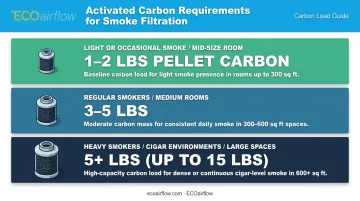
Carbon weight isn't always disclosed by manufacturers. When it isn't listed, prioritize units where the manufacturer or independent reviewers explicitly confirm pellet-based media and total weight — not just that carbon is "included."
CADR and ACH Must Match the Room
AHAM's formula for air changes per hour: ACH = Smoke CADR × 60 ÷ room volume (cubic feet). For smoke removal, targeting 4.8–5 ACH is a reasonable minimum. AHAM's 2/3 Rule is a simpler shortcut: your smoke CADR should be at least 2/3 of your room's square footage.
Be cautious of manufacturers who calculate room coverage at 1 ACH or omit CADR data entirely. That 1 ACH calculation makes units look far more capable than they perform under real smoking conditions.
Ozone-Free Certification Matters
Some "air purifier" technologies — ozone generators, certain ionizers, UV units — actively make smoke contamination worse. The EPA warns that ozone reacts with acrolein, an irritating compound already present in tobacco smoke, and can generate additional harmful byproducts.
No federal agency has approved ozone generators for use in occupied spaces. Look for UL2998 Zero Ozone Verification or ETL/UL listings as a baseline — these confirm ozone output is held to a safe minimum.
Portable vs. HVAC-Integrated
Portable units are effective for single-room applications. Homes or commercial spaces with smoke across multiple rooms — casinos, smoking lounges, and similar facilities where smoke load is continuous — benefit more from an HVAC-integrated solution that treats all circulated air, all the time.
ECOairflow's electronic air cleaners are designed for exactly this use case: installed directly into existing HVAC systems, they filter every cubic foot of air the system moves, across every room it serves.
Conclusion
Matching filter technology (HEPA + substantial pellet carbon), carbon volume to smoke severity, and CADR to actual room size will narrow the field quickly. The five options above cover the full spectrum: the IQAir HealthPro Plus and Austin Air HealthMate lead on carbon capacity; the Winix 5510 delivers verified AHAM performance at a reasonable price point; the Levoit Core 600S wins on CADR for large open spaces; and ECOairflow's EPT-based systems handle whole-home and commercial applications that portables simply can't scale to.
That said, no air purifier eliminates the health risks of active smoking in an enclosed space. These units mitigate exposure, manage residual particles and odours, and protect air quality for non-smokers. The best results combine quality filtration with adequate ventilation and, where possible, reducing smoke at the source.
For commercial facilities, smoking lounges, casinos, or homeowners looking for whole-home filtration through their existing HVAC system, ECOairflow's EPT-based electronic air filtration systems integrate directly with your HVAC to address smoke at a whole-home or facility scale — something no portable unit can replicate. Contact the team directly at customerservice@ecoairflow.com or 1-877-347-3569 to discuss your specific space and requirements.
Frequently Asked Questions
Do air purifiers actually work for smoke?
Yes, air purifiers with verified HEPA-grade filtration combined with substantial activated carbon measurably reduce both smoke particles and VOCs. Effectiveness depends on CADR matching your room size and running the unit continuously, not just when smoke is actively present.
What is the best air purifier to remove smoke?
It depends on the use case. For portable units, the IQAir HealthPro Plus and Austin Air HealthMate lead on carbon volume; the Levoit Core 600S delivers the highest CADR for large rooms. For whole-home or commercial applications, an HVAC-integrated system like ECOairflow's EPT-based filters is the more scalable, comprehensive solution.
What removes smoke from the air?
Smoke removal requires two mechanisms working together: a HEPA-grade filter traps the solid particles, while pellet-based activated carbon (in sufficient quantity) adsorbs the VOCs and odours that pass through particle filters unaffected. Neither mechanism alone solves the full problem.
How much activated carbon do I need for cigarette smoke?
At minimum, look for a pellet-based filter with at least 1–2 lbs for light or occasional smoke in a mid-size room. Regular smokers or larger spaces benefit from 5 lbs or more. Avoid thin carbon mats or fabric-coated filters; they saturate quickly and stop working long before they're replaced.
Is HEPA or activated carbon better for cigarette smoke?
Neither is sufficient alone. HEPA handles solid particles; activated carbon handles gases and odours. An air purifier with only one of the two will leave half the problem unsolved, leaving either airborne particles or persistent VOC odour unaddressed.
Can an air purifier remove cigarette smoke smell?
Yes. A substantial pellet-based activated carbon filter adsorbs the VOCs responsible for smoke odour. That said, thirdhand smoke residue embedded in furniture, walls, and fabrics requires physical cleaning — no air purifier can reach contaminated surfaces.