Introduction
Cooking is one of the most consistent sources of indoor air pollution in the average home. A 2021 peer-reviewed residential cooking study found that PM2.5 concentrations peaked at 200–1,400 µg/m³ within just one to seven minutes after cooking ended — more than nine times higher than readings in adjacent bedrooms. That spike includes fine particulates, VOCs from heated oils, nitrogen dioxide from gas burners, and polycyclic aromatic hydrocarbons.
Range hoods help, but they're inconsistent. A Lawrence Berkeley National Laboratory study found front-burner particle capture efficiency as low as 3–11% on low settings and up to 70% on high. Capture rates vary significantly based on hood size, placement, and usage habits. What escapes the hood lingers in your kitchen, then drifts into the rest of your home.
A dedicated air filter is the most reliable way to capture what the hood misses. This guide covers the best kitchen air filters for smoke — from compact portable purifiers to HVAC-integrated systems — and what to look for when choosing one.
Key Takeaways
- Kitchen smoke contains PM2.5, VOCs, and toxic gases that range hoods often fail to capture at front burners
- Effective kitchen air filters combine HEPA-grade particle capture with activated carbon or polarization technology for odors and gases
- Match filter coverage (CADR or ACH) to your kitchen's square footage — undersized units clog faster and clean less effectively
- HVAC-integrated filtration protects your whole home from cooking smoke; portable units handle targeted, room-level cleanup
- Factor in annual filter replacement costs, not just the purchase price
Why Kitchen Smoke Demands a High-Performance Air Filter
What Cooking Actually Releases
Kitchen smoke isn't just visible steam. A single cooking session releases multiple pollutant classes simultaneously:
- Fine particulates (PM2.5 and PM0.1) — solid and liquid aerosols from frying, sautéing, and grilling
- VOCs — including benzene, toluene, and xylene from heated cooking oils
- PAHs — such as benzo(a)pyrene from high-heat cooking methods
- Aldehydes — formaldehyde, acrolein, and acetaldehyde
- Nitrogen dioxide and carbon monoxide — particularly from gas burners
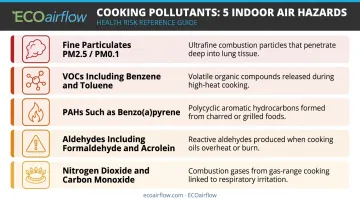
These compounds are invisible at low concentrations but harmful with repeated daily exposure. The WHO links household air pollution to an estimated 2.9 million deaths annually, driven largely by cardiovascular and respiratory disease — effects that begin accumulating well before symptoms appear.
That health risk is compounded by a filtration problem most people don't anticipate: kitchen air carries two distinct pollution streams, and they require completely different technologies to capture.
Two Pollutant Categories, Two Filter Requirements
Smoke particles (solid/liquid aerosols) are captured by mechanical filters — True HEPA or high-MERV rated media that physically trap particles as they pass through.
Odor-causing gases (VOCs, aldehydes, NO2) pass straight through HEPA filters. They require activated carbon or advanced adsorption technology to chemically bind the molecules.
A filter that handles only one category delivers only partial protection. The options below address both particle capture and gas adsorption — because kitchen air demands nothing less.
Best Kitchen Air Filters for Smoke
These filters were evaluated on filtration technology, verified CADR or MERV performance, smoke and odor capture, room size suitability, certifications, and total cost of ownership.
ECOairflow Electronic Air Filtration System
Best for: Whole-home protection in open-concept homes and multi-room spaces
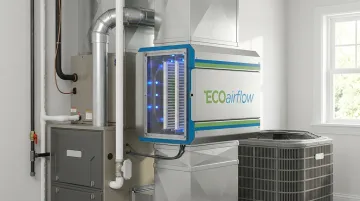
ECOairflow, headquartered in Oshawa, Ontario, manufactures HVAC-integrated electronic air filtration systems deployed across hospitals, airports, and residential installations throughout North America. Unlike every other option on this list, ECOairflow operates at the HVAC system level — filtering all air circulating through your home rather than treating a single room.
Its patented Electronic Polarization Technology (EPT) creates a charged field in the filter media that attracts and traps airborne particles, including ultrafine cooking smoke aerosols as small as 0.001 microns — well below the 0.3-micron threshold of standard HEPA filters.
Crucially, ECOairflow's M-Series filters are certified to MERV 13–16 per ASHRAE 52.2 using ASHRAE-certified test dust containing a carbon component — the same type of particulate found in cooking smoke. Many competing electronic filters are tested with non-carbon dust, which doesn't reflect real-world smoke performance.
For open-concept kitchens where smoke spreads freely into adjacent living areas, an HVAC-integrated solution addresses the whole problem rather than just the cooking zone.
| Specification | Detail |
|---|---|
| Filter Technology | Patented Electronic Polarization Technology (EPT) |
| MERV Rating | MERV 13–16 certified (ASHRAE 52.2, including Appendix J protocol) |
| Coverage | Whole-home HVAC integration; all circulated air |
| Particle Capture | Down to 0.001 microns |
| Key Certifications | ETL Listed (Intertek); UL2998 Zero Ozone Verified |
| Energy Impact | Low pressure drop; reduces HVAC operating costs up to 15% |
| Warranty | Dynamo: lifetime electronics (original owner); Models 1000/1500/2300: 5 years |
Alen BreatheSmart Flex
Best for: Large enclosed kitchens up to ~300 sq. ft.
The BreatheSmart Flex is a tower-style portable purifier with a 3-stage filtration system: pre-filter, True HEPA, and a pellet-based activated carbon filter. The FL40 Heavy Smoke filter variant contains approximately 2.3 lbs of activated carbon (per HouseFresh testing) — significantly more than most consumer purifiers — making it particularly effective for stubborn cooking odors like fried fish and spices.
Independent testing by HouseFresh recorded a smoke CADR of 191 CFM and cleared a PM1 smoke test room in 34 minutes. The main limitation for kitchen use: no built-in air quality sensor or auto-mode, so it won't ramp up automatically when you start cooking.
| Specification | Detail |
|---|---|
| Filter Technology | 3-stage: Pre-filter, True HEPA, Pellet-based Activated Carbon |
| CADR (Smoke) | 191 CFM (HouseFresh independent test) |
| Coverage Area | ~296 sq. ft. at 4.8 ACH |
| Filter Life | 9–12 months |
| Auto-Mode / Sensor | None |
| Warranty | Lifetime (Forever Guarantee) with active filter subscription |
Levoit Core 300S
Best for: Small to medium kitchens up to ~219 sq. ft.
The Core 300S is a compact cylindrical purifier with a 360-degree air intake that pulls smoke from all directions, useful in kitchens where the cooking zone isn't directly adjacent to the unit. Its three-stage filtration (nylon pre-filter, True HEPA, pellet-based activated carbon) is paired with an AirSight Plus laser dust sensor that automatically triggers high-speed mode when smoke or particulate is detected.
HouseFresh independent testing recorded a CADR of 141 CFM and room clearance in 45 minutes. Estimated annual running cost is approximately $79/year ($24 electricity + $55 filters). App control and Alexa/Google compatibility add convenience; third-party compatible filters are also available at lower cost than OEM.
| Specification | Detail |
|---|---|
| Filter Technology | 3-stage: Nylon Pre-filter, True HEPA, Pellet-based Activated Carbon |
| CADR | 141 CFM (official Levoit rating) |
| Coverage Area | 219 sq. ft. at 4.8 ACH |
| Auto-Mode / Sensor | Yes — AirSight Plus laser sensor with auto-mode |
| Smart Features | VeSync app; Alexa and Google Assistant compatible |
| Est. Annual Cost | ~$79/year (HouseFresh estimate) |
IQAir HealthPro Plus
Best for: Large or open-concept kitchens up to ~406 sq. ft.
The HealthPro Plus takes a different approach to gas-phase filtration: its V5-Cell Gas & Odor Filter contains 5 lbs of activated carbon and chemisorption media — far more than the thin carbon layers found in most consumer purifiers. For kitchens that generate heavy VOC loads from frying and high-heat cooking, that extra mass translates to substantially longer odor capture before saturation.
HouseFresh testing recorded room clearance in 28 minutes — the fastest of any portable unit on this list. Filter maintenance is infrequent: the pre-filter and V5-Cell last 12–21 months depending on use, and the HyperHEPA (H12/13 rated) lasts 3–4 years. The trade-off is cost: upfront price and replacement filters run higher than most alternatives here.
| Specification | Detail |
|---|---|
| Filter Technology | PreMax F8 pre-filter + V5-Cell Gas & Odor Filter (5 lb carbon) + HyperHEPA (H12/13) |
| CADR | ~213–260 CFM (independent test range; not official AHAM CADR) |
| Coverage Area | ~406 sq. ft. at 4.8 ACH (AirPurifierFirst) |
| Filter Life | Pre-filter/V5-Cell: 12–21 months; HyperHEPA: 3–4 years |
| Auto-Mode / Sensor | None (standard HealthPro Plus 250) |
| Warranty | 10 years with registration and subscription |
Winix 5500-2
Best for: Everyday kitchen use with hands-free operation, up to 360 sq. ft.
The Winix 5500-2 earns its place as the everyday workhorse. Its 4-stage system — washable pre-filter, washable AOC activated carbon filter, True HEPA, and optional PlasmaWave — combines solid filtration with practical features: a built-in air quality sensor, auto-mode, and remote control.
The washable pre-filter and carbon filter keep annual replacement costs low. The sensor and auto-mode combination means the unit reacts to cooking smoke without manual adjustment — no stopping mid-cook to dial it up. HouseFresh recorded room clearance in 23 minutes, the best result among all portable units tested. Official AHAM-verified smoke CADR: 232 CFM.
| Specification | Detail |
|---|---|
| Filter Technology | 4-stage: Washable Pre-filter, Washable AOC Carbon, True HEPA, PlasmaWave |
| CADR (Smoke) | 232 CFM (AHAM Verifide) |
| Coverage Area | 360 sq. ft. at 4.8 ACH |
| Auto-Mode / Sensor | Yes — air quality sensor + auto-mode + remote control |
| Filter Life | 12 months (HEPA and carbon) |
| Warranty | 2-year limited |
What to Look for in a Kitchen Air Filter for Smoke
Filter Technology: You Need Both Layers
Every effective kitchen air filter requires two distinct filtration stages:
- Mechanical particle filter — True HEPA (captures ≥99.97% of particles at 0.3 microns per EPA definition) or high-MERV electronic filtration for smoke particulates
- Gas-phase adsorption — activated carbon or advanced polarization technology for VOCs, aldehydes, and cooking odors
A filter with only a HEPA stage cleans smoke particles but leaves cooking gases and odors untouched. A carbon-only filter handles odors but ignores the PM2.5 that deposits in lung tissue. Neither alone is sufficient.
ECOairflow's HVAC-integrated systems use Electronic Polarization Technology, which extends particle capture to 0.001 microns — reaching aerosol sizes that pass through standard HEPA media.
CADR and Coverage Area
AHAM recommends a smoke CADR of at least two-thirds of your room's square footage. AHAM's room-size ratings are based on 4.8 air changes per hour (ACH) — the benchmark for effective air cleaning.
Quick reference:
- Small kitchen (~150 sq. ft.): Smoke CADR ≥ 100
- Medium kitchen (~220 sq. ft.): Smoke CADR ≥ 145
- Large kitchen (~360 sq. ft.): Smoke CADR ≥ 240
- Open-concept space (~500+ sq. ft.): Consider HVAC-integrated filtration
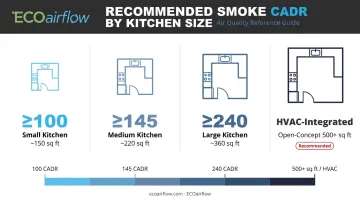
Undersized units clog faster from grease and particulate loading — and they can't turn over air quickly enough during active cooking.
Auto-Mode and Air Quality Sensors
Cooking occupies both hands. A built-in air quality sensor paired with auto-mode means the filter detects rising smoke and ramps up fan speed without requiring manual intervention. Of the portable units listed here, the Levoit Core 300S and Winix 5500-2 both include this feature; the Alen Flex and IQAir HealthPro Plus do not.
HVAC-Integrated vs. Portable
| Factor | Portable Air Purifier | HVAC-Integrated (ECOairflow) |
|---|---|---|
| Coverage | Single room | Whole home |
| Placement | Near cooking zone | In HVAC filter slot |
| Smoke that spreads beyond kitchen | Not captured | Captured via system airflow |
| Best for | Enclosed kitchens | Open-concept, multi-room homes |
| Maintenance | Filter replacement every 3–12 months | Pad replacement ~every 3 months |
For open-concept homes where kitchen air circulates freely into living areas and bedrooms, an HVAC-integrated filter addresses the problem at the system level. Portable units, however strong their CADR, only treat what reaches their intake.
Filter Lifespan and Total Cost
Grease and oil mist degrade filter media faster than standard household dust. One study found a recirculating charcoal filter in a kitchen range hood dropped from 60% NO2 removal when new to just 20% after 19 days of cooking — kitchen environments are harsh on filtration media.
When comparing options, calculate annual cost: filter replacements plus electricity, not just the purchase price. The Levoit Core 300S runs approximately $79/year all-in; the IQAir HealthPro Plus costs more annually, but its larger carbon volume means less frequent replacement.
Certifications to verify before buying:
- HEPA grade (per EPA definition)
- MERV rating per ASHRAE 52.2
- ETL Listing
- Zero Ozone compliance
Conclusion
Kitchen smoke is a daily air quality hazard that most filtration advice underestimates. The right filter depends on your kitchen configuration: a portable unit with a strong CADR and auto-mode works well for enclosed kitchens, while an HVAC-integrated system is the only practical solution when cooking air routinely spreads into adjacent living spaces.
Filter type, CADR match, certification standards, and total cost of ownership matter more than brand recognition alone. Get those factors right, and the air quality difference is noticeable — especially for households with allergy or asthma concerns.
For homeowners with open-concept kitchens or whole-home air quality concerns, ECOairflow manufactures HVAC-integrated electronic air filtration systems rated MERV 13–16 under ASHRAE 52.2, certified zero-ozone compliant by ETL, and sized to fit standard residential ductwork. They're built for whole-home coverage — not as a substitute for a range hood, but as the filtration layer that catches what your kitchen ventilation misses. Contact ECOairflow at 1-877-347-3569 or customerservice@ecoairflow.com to find the right model for your home.
Frequently Asked Questions
Do air filters actually remove kitchen smoke?
Yes, provided the unit uses both particle filtration and odor control. Filters with True HEPA or high-MERV rated media effectively capture fine smoke particles (PM2.5), while activated carbon or advanced polarization layers simultaneously adsorb the VOCs and odors that produce lingering smells. Filters lacking both components address only part of the problem.
What is the difference between a HEPA filter and an electronic air filter for kitchen smoke?
HEPA filters use dense fiber media to mechanically trap particles at 0.3 microns or larger. Electronic air filters like ECOairflow's EPT use a charged polarization field to attract and capture ultrafine particles as small as 0.001 microns — reaching smoke aerosols that pass through standard HEPA media entirely.
Where should I place an air filter for kitchen smoke?
Place portable units on the counter near the cooking source, a few inches from walls for unobstructed airflow — but not directly beside the stove where heat and grease splash can damage the unit. HVAC-integrated filters operate at the system level and require no specific room placement.
How often should kitchen air filters be replaced?
Kitchen use shortens filter life: plan on replacing activated carbon stages every 3–6 months and HEPA stages every 6–12 months, with heavy cooking pushing both toward the shorter end. ECOairflow replacement pads run approximately every 3 months; other common models range from 9–21 months depending on design and cooking frequency.
Can an air filter replace a kitchen range hood?
No — they serve different roles. Range hoods exhaust high-volume smoke and grease vapor directly outdoors at the source. Air filters clean the residual particles and gases that escape into room air. Both together deliver the most complete protection, and neither fully substitutes for the other.
What MERV rating is best for kitchen smoke?
MERV 13 or higher is recommended for capturing fine smoke particles in HVAC-integrated systems — look for filters certified per ASHRAE 52.2 using carbon-containing test dust, which reflects real-world smoke performance. For standalone portable purifiers, True HEPA is the standard benchmark — these units meet or exceed MERV 16 efficiency for fine particles under EPA classifications.