Standard household filters weren't built for this. Construction dust spans 0.1 to 10 microns in size, and the most dangerous particles — those classified as PM2.5 by the EPA — are small enough to penetrate deep into lung tissue while passing straight through a basic MERV 1–8 filter.
This guide covers the top air filters for construction dust, explains the specs that actually matter, and helps you match the right solution to your situation — whether that's an active job site or a commercial building that needs to stay occupied through a renovation.
Key Takeaways
- Construction dust includes silica, wood, drywall, and VOC particles — many invisible and harmful to lungs over time
- MERV 13+ and HEPA-certified filters are the minimum effective standard for fine construction particulate
- HVAC-integrated electronic filters are the practical choice for occupied facilities and buildings undergoing active renovation or long-term construction work
- Check CADR and MERV ratings before purchasing; independent certification confirms whether filter performance claims hold up
- ECOairflow's electronic air filters deliver MERV 13–16 performance with a low pressure drop, making them well-suited for facilities managing construction-related air quality
Why Construction Dust Demands Specialized Air Filtration
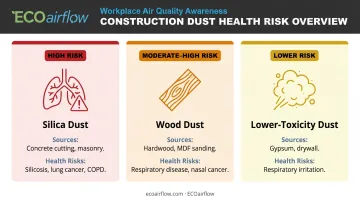
Construction dust varies widely in composition — and every type carries real health risks.
The Three Main Dust Categories
| Dust Type | Sources | Primary Health Risk |
|---|---|---|
| Silica dust | Concrete cutting, masonry, sandstone | Silicosis, lung cancer, COPD |
| Wood dust | Hardwood, softwood, MDF sanding | Respiratory disease, nasal cancer (hardwood) |
| Lower-toxicity dust | Gypsum, drywall joint compound | Respiratory irritation; still contains trace silica |
According to OSHA, approximately 2.3 million workers are exposed to silica at work, with NIOSH reporting an average of 162 annual U.S. deaths from silicosis during 2000–2005. A 2020 study of 86 construction workers exposed to respirable crystalline silica found 7.24% had severe pulmonary impairment and 26.5% showed mild impairment.
Why Standard Filters Fail
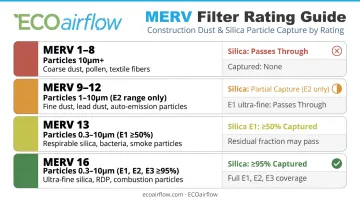
Those health risks are compounded by a critical gap in standard filtration. The ASHRAE 52.2 standard divides particle capture into three efficiency groups:
- E1: 0.3–1.0 microns (the most hazardous respirable fraction)
- E2: 1.0–3.0 microns
- E3: 3.0–10.0 microns
MERV 1–8 filters have no required E1 capture efficiency — meaning fine silica and PM2.5 particles pass through unimpeded. Even MERV 9–12 filters cover only E2 performance — submicron silica particles still slip through.
VOCs: The Chemical Hazard Particulate Filters Miss
Construction zones don't just produce particles. Paints, adhesives, solvents, and composite wood products release volatile organic compounds that can reach 1,000 times outdoor background levels during stripping or finishing work. Particulate filters capture dust, not gases. Controlling VOC exposure requires multi-stage filtration that includes activated carbon.
Top 5 Best Air Filters for Construction Dust
Each filter below was assessed on five criteria:
- Filtration efficiency (verified MERV rating or HEPA certification)
- CADR relative to unit size
- Multi-pollutant capability
- Construction-site durability
- Total cost of ownership
ECOairflow Electronic Air Filter System
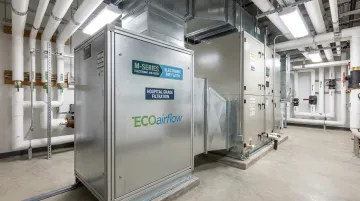
ECOairflow is a North American manufacturer of powered electronic air filtration systems, headquartered in Oshawa, Ontario. Their filters are installed across hospitals, airports, and casinos — environments where air quality during construction or renovation is non-negotiable. The commercial Model 2300 M-Series targets exactly this use case.
| Specification | Detail |
|---|---|
| Key Features | Patented EPT technology; MERV 13–16 certified; hermetically sealed electronics; recyclable pad sets; 2 watts power draw |
| Best For | Commercial buildings, hospitals, airports, and industrial facilities managing air quality continuously during construction or renovation |
| Certifications | ETL Listed (Intertek), UL2998 Zero Ozone, MERV 13–16 (ASHRAE 52.2 with carbon-component test dust), Appendix J protocol certified |
What separates ECOairflow's M-Series from most alternatives is triple-condition performance: the filter achieves its rated MERV 13–16 levels with power on, power off, and under ASHRAE Appendix J conditioning — so if a power interruption occurs on-site, filtration continues uninterrupted.
Pressure drop figures are low (0.09–0.38 inches w.c. at 300–500 FPM depending on MERV configuration), which translates to up to 15% lower HVAC operating costs compared to high-resistance mechanical alternatives. ECOairflow's EPT technology captures particles down to 0.001 microns — well beyond what conventional HEPA or pleated filters reach.
The system is LEED-compliant and qualifies for credits under WELL Building, ILFI, and Passivehaus standards.
AlorAir CleanShield HEPA 550 Air Scrubber
The CleanShield HEPA 550 is a purpose-built industrial air scrubber designed specifically for construction and remediation environments. Its rotomolded polyethylene housing and stackable design handle the punishment of an active job site.
| Specification | Detail |
|---|---|
| Key Features | CADR: 270–550 CFM; MERV 10 pre-filter + activated carbon + HEPA; ductable; stackable; ETL certified |
| Best For | Active construction and demolition sites, large open-plan renovation zones, remediation work |
| Coverage | Up to 800 sq. ft. per unit |
The ductable design allows source capture — placing the intake directly at the dust source rather than just cleaning ambient air. For silica-generating tasks like concrete cutting or tuckpointing, NIOSH recommends HEPA-filtered dust collection at the source, and the CleanShield's three-stage filtration (pre-filter, carbon, HEPA) addresses both particulate and odors. It's overkill for a residential bathroom remodel, but right-sized for commercial demolition.
Honeywell HPA300
The Honeywell HPA300 is a widely available consumer air purifier with solid verified performance for its price point. It carries AHAM Verifide status with independently tested CADR ratings.
| Specification | Detail |
|---|---|
| Key Features | CADR: 300 smoke / 320 dust / 300 pollen; activated carbon pre-filter + True HEPA; 465 sq. ft. coverage |
| Best For | Small to medium renovation rooms, residential remodels, budget-conscious contractors |
| Annual Filter Cost | Official annual combo kit (HRF-ARVP300): $89.95/year; or ~$153.75/year if HEPA and pre-filters purchased separately |
Filter lifespan is 12 months for HEPA, 3 months for the carbon pre-filter under normal use — though construction dust loads will shorten those intervals considerably. Set a reminder to check filters weekly during active work.
Levoit Core 600S
The Levoit Core 600S is one of the faster-cleaning purifiers available in its class, with patented VortexAir fan technology and a built-in air quality sensor that adjusts fan speed automatically.
| Specification | Detail |
|---|---|
| Key Features | CADR: 391 CFM; HEPA-grade filtration (99.97% at 0.3 microns, IEST RP C001.7 tested); VortexAir fan; AirSight Plus PM2.5 sensor; smart app |
| Best For | Large rooms, open-plan renovation spaces, homeowners wanting smart air quality monitoring during construction |
| Coverage | 606 sq. ft. at 4.8 ACH; up to 635 sq. ft. per Levoit's stated rating |
The auto mode and real-time PM2.5 display make it easier to know when air quality drops during active construction phases. For occupied living spaces adjacent to a renovation zone, it's a practical choice — though heavy-dust commercial environments call for a dedicated air scrubber.
High-MERV Mechanical Filters (MERV 13–16)
Brands like 3M Filtrete, Aprilaire, and Nordic Pure offer pleated MERV 13–16 filters that slot directly into existing HVAC return air locations — the simplest way to upgrade building-wide filtration during construction.
| Specification | Detail |
|---|---|
| Key Features | MERV 13–16 rating; fits standard HVAC slots; multi-brand availability; no power required |
| Best For | Commercial buildings and homes where HVAC runs during construction; supplementary to portable air scrubbers |
| Key Limitation | High pressure drop increases energy use and can strain HVAC blowers; requires filter checks every 1–4 weeks during active construction |
MERV 16 achieves ≥95% capture across all three ASHRAE particle size groups (E1, E2, E3). The tradeoff is resistance: high-MERV pleated filters significantly increase static pressure in HVAC systems. Verify your system's fan capacity before upgrading, and plan for replacement far more frequently than the packaging suggests during active renovation.
Key Features to Look for in a Construction Dust Air Filter
MERV Rating and Particle Capture Efficiency
MERV 13 is the minimum effective rating for fine construction dust in the 0.3–1.0 micron range. At MERV 13, filters achieve ≥50% E1 efficiency. MERV 16 pushes that to ≥95%.
True MERV certification under ASHRAE 52.2 uses a test dust containing 23% carbon black. Filters tested without this carbon component may underperform where carbon-rich particulate is present — which is common on active construction sites. ECOairflow's commercial products are certified using this carbon-component test dust and perform at rated levels under all three test protocols (powered, unpowered, Appendix J).
CADR and Room Sizing
Once you've confirmed a filter's certification, the next step is matching it to your space. CADR measures clean air delivery in cubic feet per minute — use this formula to size for construction environments:
Room sq. ft. × 8 ft. ceiling height ÷ 60 = minimum CFM for 8 air changes/hour
For a 500 sq. ft. room with 8 ft. ceilings: 500 × 8 ÷ 60 = 67 CFM minimum — but construction environments should target higher, closer to the unit's maximum rated CADR.
Filtration Technology: HEPA vs. Electronic
Two main approaches dominate:
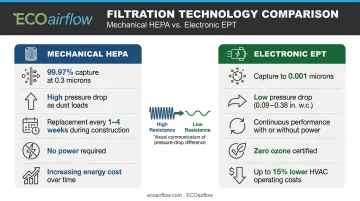
- Mechanical HEPA: Captures 99.97% of particles ≥0.3 microns through a fibre maze. Well-understood, widely certified, no power required. Pressure drop increases as filters load with dust.
- Electronic polarization (EPT): Uses electrostatic charge to capture ultrafine particles down to 0.001 microns. Lower pressure drop than mechanical alternatives. ECOairflow's EPT systems are certified to UL2998 for zero ozone emissions — a requirement under ASHRAE 62.1-2019 for air cleaning devices.
For HVAC-integrated continuous filtration in occupied buildings, electronic systems maintain airflow performance better as they load — a practical advantage on renovations that run weeks or months.
Activated Carbon for VOC Control
Particulate filters can't capture gaseous pollutants. Paints, adhesives, and composite wood products like MDF release formaldehyde that passes straight through a standard filter.
Look for units that combine particulate filtration with an activated carbon stage. ECOairflow's documentation notes VOC and formaldehyde capture capability across their residential line; for commercial VOC requirements, contact their team directly.
Durability, Pressure Drop, and Maintenance Costs
- High-MERV mechanical filters often need replacement every 1–4 weeks during active construction (versus 3–12 months under normal conditions)
- High pressure drop from loaded filters strains HVAC blowers and increases energy consumption
- Electronic systems with low pressure drop (like ECOairflow's, which range from 0.09–0.38 in. w.c.) maintain HVAC performance while delivering high filtration efficiency — reducing operating costs over a multi-month renovation
How We Chose the Best Air Filters for Construction Dust
We evaluated filters on five criteria:
- Filtration efficiency — verified by independent certification, not manufacturer claims
- CADR relative to unit size — how efficiently the unit cleans a given volume of air
- Multi-pollutant capability — whether particulate + VOC control is addressed
- Construction-site suitability — dust load tolerance, durability, and operational continuity
- Total cost of ownership — filter replacement frequency and energy use over a typical renovation period
The biggest mistake buyers make is choosing on upfront price. A $50 filter replaced every two weeks costs more than a premium solution over a six-month renovation — not counting added HVAC stress and repair costs.
Third-party certification carried significant weight in the evaluation. ETL listing, ASHRAE 52.2 MERV testing with carbon-component dust, UL2998 zero-ozone compliance, and AHAM CADR ratings all require independent verification — unlike MERV claims printed on retail packaging, which face no such requirement.
Conclusion
The right filter depends on what you're dealing with:
- Active job sites: A high-capacity HVAC-integrated electronic filter handles heavy dust loads continuously without requiring separate portable equipment
- Occupied buildings during renovation: HVAC-integrated electronic filters or MERV 13+ mechanical filters protect occupants and equipment building-wide
- Residential applications: ECOairflow's electronic air cleaners slot into standard 1-inch or 2-inch filter bays, capturing ultrafine construction particles without portable-unit complexity
No matter which scenario fits your project, the label alone won't tell you enough. Verify CADR, confirm the certification body, understand pressure drop impact, and calculate total maintenance cost before committing.
For commercial facilities, healthcare environments, industrial buildings, and homeowners who want continuous low-maintenance filtration through construction and beyond, ECOairflow's Electronic Polarization Technology filters deliver certified MERV 13–16 performance with zero ozone emissions and a pressure drop as low as 0.09 in. w.c. — well within what most HVAC systems handle comfortably. Contact the ECOairflow team directly to discuss your facility's needs.
Frequently Asked Questions
Can air purifiers remove construction dust from air?
Yes — air purifiers with HEPA or high-MERV electronic filters effectively capture construction dust particles, including fine silica and drywall particulate down to 0.3 microns or smaller. Units must be correctly sized (CADR matched to room volume) and run continuously during active construction to stay effective.
What MERV rating is best for construction dust?
MERV 13 is the minimum recommended rating for fine construction dust. MERV 16 captures the smallest hazardous particles at ≥95% efficiency across all ASHRAE particle size groups. Verify the rating was tested under ASHRAE 52.2 with carbon-component test dust. Electronic filters like ECOairflow's M-Series achieve MERV 13–16 with a significantly lower pressure drop than mechanical pleated alternatives.
What is the difference between an air scrubber and an air purifier for construction dust?
Air scrubbers are industrial-grade units built for high-dust, high-volume environments — they feature ducting for source capture and support negative pressure containment. Standard air purifiers are designed for occupied rooms with lower dust loads. For active construction zones, an air scrubber is the more appropriate choice.
How often should air filters be replaced during construction?
Filters that last 6–12 months under normal conditions may need replacement every 1–4 weeks during active construction. Check filters weekly and replace when airflow restriction is visible or air quality sensors show degraded performance. On high-dust sites, shorten your inspection interval accordingly.
Do I need a special air filter for silica dust from concrete cutting?
Silica particles can reach 0.1–0.3 microns and require at minimum a HEPA-certified or MERV 16 filter for effective capture. OSHA's construction silica standard (29 CFR 1926.1153) sets a permissible exposure limit of 50 µg/m³ as an 8-hour TWA. Proper filtration combined with source control — wet cutting, local exhaust ventilation — is the recommended approach.
Can construction dust damage HVAC systems if filters are not upgraded?
Yes. Fine construction particulate bypasses low-MERV filters and accumulates on HVAC coils, blower motors, and ductwork, increasing pressure drop and reducing heat-transfer performance. An EPA report documented lung disease linked to construction debris contaminating a poorly filtered forced-air system. Upgrading to MERV 13+ or electronic filtration during construction protects both occupants and equipment.