Introduction
Wildfire smoke is no longer something that only affects people near the fire line. During the 2023 Canadian wildfire season, approximately 267 million Americans — 79% of the U.S. population — were exposed to at least one "Canada smoke day."
On June 7, 2023 alone, New York City's daily mean PM2.5 hit 122.3 µg/m³ — more than 1,200% above the 10-year June baseline. Asthma-related emergency department visits across New York state surged 81.9% that same period.
Closing your windows isn't enough. Wildfire smoke is a compound threat: ultrafine particles that penetrate deep into lung tissue and toxic gases like benzene, formaldehyde, and acrolein. Most standard filters address only one side of that equation, leaving occupants exposed to the other.
This guide covers which filter types work for wildfire smoke, how to size them for your home, and how to build layered protection before the next smoke event hits.
Key Takeaways
- Wildfire smoke contains PM2.5 particulates and VOCs — you need filtration that addresses both threats
- MERV 13 minimum for HVAC systems; True HEPA (roughly MERV 17+) is the standard for portable units
- ECOairflow's Electronic Polarization Technology (EPT) captures particles down to .001 microns with low pressure drop and zero ozone output — suitable whole-home HVAC filtration without sacrificing airflow
- True HEPA + activated carbon is the most effective portable room-level combination
- Filters clog fast during smoke events: inspect daily, replace often, and seal your home before relying on filtration alone
What Makes Wildfire Smoke So Difficult to Filter
Two Threats, One Event
Wildfire smoke combines fine particulate matter and toxic gases — two threats that require fundamentally different filtration mechanisms. Most filters are built for one, not both.
The particle side includes PM2.5 and smaller particles, with measured wildfire aerosol diameters typically in the 25–400 nm range and a number mode of around 212 nm. These ultrafine particles bypass the body's natural defences, entering the bloodstream directly through lung tissue.
The gas side is equally serious. Hazardous air pollutants like benzene, formaldehyde, and acrolein spike during smoke events — median concentration increases of +43% for formaldehyde and +34% for acrolein compared to non-smoke days.
Understanding MERV Ratings
The EPA's MERV scale rates a filter's ability to capture particles from 0.3 to 10 microns. Here's what each tier actually captures:
| MERV Rating | Particle Capture Performance |
|---|---|
| MERV 1–4 | Less than 20% of particles 3.0–10.0 µm |
| MERV 8 | 70% of 3.0–10.0 µm; 20% of 1.0–3.0 µm |
| MERV 13 | 90% of 3.0–10.0 µm; 85% of 1.0–3.0 µm; 50% of 0.3–1.0 µm |
| MERV 16 | 95%+ across all three size ranges |
| True HEPA | 99.97% of particles at 0.3 µm |
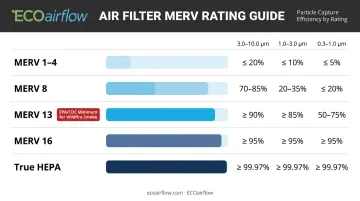
MERV 13 is the EPA/CDC minimum recommendation for wildfire events. True HEPA performs stronger — but wildfire smoke includes sub-micron particles well below the 0.3 µm threshold where HEPA is benchmarked. Capture efficiency at ultrafine sizes is where filters are won or lost during a smoke event.
The VOC Gap
Standard MERV 13 and HEPA filters capture particulates. They do nothing for gases and odours. For that, you need activated carbon — and most budget HVAC filters don't include it.
There's also a filter-loading problem. ASHRAE guidance published by the EPA notes that heavy smoke can load filters so quickly that replacement may be needed as frequently as every day. A clogged filter doesn't just fail to filter — it restricts airflow and strains your HVAC motor.
Best Air Filters for Wildfire Smoke
No single filter type handles wildfire smoke perfectly across every home and scenario. The options below cover whole-home HVAC solutions and portable room-level units, evaluated on particle capture efficiency, gas-phase capability, certifications, and real-world performance during smoke events.
ECOairflow Electronic Polarized Air Filters
ECOairflow (Oshawa, Ontario) manufactures powered electronic air filtration systems using patented Electronic Polarization Technology (EPT), deployed in hospitals, airports, casinos, and commercial buildings across North America. Their filters are tested and rated for capturing black and organic carbon from forest fires.
What sets EPT apart from standard filtration is the mechanism: rather than using a dense weave to physically intercept particles, it charges filter media fibres to attract and trap particles electromagnetically. This captures particles as small as .001 microns — far below HEPA's 0.3 µm benchmark — while maintaining very low airflow resistance.
For residential users concerned about wildfire smoke, two models stand out:
- Model Dynamo: MERV 12, pressure drop 0.11 in.w.c. @ 300 fpm, 2 watts, lifetime electronics warranty to original owner
- Model 1000: MERV 11, pressure drop 0.18 in.w.c. @ 300 fpm, 2 watts, captures black and organic carbon from forest fires
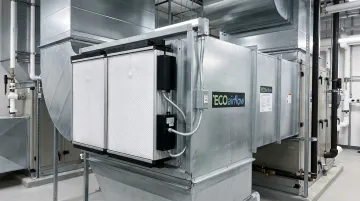
For commercial facilities (hospitals, airports, larger buildings), the Model 2300 M-Series offers MERV 13–16 ratings with pressure drops as low as 0.09 in.w.c. at 300 fpm — and maintains full rated MERV performance whether powered on, powered off, or tested under Appendix J protocol.
| ECOairflow Electronic Polarized Filters | |
|---|---|
| Filter Technology | Patented EPT; MERV 11–16 (ASHRAE 52.2); captures to .001 microns |
| Best For | Whole-home and commercial HVAC integration; hospitals, airports, large residential and commercial buildings |
| Key Differentiators | ETL Listed; UL2998 Zero Ozone Verified; up to 15% HVAC energy savings; 2 watts power draw; recyclable materials |
One note on VOCs: EPT addresses particulates, not gases. If VOC removal is also a priority, contact ECOairflow directly to discuss pairing options for your specific situation.
MERV 13–16 Pleated HVAC Filters
Standard pleated HVAC filters rated MERV 13 and above (brands like 3M Filtrete, BNX TruFilter) are the most widely available upgrade for central air systems. They represent the EPA and CDC's minimum recommended rating for capturing wildfire smoke particles.
Accessibility is their main advantage. That accessibility comes with tradeoffs:
- Higher pressure drop — standard pleated MERV 13 filters reach up to 173 Pa resistance, versus ECOairflow's electronic approach which achieves comparable or better efficiency with significantly lower resistance
- No gas-phase filtration — VOCs pass through untouched
- Faster clogging under heavy smoke conditions
Check your HVAC system's fan motor before upgrading to MERV 14–16. PSC motors lose airflow as filter resistance increases; BPM motors compensate by drawing more power.
| MERV 13–16 Pleated Filters | |
|---|---|
| Filter Technology | Mechanical pleated filtration; MERV 13 captures ≥0.3 µm particles at high efficiency |
| Best For | Central HVAC systems; best paired with portable carbon units for full smoke coverage |
| Key Differentiators | Widely available; EPA/CDC recommended minimum; no gas-phase filtration; verify HVAC compatibility before upgrading above MERV 13 |
True HEPA Portable Air Purifiers
True HEPA portable units — the Coway Airmega 400 (smoke CADR 328), Levoit Vital 200S (CADR 250 CFM), and Smart Air Blast Mini MKII (820 CFM airflow) are well-tested examples — provide effective room-level particulate filtration and are the most practical option for creating a "clean room" during smoke events.
Sizing matters. For wildfire smoke specifically, AHAM recommends selecting a unit whose Smoke CADR equals the room's square footage — more demanding than the general two-thirds rule. A 400 sq ft bedroom needs a unit with a Smoke CADR of at least 400.
Look for units that combine True HEPA with activated carbon to address both particles and VOCs — and avoid any models with non-defeatable ionizers that may produce ozone.
| True HEPA Portable Air Purifiers | |
|---|---|
| Filter Technology | True HEPA (H13: 99.97% at 0.3 µm); activated carbon for VOC/odour removal |
| Best For | Single rooms up to ~700 sq ft; bedrooms and designated clean rooms during wildfire events |
| Key Differentiators | Look for AHAM-certified CADR ratings; Energy Star for efficiency; avoid units with ozone-producing ionizers |
DIY Corsi-Rosenthal Box
The Corsi-Rosenthal Box — four MERV 13 filters taped around a box fan with a cardboard shroud — was validated by EPA research as a genuine emergency option. EPA testing measured a wildfire-smoke CADR of 401 ± 31 CFM for the four-filter cardboard-shroud design, making it comparable to many commercial units.
Build specs: four 2-inch MERV 13 filters, a 20-inch box fan, cardboard, and duct tape. Use only fans manufactured in 2012 or later with UL or ETL safety markings.
Limitations to know upfront:
- No gas-phase filtration — VOCs pass through completely
- Higher noise than commercial alternatives
- Filters need frequent replacement during active smoke events
| DIY Corsi-Rosenthal Box | |
|---|---|
| Filter Technology | MERV 13 pleated; 4-filter + cardboard shroud design |
| Best For | Emergency/budget situations; rooms up to ~600 sq ft |
| Key Differentiators | EPA-validated; ~401 CFM smoke CADR; zero gas-phase filtration; UL/ETL-marked fans required (2012 or newer) |
How to Choose the Right Air Filter for Wildfire Smoke
Wildfire smoke brings two distinct threats — fine particulate matter and volatile organic compounds — so the right filter strategy depends on your space, your HVAC system, and whether you need to address both. Here's how to work through the key decisions.
Match Size to Space
- Portable units: For wildfire smoke, target a Smoke CADR equal to the room's square footage (stricter than the general two-thirds rule)
- HVAC filters: Verify your fan motor can handle the pressure drop of the chosen MERV rating before upgrading — ECOairflow's electronic filters deliver MERV 13–16 efficiency with pressure drops starting at 0.09 in.w.c.
Address Both Threats
Before purchasing any filter, ask: does this handle PM2.5/PM1 particles and VOCs?
If not, layer your approach:
- MERV 13+ HVAC filter (particles) + portable activated carbon unit (VOCs)
- Electronic HVAC filter capturing ultrafine particles + supplemental carbon stage
- True HEPA portable with built-in activated carbon layer
Watch for Ozone
Some electronic air cleaners generate ozone as a byproduct of ionization — a respiratory irritant that worsens smoke-related health risks.
Look specifically for UL 2998 Zero Ozone Verification, which validates emissions at or below 0.005 ppm (the quantifiable detection threshold). ECOairflow's entire product line carries this certification through Intertek/ETL.
Residential vs. Commercial Scale
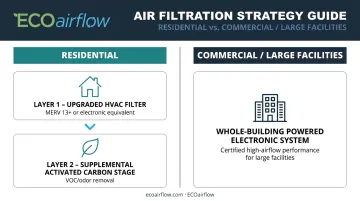
- Homeowners: Upgraded HVAC filter (MERV 13+ or electronic equivalent) + a supplemental activated carbon stage to address VOCs alongside particulates
- Hospitals, airports, large commercial facilities: Whole-building powered electronic systems with certified performance at high airflow rates — ECOairflow's Model 2300 M-Series (MERV 13–16) is designed specifically for these environments, with performance verified under Appendix J protocol in both powered and unpowered states
Tips to Protect Your Indoor Air During Wildfire Season
Seal the building first. Close all windows and doors, apply weatherstripping to gap-prone areas, and switch your HVAC to recirculate mode to stop drawing outdoor smoke indoors. The best filter can't keep up if smoke enters faster than it can be cleaned.
Run filtration continuously. During active smoke events, run air purifiers and HVAC fans 24/7 on medium to high speed. Wildfire smoke infiltrates even well-sealed buildings over time. Monitor conditions using the AirNow Fire and Smoke Map and don't reduce filtration until PM2.5 levels return to acceptable levels.
Replace filters more often than you think. During heavy smoke:
- Inspect filters daily — replace when visibly darkened or when smoke odor persists
- MERV 13 and HEPA filters can clog in days rather than months under sustained smoke conditions
- ECOairflow pads typically last 3 months under normal conditions — during active smoke events, inspect weekly and replace as soon as airflow feels restricted or odor breaks through
- Stock backup filters before fire season starts — backup stock sells out fast once smoke events hit
Taking these steps before and during smoke season keeps your filtration system ahead of the problem rather than playing catch-up.
Frequently Asked Questions
What air filter is best for wildfire smoke?
For whole-home HVAC systems, MERV 13 is the EPA-recommended minimum. Electronic polarized filters like ECOairflow go further — capturing ultrafine particles as small as 0.001 microns with a lower pressure drop than standard pleated filters. For supplemental room-level protection, a portable True HEPA unit with activated carbon can address both particles and VOCs in a single space.
Can air purifiers help with wildfire smoke?
Yes — portable True HEPA purifiers remove PM2.5 and finer particles from a single room, with activated carbon units also addressing VOCs and odors. For whole-home coverage, a properly rated HVAC filter running in recirculate mode is more effective. Size any unit so its Smoke CADR matches the room's square footage.
What MERV rating do I need for wildfire smoke?
MERV 13 is the EPA-recommended minimum for HVAC systems. Ratings of MERV 14–16 increase efficiency but require HVAC compatibility verification. Electronic polarized filters like ECOairflow achieve equivalent or superior performance with significantly lower airflow resistance.
How often should I change my air filter during wildfire season?
Inspect filters daily during active smoke events and replace when visibly dark or when smoke odors are detectable indoors. Filters rated for 3 months under normal use may need replacement within days to weeks during heavy smoke conditions.
Can wildfire smoke trigger migraines?
Yes. Wildfire smoke contains fine particulates and chemical irritants linked to headaches and, with prolonged exposure, increased migraine frequency and severity. The CDC lists headaches as a documented symptom of smoke exposure, making adequate indoor air filtration one of its primary recommended protective measures.
Can HVAC filters remove wildfire smoke from my whole home?
Yes — a MERV 13 or higher HVAC filter running in recirculate mode effectively reduces wildfire smoke particles throughout a home. Results depend on run time, filter rating, and how well the home is sealed. A gas-phase (carbon) component is also needed for VOCs; particulate filtration alone leaves that threat unaddressed.