Beyond energy costs, a neglected filter stops doing its primary job: trapping dust, pollen, pet dander, and fine particles like PM2.5 before they recirculate through your home. ENERGY STAR recommends checking filters monthly during heavy-use seasons and replacing them at least every three months.
This guide covers exactly where HVAC filters are located across different system types, how to assess whether yours needs replacing, and how to swap it correctly — including the installation errors that quietly reduce filtration performance.
Key Takeaways
- Most filters sit in the return air duct, blower compartment, or behind a return air grill
- Check walls, ceilings, utility closets, attics, and basements — location depends on system type
- Many homes have multiple filters — inspect every large return air grill, not just one
- A dirty filter drives up energy bills, strains HVAC components, and degrades air quality
- Replace 1-inch filters every 30–90 days; 4-inch deep filters can last up to 12 months
Why Locating Your HVAC Air Filter Matters
Locating your air filter is the starting point for every other HVAC maintenance task — and skipping it has real consequences for both your system and your air quality.
When a filter clogs, the blower motor works harder to pull air through. ENERGY STAR notes that a dirty filter slows airflow, increases energy use, and can lead to costly repairs or early system failure.
A clogged filter also creates a mechanical risk: obstructed airflow can allow dirt to bypass the filter entirely and accumulate on the evaporator coil. That buildup impairs heat absorption and compounds the efficiency loss over time.
The air quality angle is equally direct. The EPA confirms that HVAC filters can capture fine particles including PM2.5 — the particulate matter most associated with respiratory health concerns — but a dirty, overloaded filter stops functioning effectively. The filter can't protect air you're breathing if it's already at capacity.
HVAC contractors consistently flag neglected filters as one of the most common causes of unnecessary service calls. The root issue is straightforward: most homeowners simply don't know where their filter is or how often to change it. That's what this guide covers.
A neglected filter affects your system in three compounding ways:
- Energy costs rise as the blower motor compensates for restricted airflow
- Equipment wears faster from the added mechanical strain
- Air quality drops once the filter media is saturated and no longer capturing particles
Where Is the Air Filter Located in Your HVAC System?
Filter location depends on your system type, installation era, and home layout. Some homes have one central filter; others have individual filters behind multiple return air grills throughout the house. The common thread is that filters always sit on the return side of the system — where air enters before being conditioned and redistributed.
Return Air Duct and Grill (Most Common Location)
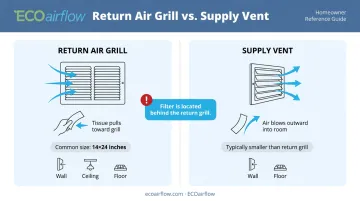
A return air grill pulls air into the system — it doesn't blow air out. To tell the difference: hold a tissue near a grill while the system runs. If it gets sucked toward the grill, that's a return. If it blows away, that's a supply.
Return grills are typically:
- Large metal grates (often 14×24 inches or bigger)
- Located on walls, ceilings, floors, or utility closet doors
- Accessible by removing screws or releasing pull-levers
The filter sits directly behind this grill. Start your search with the largest grill in the home — that's the most likely filter housing.
Furnace or Air Handler Blower Compartment
If there's no filter behind the return grill, look at the furnace or air handler itself. According to Carrier, the filter cabinet is typically found along the sides, top, or bottom of the blower cabinet — and on older units, the filter may be inside the blower cabinet itself.
Air handlers are commonly installed in:
- Basements and utility rooms
- Attics and garages
- Dedicated mechanical closets
The filter slot sits on the air intake side of the unit, just before the blower fan. Open the blower compartment door or tray to access it.
Horizontal vs. Vertical Unit Configurations
- Horizontal units (common in attics, large basements, garages): the filter slides into a slot on the return side, the end where air enters, not the discharge end
- Vertical units (common in crawl spaces, small basements): the filter slot is typically above or below the unit depending on airflow direction
When in doubt, trace the large ductwork back to the unit and identify which end pulls air in. That's your starting point.
Other Locations: Duct Openings and Inside Closets
Older systems sometimes have filters installed inside duct openings upstream of the air handler, not at a grill or inside the unit itself. Some homes also have filter slots tucked into a 1-inch-wide channel inside a utility closet, covered by a hinged or removable panel.
If you've checked the obvious spots and still haven't found it, work through these:
- Check inside closets adjacent to mechanical spaces
- Look in the attic if the air handler is installed up there
- Examine any accessible duct sections near the return side of the unit
How to Tell If Your HVAC Air Filter Needs Replacing
Once you've found the filter, a quick inspection tells you whether to replace it now or put it back and check again next month.
Visual Inspection: What to Look For
The simplest test: hold the filter up to a light source.
- Light passes through — filter appears off-white or light grey with visible fibre structure; still usable
- Light is blocked — media appears dark grey, brown, or visibly matted; replace now
Also check how the filter sits in its frame. If one section looks heavily loaded while the edges are clean, that points to a fit problem — gaps around the frame are letting unfiltered air bypass the media entirely. A replacement filter won't fix bypass; the sizing or seating needs to be corrected.
Signs the Filter Is Beyond Inspection
Replace immediately if you notice any of these:
- Filter media is black or dark brown throughout
- Physical collapse or sagging of the filter structure
- Visible moisture or mold on the filter surface
- Musty or dusty smell from vents while the system is running
Understanding Filter Type and Maintenance Signals
Standard disposable filters — fiberglass or pleated — show degradation visually. But not all filters work the same way.
Electronic air filtration systems, like those from ECOairflow, use replaceable collector pads rather than disposable filter media. The pads don't show gradual grey-to-black degradation the same way pleated filters do. ECOairflow recommends replacing pads every 3 months under normal household conditions, regardless of visual appearance — making the calendar a more reliable indicator than colour alone.
For any non-standard filter type, consult the manufacturer's maintenance guide or contact their tech support directly.
When In Doubt, Check the Install Date
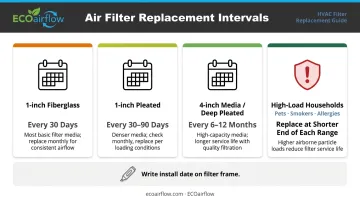
Write the installation date on the filter frame in marker every time you replace it. General replacement intervals:
| Filter Type | Typical Replacement Interval |
|---|---|
| 1-inch fiberglass | Every 30 days |
| 1-inch pleated | Every 30–90 days |
| 4-inch media / deep pleated | Every 6–12 months |
| High-load households (pets, smokers, allergies) | Lean toward the shorter end of each range |
Step-by-Step: How to Replace Your HVAC Air Filter
Most filter replacements take under five minutes and require no tools. A few specific steps prevent the installation errors that reduce filtration effectiveness.
Tools and Prep
Have these on hand before you start:
- Replacement filter in the correct dimensions (measure the old filter's frame or check the owner's manual)
- Flat-head screwdriver if the return grill has screws
- Marker to write the installation date
- Flashlight for hard-to-see slots
Before opening any compartment: turn off the HVAC system at the thermostat. Running the blower without a filter — even briefly — pulls unfiltered debris directly onto internal components.
Step-by-Step Replacement Process
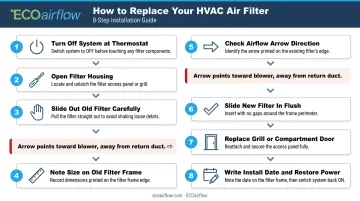
- Turn off the system at the thermostat
- Open the filter housing — remove grill screws or release pull-levers, or open the blower compartment door
- Slide out the old filter carefully — avoid shaking it, which dislodges accumulated debris into the duct
- Note the size printed on the old filter's frame — confirm the replacement matches exactly (length × width × thickness)
- Check the airflow arrow on the new filter — this arrow must point toward the blower/furnace, away from the return duct
- Slide the new filter in flush against all four edges with no gaps at the frame
- Replace the grill cover or compartment door
- Write today's date on the filter frame, then restore power to the system
Upgrade Consideration
If your current filter is a standard 1-inch pleated, a replacement cycle is a good moment to evaluate whether the filter type itself is the right fit for your household.
ECOairflow's electronically polarized filters (MERV 13–16 certified via ASHRAE 52.2) are designed to drop into the same slot your current filter occupies. Key differences from standard pleated filters:
- Capture ultrafine particles as small as 0.001 microns, including bacteria and allergens
- Low-pressure-drop design reduces HVAC operating costs by up to 15%
- Available in all standard sizes plus custom dimensions
The Dynamo, Model 1000, and Model 1500 cover most residential applications. The Dynamo also carries a lifetime electronics warranty to the original owner — worth factoring in against the cost of disposable replacements.
Common Mistakes When Finding and Replacing HVAC Filters
Most filter problems come down to three avoidable errors. Each one quietly defeats the purpose of changing the filter at all.
- Check the airflow arrow before inserting. A backwards filter loses efficiency fast — and under suction pressure, the media can collapse inward toward the blower, restricting airflow and damaging the filter structure.
- Match the printed size, not your estimate. Even a filter that looks close will leave bypass gaps. ACHR News reports that gaps around the filter rack let air bypass the media entirely, leaving the system running without effective filtration. Always use the size printed on the existing filter frame.
- Check every return grill in the home. Many homes have multiple return air grills, each with its own filter. Replacing one while ignoring the rest means dirty air re-enters the system through unchanged filters. Walk the full home and check each one.
These mistakes are easy to miss — but just as easy to prevent once you know where to look.
Frequently Asked Questions
How often should you change your HVAC air filter?
ENERGY STAR recommends at least every 3 months as a minimum. Carrier specifies 30 days for 1-inch fiberglass and 30–90 days for 1-inch pleated filters, while 4-inch media filters typically last 6–12 months. Homes with pets, smokers, or allergy sufferers should replace at the shorter end of the range.
Is there an air filter in the HVAC unit itself?
Yes. The filter is either housed inside the blower compartment of the furnace or air handler, or located in the return air duct directly next to the unit. It's a built-in part of the system, not an optional add-on.
Can I run my HVAC system without an air filter?
Avoid it. Even a brief run draws dust, hair, and debris directly onto the blower motor and evaporator coil, reducing heat transfer efficiency and risking costly component damage. A replacement filter costs far less than that repair bill.
What happens if my HVAC air filter gets too dirty?
A clogged filter restricts airflow, forcing the blower to work harder and raising energy consumption. The DOE warns that obstructed airflow can allow dirt to bypass the filter and coat the evaporator coil. Indoor air quality also declines as particles that should be captured re-enter circulation instead.
How do I know what size air filter my HVAC system needs?
Check the size printed on the existing filter's frame — it shows length × width × depth in inches. You can also measure the filter slot opening directly or consult the HVAC owner's manual. Never estimate by sight; a filter that doesn't seat flush on all four sides will leave bypass gaps.
Do all HVAC systems have their air filter in the same location?
No. Location varies by system type (furnace, air handler, packaged unit), home layout, and installation era. That's why checking return air grills, the blower compartment, and utility areas is the right approach — there's no single universal location across all residential systems.