Introduction
Most HVAC filter decisions come down to two things: MERV rating and price. Neither tells you what actually matters most — the airflow resistance a filter creates across its entire service life.
Pressure drop drives how hard the blower works, how much energy the system consumes, and whether conditioned air actually reaches every room. Specify a filter without understanding its pressure drop behavior, and you'll end up with undersized airflow, inflated energy bills, and premature equipment wear — often without tracing any of those symptoms back to the filter.
This guide covers the full picture: what pressure drop is and how it's measured, what acceptable ranges look like across MERV ratings, why the efficiency-versus-resistance trade-off isn't as fixed as it seems, and how to recognize when a filter is costing you more than it should.
Key Takeaways
- Pressure drop is airflow resistance across a filter, measured in inches of water gauge (in. w.g.) — the higher it is, the harder your blower works
- Higher MERV ratings generally raise pressure drop, but filter construction (pleat depth, surface area, technology) can substantially offset this
- Most residential HVAC systems operate below 0.5" w.g. total external static pressure — one filter consuming too much of that budget strains the whole system
- Pressure drop rises as filters load with dust, so both initial and final resistance ratings matter for accurate system specification
- Electronic polarization technology delivers MERV 13–16 efficiency at significantly lower pressure drop than conventional dense media — electrostatic attraction does the heavy lifting instead of thick mechanical filtration
What Is Pressure Drop in HVAC Air Filters?
ASHRAE 52.2-2017 defines filter resistance as the loss of static pressure caused by an air-cleaning device at a stated airflow rate, expressed in Pascals or inches of water. In practical terms, it's the energy cost of pushing air through filtration media — the filter is a flow constraint sitting in series with your ductwork, coils, and registers.
The blower generates static pressure to overcome all these resistances combined. The filter's share of that budget is its pressure drop, and it competes directly with every other component in the system.
Initial vs. Final Pressure Drop
Pressure drop has two distinct states that both matter for filter selection:
- Initial pressure drop — clean-filter resistance at rated airflow under ASHRAE 52.2 test conditions; the number datasheets report
- Final pressure drop — resistance at end of service life when the filter is fully loaded; ASHRAE 52.2 requires this to be at least twice the initial value
ASHRAE 52.2 also defines rated final resistance as the operating pressure loss at which the manufacturer recommends replacement. If no value is specified, testing proceeds to 350 Pa (1.4 in. w.g.) or until arrestance drops below 85% of peak, whichever comes first.
Specifying only initial pressure drop tells you how the filter performs on day one — not how it performs across its actual service life.
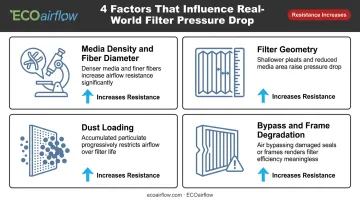
What Moves the Number in Real Operation
Real-world pressure drop deviates from datasheet values because lab conditions are rarely replicated in the field:
- Media density and fiber diameter — finer fibers capture smaller particles but increase flow resistance at the same face velocity
- Filter geometry — deeper pleats and larger face area spread airflow across more media, lowering resistance even at equivalent MERV ratings
- Dust loading — pressure drop climbs as particulate accumulates; humid conditions accelerate this because moisture causes particles to clump and swell on the media
- Bypass and frame degradation — distorted frames or failed gaskets can actually reduce measured pressure drop while letting unfiltered air pass around the media entirely; field monitoring often misses this failure mode
Pressure Drop Ranges and Acceptable System Limits
Understanding where a filter sits within a system's total static pressure budget matters as much as the filter's own rated value.
Reference Pressure Drop by MERV Rating and Thickness
The values below are manufacturer benchmarks — useful for comparison across filter types, not universal standards. Ratings vary by airflow rate and installation conditions:
| Filter | MERV | Thickness | Test Basis | Initial Pressure Drop |
|---|---|---|---|---|
| Camfil AQ13 | 13 | 1 in. | 350 fpm | 0.45 in. w.g. |
| AirFilterUSA pleated | 13 | 1 in. | Standard residential | ~0.27 in. w.g. |
| AirFilterUSA pleated | 8 | 1 in. | Standard residential | ~0.14 in. w.g. |
| Aerostar GeoPleat | 11 | 4 in. | 1,500–2,500 cfm | 0.13–0.27 in. w.g. |
| Aerostar GeoPleat | 13 | 4 in. | 1,500–2,500 cfm | 0.22–0.48 in. w.g. |
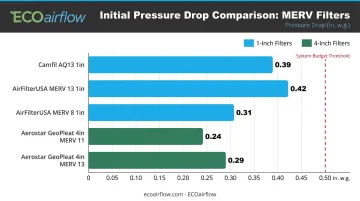
The pattern is clear: a 4-inch MERV 13 filter can have lower initial pressure drop than a 1-inch MERV 11, purely because of increased media surface area. That distinction becomes critical once you look at how much pressure budget the whole system actually has.
System Budget and Acceptable Limits
ENERGY STAR/NCI guidance specifies that total external static pressure (TESP) and component pressure drops should be measured and compared against equipment manufacturers' published specifications. As an industry benchmark, ACHR News cites a common residential target of around 0.5 in. w.g., with 0.8 in. w.g. or higher treated as a concern.
That 0.5 in. w.g. must cover the filter, ductwork, coils, and registers simultaneously. A single filter consuming 0.35–0.45 in. w.g. leaves almost nothing for the rest of the system.
Why Operating Near the Final Limit Causes Real Damage
Running a filter past its recommended replacement threshold, rather than swapping it at a defined limit, creates cumulative strain on the entire system:
- Blower motors draw higher current to maintain airflow against rising resistance
- Reduced airflow forces longer run cycles to reach temperature setpoints
- Thermal stress accumulates on motor windings, capacitors, and compressor components
- In severe cases, evaporator coils freeze as refrigerant cannot absorb sufficient heat from restricted airflow
The Efficiency–Pressure Drop Trade-Off: How Technology Changes the Equation
Conventional mechanical filters achieve higher MERV ratings by making media denser. This improves particle capture through interception and impaction — but there is no way to escape the resulting pressure drop increase using passive media alone. Denser media always means more resistance.
How Geometry Partially Offsets This
Filter construction can reduce the penalty without changing the media type:
- Deeper pleats increase the effective filtration surface area
- Higher pleat counts distribute airflow across more media per square foot of face area
- Larger face dimensions reduce face velocity through the media
This is why a 4-inch MERV 13 filter can outperform a 1-inch MERV 11 on pressure drop. The media itself may be denser, but it's spread across enough surface area that resistance stays lower.
Electronic Polarization: A Different Physical Mechanism
Rather than relying on dense media to intercept particles mechanically, polarized filtration charges both the media fibres and the particles electrostatically — causing particles to be actively attracted to the filter rather than simply blocked by it.
A 2021 review published in Current Research in Environmental Sustainability confirmed that exploiting electrostatic forces can effectively alleviate the filtration efficiency versus pressure drop trade-off. Because particles seek out the media rather than collide with it, the media can have larger gaps between fibres — maintaining high capture efficiency with substantially lower resistance.
ECOairflow's EPT in Practice
That mechanism is what ECOairflow's EPT delivers in practice — lower resistance at the media level translates directly into measurable pressure drop figures across the product line.
| Model | Application | Pressure Drop | Face Velocity |
|---|---|---|---|
| Dynamo | 1-inch residential | 0.11 in. w.c. | 300 fpm |
| Model 1500 | 1-inch residential | 0.13 in. w.c. | 300 fpm |
| Model 1000 | 1-inch residential | 0.18 in. w.c. | 300 fpm |
| Model 2300 M-Series | Commercial MERV 13–16 | 0.09–0.38 in. w.c. | 300–500 fpm |
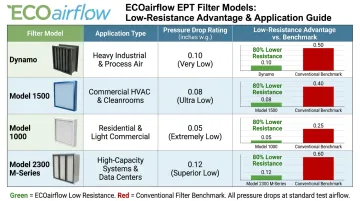
All residential models sit well below typical 1-inch pleated filter benchmarks at equivalent or higher filtration performance.
The commercial Model 2300 M-Series Hybrid carries one notable distinction: it's certified under ASHRAE 52.2 including Appendix J protocol, meaning performance is validated with power on, power off, and under real-world loading conditions using ASHRAE-certified test dust with a carbon component. Many electronic air cleaners are tested only unpowered or with non-carbon dust — which doesn't reflect environments with wildfire smoke or traffic-related pollution.
Every ECOairflow model operates on 2 watts or less, verified by ETL to UL2998 Zero Ozone standards — a requirement under ASHRAE 62.1-2019 Section 5.7.1 for air-cleaning devices.
How Pressure Drop Is Measured and Validated
Reading Filter Datasheets
Filter datasheets report initial pressure drop at a rated airflow (CFM) under ASHRAE 52.2 standardized conditions. When evaluating a spec sheet:
- Confirm the rated airflow matches your system's actual CFM — pressure drop scales with face velocity
- Check whether ratings reflect standard protocol or Appendix J (real-world conditioning with ASHRAE-certified test dust)
- Note whether the filter was tested powered or unpowered, and with what dust type — this affects whether MERV ratings translate to actual field performance
Field Measurement
In the field, a digital differential pressure manometer with static pressure taps placed upstream and downstream of the filter measures pressure drop directly. Device costs vary widely — from around $232 USD for a basic handheld unit (Dwyer 476A series) to $1,635 USD for professional-grade wireless instruments (Testo differential manometer). For most HVAC technicians, a mid-range handheld unit is sufficient.
Field readings will differ from datasheets because:
- Installed systems rarely operate at exactly rated airflow
- Ductwork leakage alters true face velocity at the filter
- NCI guidance suggests adding the manufacturer's rated clean filter pressure drop to the measured TESP if the filter location prevents a direct reading
Consequences of Excessive Pressure Drop
The damage from an over-restricted filter appears gradually, which is why it's so commonly misattributed.
Performance degradation:
- System runs longer cycles to maintain temperature setpoints
- Uneven conditioning across zones, particularly rooms far from the air handler
- Evaporator coil freeze-up in severe restriction cases
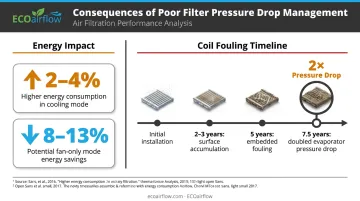
Energy impact: Research from Zaatari et al. (2014) found that replacing MERV 8 filters with MERV 13/14 filters produced 2–4% higher energy consumption during cooling mode but 8–13% savings during fan-only mode. The direction and magnitude of energy impact depends heavily on whether the system has variable-speed fan control. This is why managing pressure drop matters regardless of MERV rating choice.
Coil fouling from under-filtration: Low-MERV filters allow particulate to accumulate on evaporator coils. LBNL/ACEEE research on coil fouling found that deposition of indoor dust and particulate matter increases system pressure drop and reduces heat transfer efficiency. Their estimates suggest typical coils foul enough to double evaporator pressure drop in approximately 7.5 years — a permanent resistance source that filter changes alone cannot address.
Compliance implications: For facilities pursuing LEED credits or ASHRAE 90.1 compliance, uncontrolled filter pressure drop undermines energy benchmarking targets. Key compliance details to know:
- ASHRAE 90.1 addenda include a particulate filtration credit for MERV 16 and electronically enhanced filters
- The credit is calculated as two times the clean filter pressure drop at design conditions
- Facilities that fail to manage pressure drop risk missing compliance thresholds entirely
Common Misconceptions About Low Pressure Drop Filters
"A fiberglass filter is better for my system because the pressure drop is lower." The initial resistance is lower, but the inability to capture fine particles allows accumulation on coils and fan blades. That particulate builds a permanent pressure drop that no filter change removes — and it degrades heat transfer efficiency in ways that compound over years.
"All MERV 13 filters have the same pressure drop." The manufacturer benchmark data above shows this isn't true. Measured initial resistance varies widely across MERV 13 products:
- 1-inch Camfil AQ13: 0.45 in. w.g.
- 4-inch Aerostar GeoPleat: 0.22–0.48 in. w.g.
- ECOairflow EPT-based residential filter: below 0.20 in. w.c. at 300 fpm
MERV describes particle capture efficiency — it says nothing about resistance.
"Low pressure drop filters last longer between replacements." Every filter accumulates dust and approaches its final pressure drop limit over time. ECOairflow recommends pad replacement every 3 months under typical operating conditions, the same interval as conventional pleated filters. The difference is the initial resistance is lower throughout the service life — not that loading stops occurring.
Frequently Asked Questions
What is a low pressure drop filter?
A low pressure drop filter allows air to pass through with minimal resistance, measured in inches of water gauge. This can be achieved through larger media surface area, optimized pleat geometry, or electronic filtration technology that uses electrostatic attraction rather than dense mechanical interception.
Which is better, MERV 8, 11, or 13?
The right rating depends on your air quality needs and system static pressure capacity. MERV 8 suits basic dust protection; MERV 11 handles allergens; MERV 13 captures fine particles and bacteria carriers — but achieving it without excessive resistance requires a system built for higher static pressure, or an electronic polarization filter that hits MERV 13+ at a fraction of the pressure drop.
Are electronic low pressure drop filters worth it?
They make the most sense when your blower can't handle high static pressure, energy costs are a concern, or you need strong filtration without sacrificing airflow. Life cycle savings from reduced energy use and extended equipment life offset the higher upfront cost.
How do I know if my filter has too much pressure drop?
Watch for these warning signs: the system runs constantly without reaching setpoint, energy bills climb, distant rooms are poorly conditioned, or return vents whistle under suction. A manometer reading above roughly 0.3 in. w.g. across the filter alone warrants investigation.
Can a high-MERV filter have low pressure drop?
Yes — through two approaches. Increased media surface area (thicker, more deeply pleated filters) spreads resistance over a larger area. Electronic polarization works differently — it attracts particles electrostatically, so the media doesn't need to be dense to be effective. ECOairflow's EPT-based filters reach MERV 13–16 at pressure drops comparable to basic conventional filters.
How often should I service a low pressure drop air filter?
Mechanical low pressure drop filters follow standard MERV-based replacement schedules (generally 30–90 days). ECOairflow's electronic polarizing filters with replaceable pads are recommended for pad replacement every 3 months under typical operating conditions. Always monitor pressure drop when possible and follow manufacturer guidance — loading still occurs regardless of filter type.