The problem isn't just cosmetic. Pets continuously release microscopic allergens that standard filters weren't designed to handle at the volume or frequency pet households require. Run the wrong filter — or the right filter on the wrong schedule — and those allergens cycle back through your air supply repeatedly.
This guide covers the best HVAC filter types for pet owners, how MERV ratings map to pet-specific particles, key buying factors, and maintenance habits that actually make a difference.
Key Takeaways
- MERV 11 minimum for most homes with one or two pets; MERV 13 or electronic polarization filters for allergy sufferers or multi-pet households
- Replace 1-inch filters every 30–60 days — not the standard 90 days. Pet dander and hair load filters faster than most manufacturers assume.
- Filter fit matters as much as MERV rating — gaps around a loose filter let unfiltered air bypass the media entirely
- Electronic polarization filters capture particles down to 0.001 microns — far smaller than pet dander — while using as little as 2 watts of power
- Higher MERV ratings restrict airflow — electronic filters deliver superior particle capture without the pressure drop that strains your HVAC system
How Pets Strain Your HVAC Filter — and Why It Matters
What Pets Add to Your Air
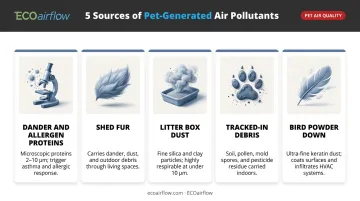
Pets introduce a continuous mix of particulates that standard household dust simply doesn't match in volume or variety:
- Dander and allergen proteins — Fel d 1 (cat) and Can f 1 (dog) span a wide range of particle sizes; the finest fraction stays airborne the longest and is hardest to capture
- Shed fur — Larger particles that load filter media quickly and visibly
- Litter box dust — Generates respirable particulate under 10 microns, according to OEHHA measurements of mineral-based cat litter
- Tracked-in debris — Outdoor pollutants, pollen, and soil particles brought in on paws
- Bird powder down — Extremely fine keratin dust from feather maintenance; one of the most challenging particulate sources for residential filters
All of that airborne material has to go somewhere — and your HVAC filter is the first thing it hits.
The Downstream Effect on Your HVAC System
A loaded filter creates a cascade of problems. Per ENERGY STAR's guidance, a dirty filter slows airflow and forces the system to work harder, raising energy consumption and accelerating equipment wear.
The efficiency hit is only part of the issue. Research shows that Can f 1 and Fel d 1 cling to small particles that easily stay airborne, and homes with forced-air heating showed significantly higher Can f 1 concentrations than those without.
Your HVAC system's recirculation cycle is the mechanism that either removes these allergens or spreads them further.
The fine fraction of Fel d 1 (particles under 4.8 microns) proved persistent in the Thorax study — roughly 49% of airborne Fel d 1 attaches to particles larger than 9 microns, while about 23% rides on particles under 4.7 microns. That smaller fraction remained largely unchanged for four days after cat removal before finally dropping to 33% of baseline by day 14. Without adequate filtration, those particles keep circulating.
Best HVAC Air Filters for Homes with Pets
Four filter types stand out for pet owners: MERV 11 and MERV 13 pleated filters for solid baseline performance, electronic polarization filters for ultrafine particle capture, and activated carbon layers for odor control. Each fills a different role — and the right choice depends on your household's pet count, allergy load, and HVAC system.
MERV 11 Pleated Filters
MERV 11 is the widely recommended baseline for homes with one or two pets. Densely folded filter media at this rating captures:
- ≥85% of particles in the 3–10 micron range (where most pet dander sits)
- ≥65% of particles in the 1–3 micron range — a band that standard MERV 8 filters largely miss
The American College of Allergy, Asthma & Immunology recommends disposable filters in the MERV 11–13 range for capturing pollen, mold, and pet allergens, specifically noting they don't impede airflow at this level.
That balance is the key advantage: MERV 11 delivers meaningfully better allergen capture than MERV 8 without the pressure drop concerns of higher ratings, making it compatible with virtually all standard residential systems.
| Attribute | Detail |
|---|---|
| MERV Rating | MERV 11 (ASHRAE 52.2 scale) |
| Best For | Single or two-pet households without severe allergy concerns |
| Filter Life (with pets) | 30–60 days for 1-inch filters; up to 6 months for 4–5-inch media filters |
MERV 13 High-Efficiency Pleated Filters
For households with multiple pets, heavy shedders (German Shepherds, Huskies, Persian cats), or any resident with diagnosed pet allergies, MERV 13 is the recommended upgrade. At this rating:
- ≥90% of particles in the 3–10 micron range are captured
- ≥85% of particles in the 1–3 micron range
- ≥50% of particles as small as 0.3–1 micron — the fine dander fragments that carry the most allergenic proteins
EPA guidance recommends at least MERV 13 for residential upgrades, noting that most HVAC systems can accommodate it without equipment issues if filters are replaced frequently. That last point matters: denser media means higher resistance, so confirm your system's blower capacity before upgrading, or consult your HVAC contractor.
| Attribute | Detail |
|---|---|
| MERV Rating | MERV 13 (ASHRAE 52.2 scale) |
| Best For | Multi-pet homes, allergy sufferers, households with heavy-shedding breeds |
| Filter Life (with pets) | 30–45 days for 1-inch; up to 4–6 months for thicker media formats |
Electronic Polarization Air Filters
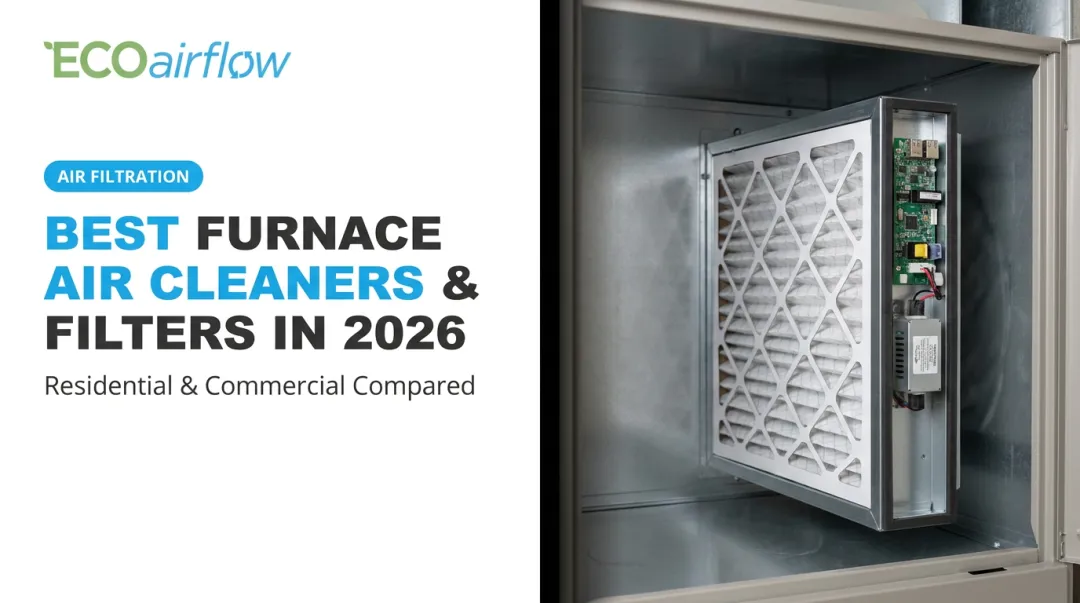
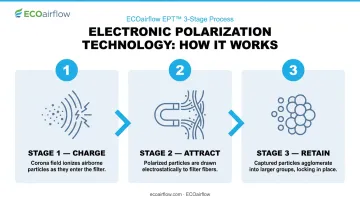
Electronic polarization filters work fundamentally differently from passive media filters. Instead of relying on filter density alone, they use a low-powered electric field — generated by a corona field using high-voltage, low-amperage electronics — to actively attract and capture particles.
ECOairflow's Electronic Polarization Technology (EPT) works in three stages:
- Charge — The corona field polarizes particles passing through the filter
- Attract — Charged particles are drawn to collector pad fibers like a magnet, rather than simply colliding with media at random
- Retain — Captured particles also attract other particles through agglomeration, forming larger clusters that are more easily held
Third-party testing across ECOairflow's Dynamo and Model 1000 residential lines confirms capture down to 0.001 microns — well below the threshold where even MERV 13 pleated filters lose effectiveness. For pet owners, that sub-micron reach is where it gets practical:
- Low pressure drop (0.11–0.18 in.w.c. at 300 fpm) means the blower works less hard than with high-density pleated media
- Power consumption is 2 watts or less across all residential models — negligible operating cost
- The low pressure drop design can reduce heating and cooling costs by up to 15%
- All models are ETL-listed and UL2998 Zero Ozone Verified — a critical distinction from ionizers or ozone generators, which can harm pets at concentrations lower than those affecting humans
ECOairflow's residential units — the Dynamo, Model 1000, and Model 1500 — are available in all standard HVAC sizes and custom dimensions, with replacement pads sold directly through their website.
| Attribute | Detail |
|---|---|
| Technology | Patented Electronic Polarization Technology (EPT); MERV 11–13 certified (ASHRAE 52.2) |
| Certifications | ETL Listed (Intertek); UL2998 Zero Ozone Verified; Appendix J protocol certified |
| Key Advantage for Pet Owners | Captures ultrafine dander particles; low pressure drop protects HVAC efficiency; zero ozone safe for pets |
Activated Carbon Filters
Activated carbon addresses pet odors, not dander or allergens. The carbon layer absorbs and traps volatile organic compounds (VOCs) and odor-causing particles — a gap that pleated and electronic filters alone don't fill.
Standard MERV-rated filters are tested only for particulate capture. ASHRAE 52.2 explicitly does not address gaseous contaminants, so no MERV rating carries an odor-control implication.
Use activated carbon as an add-on layer, combined with a higher-MERV pleated filter, or select a MERV-rated + carbon hybrid product. Not a standalone pet filtration solution.
Key Factors to Consider When Choosing a Pet-Friendly HVAC Filter
MERV Rating Matched to Your Household
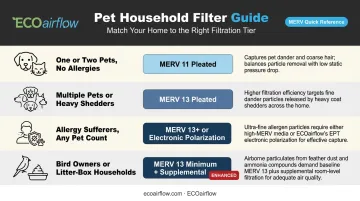
| Household Type | Recommended Starting Point |
|---|---|
| One or two pets, no allergies | MERV 11 pleated |
| Multiple pets or heavy shedders | MERV 13 pleated |
| Allergy sufferers, any pet count | MERV 13+ or electronic polarization |
| Bird owners or litter-box households | MERV 13 minimum; consider supplemental filtration |
Going higher than your system can handle (dense MERV 16 pleated in an incompatible blower) reduces efficiency and may shorten equipment life. ECOairflow's electronic polarization filters use an electrostatic charge to attract and trap particles without restricting airflow — delivering MERV 13–16 equivalent performance at a pressure drop as low as 0.09 inches w.c., well within what most residential blowers handle comfortably.
Filter Size and Fit
A filter that fits loosely renders its MERV rating irrelevant. Unfiltered air bypasses the media along the edges — even a 1/8-inch gap can allow a significant share of airborne particles to pass around the filter entirely rather than through it.
- Measure both nominal and actual dimensions before ordering
- Nominal sizing (e.g., 16×20×1) is always rounded — actual dimensions are slightly smaller
- ECOairflow's residential models are available in custom sizes for non-standard compartments; contact their team at 1-877-347-3569 or customerservice@ecoairflow.com for sizing assistance
Replacement Frequency for Pet Owners
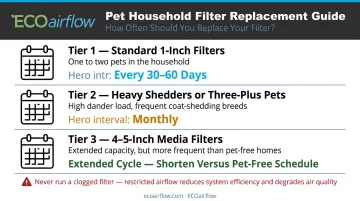
Standard 90-day guidance doesn't apply here. The realistic schedule:
- 1-inch filters: Every 30–60 days in pet households
- Three or more pets or heavy shedders: Monthly replacement is standard
- 4–5-inch media filters: Extended life due to greater surface area, but still need more frequent attention than in pet-free homes
- Keep a supply on hand — running a clogged filter while waiting on a delivery is a common, avoidable problem
Safety for Pets
Some air filtration products — particularly ionizers and ozone generators marketed as air purifiers — produce ozone as a byproduct. Pets' smaller respiratory systems are sensitive at lower concentrations than humans, and the California Air Resources Board advises against ozone generators in any occupied space.
When evaluating a powered filtration product, check for these safety indicators:
- UL2998 Zero Ozone Verification — confirms ozone output stays below 5 ppb (one-tenth of the UL867 threshold)
- No ionizer or ozone-generating components — some products combine filtration with ionization; verify the technology type
- ETL or UL listing — independent safety certification for the electrical components
ECOairflow's residential line carries UL2998 verification, making it a safe option for households with pets.
Filter Maintenance Tips for Pet Owners
Replace on a Pet-Owner Schedule
For 1-inch filters, plan on every 30–60 days. For three or more pets or heavy-shedding breeds, treat monthly replacement as the default. Keep spares on hand — a missed delivery shouldn't mean weeks on a clogged filter.
Make the Most of Every HVAC Cycle
EPA data shows HVAC systems run less than 25% of the time during heating and cooling seasons. That means every cycle your system does run needs to count. A high-performing HVAC filter — one rated to capture fine particles like dander and pet hair — does the heavy lifting in those windows. Choosing a filter with low pressure drop (like ECOairflow's electronic models) also means your system runs more efficiently, so you're not paying extra to move air through a restrictive media.
Reduce Upstream Filter Load
No filter outperforms good habits upstream:
- Groom pets regularly to reduce airborne dander at the source
- Vacuum frequently to pull surface-deposited hair before it re-enters the air
- Wipe paws after outdoor time to limit tracked-in debris and pollutants
These habits extend filter life and reduce the particle load your HVAC system has to handle — a straightforward way to get more out of every filter.
Conclusion
Choosing the right HVAC filter for a home with pets isn't a one-variable decision. MERV rating matters, but so does filter size, replacement frequency, system compatibility, and whether the technology you're using is actually suited to the particle sizes your pets generate.
The full cost of ownership goes well beyond the per-filter price. Before committing to any filter type, weigh:
- Replacement frequency — how often you're buying and swapping filters
- Energy impact — a clogged or overly restrictive filter strains your system
- Long-term blower wear — high static pressure shortens equipment life
Electronic polarization filters cost more upfront but last longer and can reduce HVAC operating costs by up to 15%. Over time, that total often comes out lower than budget pleated filters replaced every five weeks.
If you're unsure whether ECOairflow's Electronic Polarization Technology is the right fit for your specific HVAC system and household, Jeff Chesebrough, President of ECOairflow, welcomes direct conversations with homeowners. Reach out at jeff@ecoairflow.com, call 1-877-347-3569, or email customerservice@ecoairflow.com.
Frequently Asked Questions
What is the best HVAC filter for a house with pets?
MERV 11 pleated filters are the recommended baseline for single or two-pet households, while MERV 13 or electronic polarization filters (rated MERV 11–13) suit multi-pet homes and allergy sufferers better. Regardless of rating, proper fit and a consistent replacement schedule are equally important — a perfectly rated filter that fits loosely or runs past its service life won't protect your air.
What MERV rating do I need with pets?
MERV 8 misses fine dander in the 1–3 micron range, making MERV 11 the recommended minimum — it captures at least 85% of particles in the 3–10 micron range. MERV 13 is the better choice where allergies are a concern, adding meaningful capture of finer allergen-carrying particles. Electronic polarization filters can match that performance with a lower pressure drop than dense pleated media.
How often should I change my HVAC filter if I have pets?
The standard 90-day guideline doesn't apply. Plan for every 30–60 days with 1-inch filters, and monthly for households with three or more pets or heavy-shedding breeds. Thicker 4–5-inch media filters last longer due to greater surface area but still need more frequent changes than in pet-free homes.
Can HVAC filters help reduce pet odors?
Standard MERV-rated pleated filters capture dander and allergens but don't neutralize odors — ASHRAE 52.2 ratings cover particulate only, not gaseous contaminants. For odor control, look for filters with an activated carbon layer, which absorbs and traps odor-causing volatile compounds.
Are washable or electrostatic filters a good choice for pet owners?
Reusable electrostatic filters typically carry lower effective MERV ratings, and removing pet fur from their media is a real challenge. For most pet owners, a quality disposable pleated filter at MERV 11–13 or a powered electronic filter delivers more consistent allergen capture.
Will a higher MERV filter damage my HVAC system?
Very dense media (MERV 14+ pleated) can restrict airflow in systems not rated for it, causing blower strain and potentially shortening equipment life. Confirm your system's filter specifications before upgrading. Electronic polarization filters like ECOairflow's achieve high MERV-equivalent performance with a low pressure drop by design, which resolves this trade-off for compatible systems.