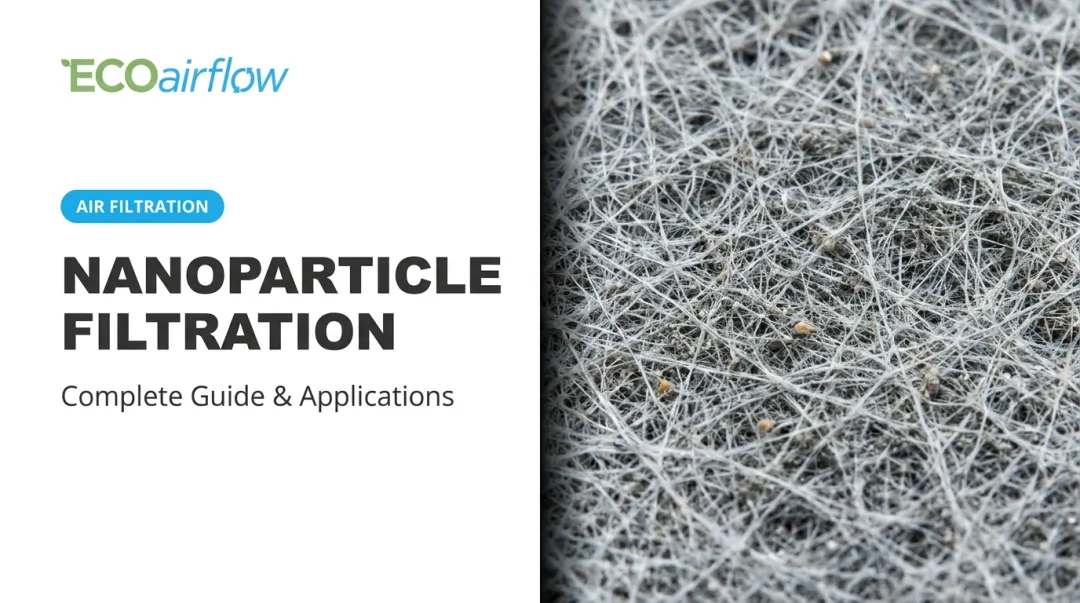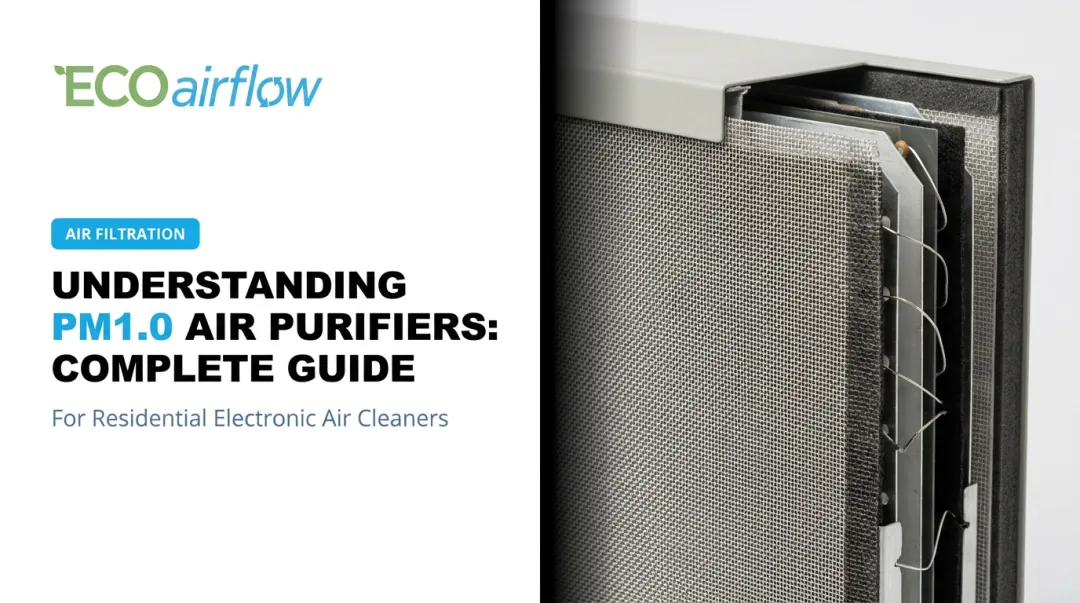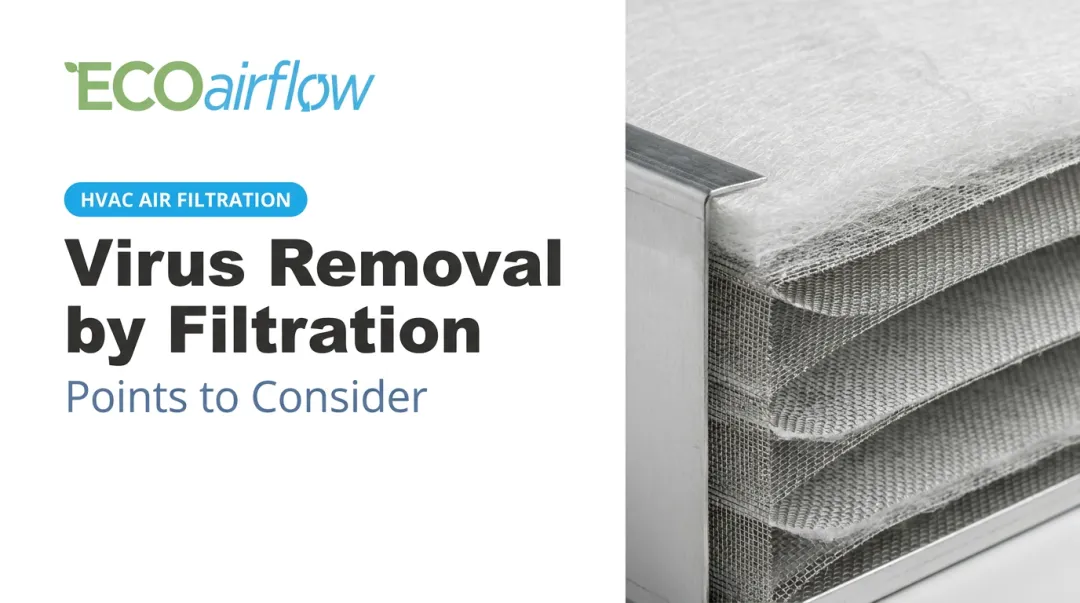
These are ultrafine particles (UFPs). Unlike PM2.5, which has regulated limits under EPA and WHO guidelines, UFPs occupy a largely unmonitored category. They're invisible to most air quality sensors, absent from regulatory standards, and routinely missed by filters that carry "high efficiency" labels.
This article covers what UFPs actually are, where they come from, why they pose a distinct biological threat, where conventional filtration breaks down, and what technologies are actually engineered to address particles at this scale.
Key Takeaways
- UFPs are particles ≤0.1 microns (100 nanometres) — far smaller than PM2.5 — and they dominate air by particle count, not mass
- Sources include vehicle exhaust, cooking, laser printers, candles, and wildfire smoke infiltrating buildings
- Their nanoscale size lets them bypass the lungs' natural defences and potentially enter the bloodstream
- Standard MERV ratings cover particles down to 0.3 microns — UFPs fall entirely outside that tested range
- Electronic polarization technology (EPT) captures particles through electrostatic attraction, reaching particles as small as 0.001 microns — far beyond what mechanical filters can address
What Are Ultrafine Particles?
UFPs are aerosols with an aerodynamic diameter of 0.1 microns (100 nanometres) or less. For context: a human hair averages roughly 70,000 nm wide, making UFPs about 700 times smaller than a single strand.
The Particle Size Hierarchy
Most people have heard of PM2.5. Fewer know where it sits in the full classification:
| Category | Size | Regulatory Status |
|---|---|---|
| Coarse particles (PM10) | ≤10 microns | EPA standard: 150 µg/m³ (24-hr) |
| Fine particles (PM2.5) | ≤2.5 microns | EPA standard: 35 µg/m³ (24-hr) |
| Ultrafine particles (PM0.1/UFP) | ≤0.1 microns | No EPA or WHO numerical limit |
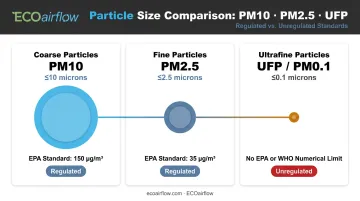
The EPA's current NAAQS table lists PM2.5 and PM10 standards. UFPs have no equivalent numerical guideline — WHO's 2021 air quality update offers only good-practice statements, not enforceable limits.
How UFPs Are Measured — and Why That Creates a Blind Spot
Because their mass is negligible, UFPs cannot be meaningfully captured on standard mass-based measurement equipment. Instead, they're quantified by particle number concentration (particles per cm³) using condensation particle counters. This measurement gap is part of why UFPs remain outside regulatory frameworks — the monitoring infrastructure simply wasn't built for them.
What UFPs Are Made Of
UFPs aren't a single substance. Depending on their source, they may carry:
- Black carbon (soot)
- Polycyclic aromatic hydrocarbons (PAHs), some carcinogenic
- Heavy metals
- Sulfates
- Reactive oxygen species
Their high surface area-to-mass ratio lets them adsorb a disproportionate load of these toxic compounds compared to larger particles of equivalent mass. Those compounds — carcinogens, heavy metals, reactive oxygen species — are what make UFPs disproportionately dangerous relative to their tiny size.
How UFPs form shapes where they come from — and where they end up. Primary UFPs are emitted directly from combustion as solid or liquid particles. Secondary UFPs start as gases or vapours and nucleate into particles after emission, which is why they're frequently absent from standard emission inventories despite being equally hazardous.
Common Sources of UFPs Indoors and Outdoors
Outdoor Sources
Road traffic — particularly diesel engines — is consistently the dominant source of UFP number concentrations in urban air. The numbers from HEI monitoring are striking:
- 10,760 particles/cm³ — average urban background
- 48,180 particles/cm³ — at roadsides
- 167,700 particles/cm³ — inside traffic tunnels
UFP concentrations drop sharply with distance from roads, which makes proximity to high-traffic corridors a primary exposure risk factor. Coal combustion, industrial processing, biomass burning, and gas-to-particle conversion of VOCs also contribute.
Modern diesel emission controls — particulate filters, oxidation catalysts — have reduced total PM mass from vehicles. Research suggests, however, that certain configurations can shift the particle size distribution toward smaller, potentially more reactive UFPs.
Wildfire smoke adds a separate concern for North American residents. Wildfire activity has expanded geographically and intensified seasonally, carrying black carbon and toxic organic compounds hundreds of miles from the fire source. Buildings across a much wider region now face seasonal UFP infiltration from wildfire smoke than in previous decades.
Indoor Sources
Outdoor UFPs don't stay outside. The EPA estimates Americans spend approximately 90% of their time indoors — so the sources generating particles inside your home or building shape most of your actual daily dose.
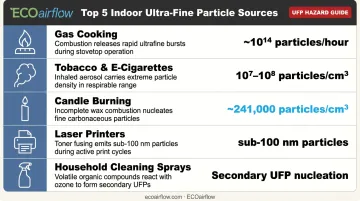
Key indoor sources include:
- Gas cooking (frying, grilling): Peak emissions around 10¹⁴ particles/hour in high-particle cooking events, with particle size peaks near 0.06 and 0.01 microns
- Tobacco and e-cigarette aerosols: E-cigarette measurements reached particle number concentrations of 10⁷–10⁸ particles/cm³; one cigarette produced 1.1–1.5 × 10⁵ particles/cm³ in indoor studies
- Candle burning: Chamber tests recorded approximately 241,000 particles/cm³ from pure wax candle combustion
- Laser printers: Fuser units emit UFPs under 100 nm during operation — even without paper or toner
- Household cleaning sprays: VOC-containing aerosols that can nucleate into secondary UFPs
Outdoor UFPs also infiltrate indoor spaces through ventilation gaps and HVAC air handling. A building near a freeway with no internal combustion sources can still have elevated UFP concentrations driven entirely by outdoor infiltration.
Why UFPs Are a Unique Health Threat
Deep Deposition and Translocation
Larger particles get trapped in the nose and upper airways — the body's natural filtering system. UFPs bypass that. Their nanoscale size allows them to travel through the respiratory tract and deposit efficiently in the alveoli, the deepest lung regions where gas exchange occurs.
From there, research indicates a fraction of UFPs can cross the alveolar-capillary barrier and enter the bloodstream — a process called translocation. Once in circulation, they may distribute to the cardiovascular system and organs including the liver and brain.
This should be understood as mechanistic and experimental evidence, not confirmed population-level causation, but the biological plausibility is well-established.
Surface Area and Toxic Load
For a given particle mass, UFPs have far more surface area than larger particles. That surface area carries proportionally more adsorbed toxic compounds — heavy metals, PAHs, reactive oxygen species — directly into the body. This explains why health effects attributed to "fine particulate matter" may be driven specifically by the UFP fraction, even when UFPs represent a tiny share of total particle mass.
Documented Health Associations
Current research links UFP exposure to several outcomes (associations under active investigation, not confirmed causal relationships):
- Cardiovascular: Oxidative stress pathways, endothelial dysfunction, blood pressure changes
- Respiratory: Lung inflammation, worsening of asthma symptoms
- Neurological: Associations between UFP exposure and neuroinflammation have been documented in research literature
- Prenatal/child development: A Northeastern US cohort study found prenatal UFP exposure was associated with increased childhood asthma risk, independent of correlated NO₂ levels
Who Faces Elevated Risk
- People who live or commute near high-traffic roads
- Workers in occupational settings: mechanics, tunnel workers, welders, commercial kitchen staff
- Office workers with laser printers in poorly ventilated spaces
- Children, the elderly, and those with pre-existing cardiovascular or respiratory conditions
The regulatory gap makes this worse: spaces that technically pass PM2.5 compliance tests can have high UFP concentrations that go entirely undetected.
Why Most Standard Filters Struggle with UFPs
The Mechanical Filtration Paradox
Standard mechanical filters capture particles through three mechanisms:
- Inertial impaction — large particles hit fibres and stick
- Interception — mid-size particles make contact with fibres as they follow airflow
- Brownian diffusion — small particles move randomly and collide with fibres
This is where mechanical filtration hits a structural limit. The Most Penetrating Particle Size (MPPS) for mechanical filters sits around 0.1–0.3 microns — exactly the upper boundary of the UFP range. Particles smaller than this move so erratically under Brownian motion that capture efficiency at the deepest ultrafine sizes becomes inconsistent.
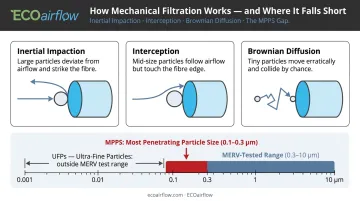
MERV ratings don't cover this range at all. The ASHRAE 52.2 test protocol covers particles from 0.3 to 10 microns. A MERV 13 filter is rated for ≥50% efficiency at 0.3–1.0 microns — it carries no certification for particles in the 0.01–0.1 micron range.
The HEPA Clarification
HEPA is rated at 99.97% efficiency at 0.3 microns — which is the MPPS, meaning it's the hardest size for HEPA to capture. Particles smaller than 0.3 microns can actually be captured at higher efficiency through diffusion, but this only applies within HEPA's tested range.
Sub-0.1 micron performance hasn't been specifically tested or certified under HEPA standards. A portable air purifier labelled "HEPA" is not the same as a system specifically engineered and verified for sub-0.1 micron capture.
The Pressure Drop Trade-Off
These particle-size limitations aren't the only constraint. Denser mechanical filters (higher MERV ratings) reduce particle penetration but also increase airflow resistance. ASHRAE notes that upgrading to a higher-MERV mechanical filter requires confirming the system can handle the additional pressure drop.
Higher resistance means the HVAC system works harder — increasing energy consumption, accelerating mechanical wear, and shortening equipment life. For buildings trying to address UFPs, this trade-off points toward filtration approaches that don't rely on mechanical density alone.
How to Filter Ultrafine Particles Effectively
Electronic Polarization Technology
Electronic polarization takes a fundamentally different approach. Instead of relying on physical barriers, it applies an electrostatic charge to particles in the airstream. Charged particles are actively attracted to collector surfaces — the process is similar in principle to magnetism.
Because capture doesn't depend on particle size the way mechanical sieving does, this mechanism remains effective well into the ultrafine range. ECOairflow's patented Electronic Polarization Technology (EPT) works by creating an electronic corona field that alters particle polarity, causing them to seek out and adhere to collector pad fibres rather than pass through gaps in the media.
This agglomeration effect adds another layer: charged particles attract other particles, forming larger clusters that are more easily captured on subsequent air passes.
ECOairflow's EPT-based filters are engineered to capture particles as small as 0.001 microns — independent certified lab testing has shown performance up to 45 times more effective than the best non-powered filters in the 0.001–0.010 micron range.
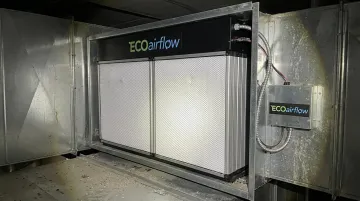
Commercial models (the Dynamo™ 2" and M-Series™ 2") carry MERV 13–16 certification under ASHRAE 52.2 and hold UL2998 Zero Ozone Verification — confirming ozone output below 0.005 ppm, one-tenth of the UL 867 threshold.
Practical Strategy for Buildings and Homes
Choosing the right filter technology is only part of the equation. Effective UFP control also depends on how that technology is deployed throughout the space — a layered approach covers the gaps no single filter can address on its own:
- Whole-building filtration: Integrate an electronic air filtration system into the HVAC for continuous coverage across all supply air
- Source control: Ventilate when cooking, especially when frying; avoid candles and incense in poorly ventilated rooms
- Outdoor infiltration: Buildings near high-traffic roads or in wildfire-prone regions should prioritise building-integrated filtration that treats all incoming air
For commercial environments — hospitals, airports, casinos — where UFP loads from occupants, cooking, and outdoor infiltration are high, electronic air filtration systems offer a scalable solution with a critical practical advantage over high-density mechanical filters: low pressure drop. ECOairflow's commercial models operate at 0.09–0.38 in. w.c. depending on configuration, and consume 2 watts of power — meaning superior filtration without the HVAC load penalty that high-MERV mechanical filters impose.
Informed Buyer's Checklist for UFP Filtration
When evaluating any filter for ultrafine particle performance, verify:
- MERV rating uses ASHRAE-certified test dust with a carbon component — not alternate dust types without carbon
- Testing conducted under power-on, power-off, and Appendix J protocol conditions — filters that only pass when unpowered don't reflect real-world performance
- Third-party certification from a recognised lab (not manufacturer self-reporting)
- UL2998 Zero Ozone Verification for any electronic or ionisation-based system
- Stated particle capture size below 0.1 microns — not just a MERV 13 label, which covers 0.3 microns and up
Frequently Asked Questions
What is the best filter for ultrafine particles?
Mechanical filters, including standard HEPA, are not tested or rated for sub-0.1 micron performance. Electronic polarisation technology (which captures particles through electrostatic attraction rather than physical sieving) is specifically engineered for this range. Look for third-party certified MERV ratings tested with carbon-component dust, Appendix J protocol results, and UL2998 zero-ozone compliance.
Are ultrafine particles more dangerous than PM2.5?
UFPs are a distinct and measurably more biologically aggressive category. While PM2.5 carries significant health risk, UFPs penetrate deeper into the lungs, enter the bloodstream, and carry a higher toxic chemical load per unit mass due to their larger surface area — effects that research increasingly links to the UFP fraction specifically.
Can HEPA filters capture ultrafine particles?
Standard HEPA filters are rated at 99.97% efficiency at 0.3 microns, the most penetrating particle size for mechanical filtration. UFPs smaller than 0.1 microns fall outside this certification scope entirely. Capturing them requires filtration technology specifically designed and tested at sub-0.1 micron scales.
What are the main indoor sources of ultrafine particles?
The main sources include gas cooking, tobacco and e-cigarette aerosols, laser printers, candles and incense, and outdoor UFPs entering through ventilation. Gas cooking ranks among the highest — frying alone can produce around 10¹⁴ particles per hour.
Is there a regulatory limit for ultrafine particles in indoor air?
No. Neither the EPA nor the WHO has established specific numerical limits for UFPs (PM0.1) in indoor or outdoor air — guidelines cover PM10 and PM2.5 only. This means individuals and building operators need to address UFP exposure proactively, rather than relying on air quality compliance readings.
How do I know if ultrafine particles are a problem in my home or building?
UFPs are invisible and have negligible mass, so standard indoor air quality monitors measuring PM2.5 will not detect them. Proximity to high-traffic roads, gas cooking, laser printers, or any combustion source indoors is a strong indicator of elevated UFP exposure — even when your PM2.5 readings look fine.