
This leads to a critical knowledge gap. Most building operators and homeowners don't know what to look for in a virus-removing air filter. Confusing MERV ratings, different filtration mechanisms, and a sea of certifications often lead to inaction or poor choices, leaving occupants vulnerable.
This guide cuts through the noise. We’ll walk through the key points to consider when evaluating air filters for virus removal, covering the science behind particle capture, essential selection criteria, and maintenance must-dos. By the end, you'll have the information needed to make an informed decision for your building or home.
TLDR: Key Takeaways
- Viruses travel on tiny aerosol particles; filters rated MERV 13 or higher are the minimum for meaningful virus-scale particle capture.
- The filtration mechanism is crucial. Advanced electronic polarization can capture ultrafine particles far more efficiently than standard mechanical filters.
- Look beyond MERV to certified capture range, pressure drop, and application-specific needs (residential, commercial, or healthcare).
- Proper installation and maintenance are non-negotiable. Even the best filter fails if air bypasses it or it isn’t replaced on schedule.
- Certifications like ASHRAE 52.2, ETL, and Appendix J testing are the clearest indicators that a filter performs as claimed.
What Is Virus Removal by Air Filtration?
In the context of indoor air quality (IAQ), virus removal by air filtration is the process of capturing virus-carrying airborne particles as they pass through a filter in a building’s HVAC system. This is different from the highly specialized filtration used in pharmaceutical bioprocessing.
Viruses don't typically travel through the air alone. Instead, they attach to respiratory aerosols and droplets produced when we breathe, talk, or cough. According to ASHRAE, the professional society for heating and air-conditioning engineers, exposure to these infectious aerosols is a dominant factor in the transmission of respiratory infections indoors.
These carrier particles range from 0.1 to 10 microns—a size that standard, low-efficiency HVAC filters (MERV 8 and below) simply aren't designed to catch.
Those basic filters are made to protect expensive HVAC equipment from large dust particles, not to protect people from airborne pathogens. For any serious virus removal strategy, you need a filter built for the job.
How Air Filters Capture Airborne Viruses: The Science
Understanding how different filters work is the first step to choosing the right one. The capture method directly impacts a filter's effectiveness against the smallest particles, which carry viruses.
Mechanical Filtration
Traditional pleated filters rely on mechanical capture, using a dense web of fibers to physically intercept particles in three ways:
- Impaction: Large particles are too heavy to follow the air's path and slam directly into a fiber.
- Interception: Mid-sized particles follow the airflow but are caught as they brush against a fiber.
- Diffusion: The smallest particles move erratically (Brownian motion) and eventually collide with a fiber.
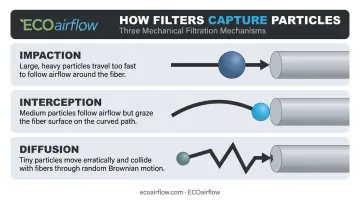
The effectiveness of mechanical filters depends on fiber density. To catch smaller particles, the fiber web must be tighter, which also leads to higher airflow resistance, or pressure drop.
Electronic and Electrostatic Filtration
Instead of just physically blocking particles, electronic filters use an electric charge to attract and hold them. This allows them to capture incredibly small particles without creating the airflow resistance of a dense mechanical filter.
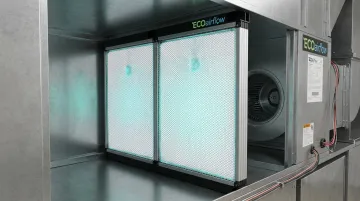
A key innovation in this area is Electronic Polarization Technology (EPT). Systems like those from ECOairflow use a powered, charged media to create an electric field. As particles pass through, they become polarized and stick to the filter's collector pads. This method is exceptionally effective for ultrafine particles—those smaller than 0.1 microns.
Independent lab tests confirm this technology can capture particles as small as 0.001 microns. This range includes viruses, as well as bacteria, radon decay products, and dangerous wildfire smoke particles. In fact, ECOairflow’s technology captures 74.73% of these PM0.1 particles, outperforming even HEPA filters in this critical size range.
This highlights the central trade-off: higher-efficiency mechanical filters increase capture rates at the cost of high pressure drop, which strains HVAC systems and increases energy costs. Active electronic systems can achieve superior capture efficiency with significantly lower pressure drop.
Key Considerations When Selecting a Virus-Removing Air Filter
Once you understand the science, you can evaluate filters based on a few critical benchmarks. Look for verified performance data, not just marketing claims.
MERV Rating
The Minimum Efficiency Reporting Value, or MERV, is a standard ASHRAE rating that measures a filter's effectiveness at capturing particles across different size ranges. For meaningful capture of virus-carrying aerosols, MERV 13 is widely considered the minimum, with MERV 14 or higher being preferred. A MERV 8 filter has no requirement to capture particles in the 0.3-1.0 micron range, while a MERV 13 filter must capture at least 50% of them.
Particle Size Capture and Test Method
Don't stop at the MERV number. Investigate the specific particle sizes a filter is certified to capture and, just as importantly, how it was tested.
Some manufacturers use test dust that lacks a carbon component, which can overstate performance. Because real-world air contains carbon from smoke and pollution, a true MERV certification requires testing with ASHRAE-certified dust that includes carbon.
Certifications
Independent, third-party certifications are your best guarantee of performance and safety. Look for these marks:
- ASHRAE 52.2: Confirms the MERV rating was determined using the industry-standard testing protocol.
- ETL Listed: An independent mark from Intertek verifying the product meets safety standards.
- UL 2998 Zero Ozone: Critical for electronic filters, this certification validates that the device produces no harmful ozone.
- Appendix J Protocol: This optional ASHRAE test shows how a filter performs under real-world conditions, including when unpowered.
Finding a filter that carries all these certifications is rare, but it signifies a top-tier product.
For example, ECOairflow's M-Series Hybrid electronic air filters meet these strict standards, making them a verifiably safe and effective choice for hospitals, schools, and homes.
Pressure Drop and HVAC Compatibility
High-efficiency mechanical filters can choke your HVAC system, forcing it to work harder and increasing energy bills. This resistance, known as pressure drop, can also reduce the total volume of air being cleaned.
A lower pressure drop saves money and ensures your system can move enough air to effectively reduce viral load. In a 12-week study, an ECOairflow system demonstrated a 54% reduction in fan power consumption compared to a typical hospital-grade MERV 8 + MERV 14 filter setup. This highlights the massive energy savings possible with advanced electronic filtration.
Filter Performance Factors That Affect Virus Removal
Even the highest-rated filter won't perform well if it's installed or maintained improperly. Several real-world factors can undermine your efforts to clean the air.
- Improper Airflow: Air moving too quickly through a filter (high face velocity) prevents the media from having enough time to capture particles. Every filter has an optimal speed range for effective capture.
- Excessive Filter Loading: As a filter clogs with dirt, its resistance to airflow (pressure drop) increases. An overloaded filter captures fewer new particles and may even release those already trapped.
- Bypass Leakage: Air leaking through gaps around the filter frame is not being cleaned. This common issue undermines performance, making a proper seal absolutely essential.
- Harsh Environmental Conditions: High humidity or heavy dust loads can negatively impact a filter's performance and lifespan. Using a pre-filter can help in these demanding environments.
Implementation and Maintenance Considerations
A successful virus removal strategy doesn't end with purchasing a filter. Proper implementation and a consistent maintenance schedule are required to protect building occupants over the long term.
Installation and System Integration
Before you even turn the system on, verify that the filter is properly seated and sealed within its housing. There should be no visible gaps that would allow for air bypass. Taking a baseline pressure drop reading right after installation gives you a valuable reference point for monitoring the filter's condition over time.
Maintenance Schedules
Filter maintenance is not optional. A clogged or forgotten filter quickly becomes ineffective, compromising air quality. Follow the manufacturer's recommended replacement schedule, which depends on factors like runtime and local air quality.
Some electronic filters, like those from ECOairflow, use a permanent frame with easy-to-replace pad sets. These often have a longer service life than traditional pleated filters, reducing both maintenance time and total cost of ownership.
Balancing Protection and Performance
Finally, effective virus protection must also consider the health of your HVAC system. The key is to select a high-efficiency filter with a low pressure drop. This approach removes pathogens from the air without placing unnecessary stress on your heating and cooling equipment.
Frequently Asked Questions
Optimize Air Quality with Advanced Virus Filtration Solutions
Request a quote and our experts will contact you within 24 hours with tailored solutions and pricing.
For immediate assistance, feel free to give us a direct call at 971-552116781. You can also send us a quick email at customerservice@ecoairflow.com.
For immediate assistance, feel free to give us a direct call at 971-552116781. You can also send us a quick email at customerservice@ecoairflow.com.