Introduction
A filter rated to 0.3 microns actually captures nanoparticles better than it captures that benchmark size. The physics of ultrafine particle filtration run counter to intuition — below a certain threshold, smaller particles become easier to catch, not harder.
Nanoparticles (1–100 nm) are invisible on most filter specification sheets because standard MERV testing begins at 300 nm. Yet these particles carry some of the most serious indoor air quality risks: they can reach the alveoli and enter the bloodstream in ways larger particles simply cannot.
This guide covers the science behind nanoparticle capture, the main filtration methods across air and water, key industry applications, and how to choose the right approach for your situation.
Key Takeaways
- Nanoparticles (1–100 nm) come from combustion, manufacturing, and natural sources — and pose serious health risks by bypassing upper-respiratory defenses
- Filters capture nanoparticles via Brownian diffusion, making them easier to trap than mid-range particles as size drops below ~0.1 microns
- 0.3 microns is the hardest particle size to capture (MPPS) — nanoparticles fall outside this worst-case zone
- For air, HEPA/MERV fiber filters capture nanoparticles effectively; electronic polarization systems extend that capture down to 0.001 microns
- For water, ultrafiltration membranes and reverse osmosis are the primary removal methods
What Are Nanoparticles and Why Does Filtration Matter?
Nanoparticles are particles ranging from 1 to 100 nanometres (0.001–0.1 microns) — smaller than most bacteria and many viruses. ISO/TR 18401:2017 defines this nanoscale range for nanotechnology terminology, and researchers studying ultrafine particles typically use 100 nm or less as the aerodynamic diameter threshold.
Where Do Nanoparticles Come From?
Sources split into two categories:
Natural sources:
- Wildfire and wood combustion smoke
- Volcanic ash and emissions
- Sea spray (though concentration varies by location)
Anthropogenic sources:
- Vehicle exhaust and non-exhaust traffic emissions (tyre and brake wear)
- Industrial manufacturing and factory emissions
- Engineered nanomaterials: carbon nanotubes, silver nanoparticles, titanium dioxide
- Consumer products including certain cosmetics and sunscreens
Why the Health Risk Is Different at the Nanoscale
Size determines where particles deposit in the respiratory tract. According to research on ultrafine particle health effects, nanoparticles bypass primary airway defences and reach the distal lung, including the alveoli.
The EPA notes that a small fraction of insoluble ultrafine particles can translocate from the alveolar region directly into the bloodstream in less than one hour, contributing to cardiovascular effects including heart attacks, heart failure, and stroke.
This isn't just an outdoor air problem. Cooking alone can generate 150,000 to 500,000 particles/cm³ in residential kitchens during and immediately after use.
The Dual Nature of Nanoparticles
Not all nanoparticles are hazards. Engineered nanoparticles are intentionally used in:
- Targeted drug delivery systems (lipid nanoparticles in mRNA vaccines)
- Biosensing and diagnostic imaging
- Water purification processes
That distinction shapes how filtration is designed and applied. The goal shifts from removal in safety applications to purification and concentration in biomedical ones.
The Science Behind Nanoparticle Filtration
Why the "Sieve" Model Breaks Down
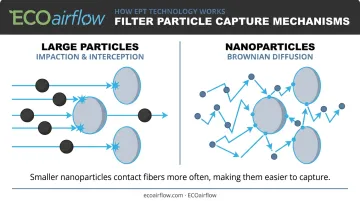
Most people assume filters work like a net — particles smaller than the pore size pass through. This holds reasonably well for large particles caught by impaction (hitting fibers head-on) and interception (grazing fibers as they pass). For nanoparticles, the physics changes entirely.
Brownian Motion and the Diffusion Mechanism
Nanoparticles are so small they're continuously bombarded by surrounding gas molecules, knocking them into erratic, zigzag trajectories rather than straight-line paths. This is Brownian motion, and the consequence is counterintuitive: a particle bouncing erratically through a filter contacts fiber surfaces far more often than one travelling in a straight line.
This capture mechanism is called diffusion, and it becomes more effective as particle size decreases. Research by Shin et al. studying fibre filter performance against 3–20 nm silver nanoparticles confirmed that filtration efficiency increases as nanoparticle size decreases, with no evidence of thermal rebound even at 3 nm — the smallest particles tested were the easiest to capture.
The Most Penetrating Particle Size (MPPS)
That diffusion advantage fades as particles grow larger. The hardest size range to capture sits at approximately 0.1–0.3 microns — not nanoparticles.
At this intermediate size:
- Particles are too large for diffusion to dominate capture
- Particles are too small for impaction and interception to work reliably
Both mechanisms fall short at the same time, leaving a performance gap.
This is why HEPA certification benchmarks at 0.3 microns with 99.97% minimum efficiency — it represents the worst-case performance point. The EPA confirms that particles both larger and smaller than 0.3 microns are trapped with even higher efficiency.
A HEPA filter's rating reflects its floor performance, not its ceiling. True nanoparticles — anything below 100 nm — are captured at rates that exceed the 99.97% benchmark, often by a meaningful margin.
Methods of Nanoparticle Filtration
Nanoparticle filtration spans three domains — air, liquid, and lab-scale separation — each using different physical principles.
Air Filtration Methods
Mechanical fibre filters (HEPA and MERV)
Dense fibre mats capture nanoparticles primarily through diffusion. HEPA-grade filters achieve ≥99.97% at the 0.3-micron MPPS, with superior performance at true nanoparticle sizes. MERV 13–16 filters, rated under ASHRAE 52.2 for particles as small as 0.3 microns, leverage the same diffusion mechanism and provide strong sub-100 nm capture in practice — though ASHRAE's standard test range doesn't formally extend below 300 nm.
Electronic and polarization-based filtration
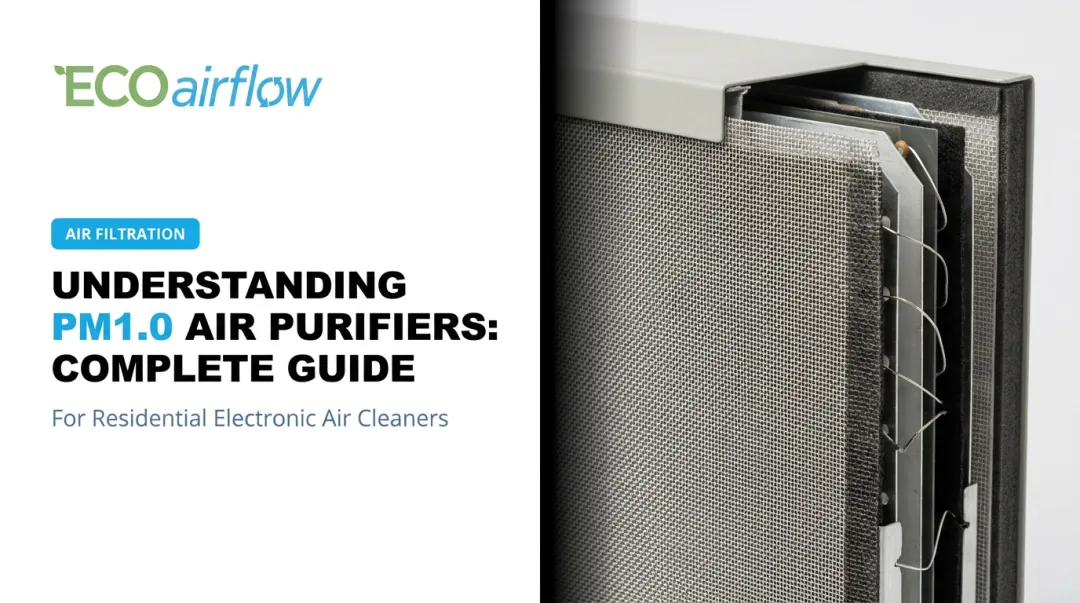
Electronic filtration adds an active capture mechanism that goes beyond what fibre density alone can achieve. Instead of relying on particles randomly diffusing into fibres, these systems induce an electrical charge that makes particles actively seek out collection media.
ECOairflow's patented Electronic Polarization Technology (EPT) creates a corona field that alters particle polarity, turning filter media into an electromagnetic trap. Once charged, particles are drawn to collector pads rather than passing through gaps — similar to magnetic attraction. Charged particles also attract each other, forming larger clusters that are progressively easier to capture.
ECOairflow's EPT-based filters are certified to capture particles as small as 0.001 microns (1 nanometre). Independent lab testing at Blue Heaven Technologies found EPT up to 45 times more effective than the best passive filters in the 0.001–0.010 micron range. Pressure drop stays low (0.09–0.38 in. w.c. depending on model), reducing HVAC energy consumption by up to 15%.
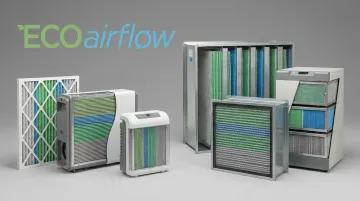
Available products span residential to commercial:
| Model | Form Factor | MERV Rating | Min. Particle Size |
|---|---|---|---|
| Model 1000 | 1-inch residential | MERV 11 | 0.001 microns |
| Dynamo™ 1" | 1-inch residential | MERV 12 | 0.001 microns |
| Model 1500 | 1-inch residential | MERV 12 | 0.007 microns |
| Dynamo™ 2" (Model 2300) | 2-inch commercial | MERV 13 | 0.001 microns |
| M-Series™ 2" (Model 2300) | 2-inch commercial | MERV 13–16 | 0.001 microns |
The M-Series carries UL2998 Zero Ozone Verification (ETL certified), ASHRAE 52.2 MERV 13–16, and Appendix J protocol certification — maintaining full rated performance whether powered or unpowered.
Electrostatic precipitators and ionizers
These devices charge airborne particles so they deposit onto collector plates or room surfaces. They can be effective for nanoparticles in some configurations, but research on in-duct ESPs found limited removal efficiency for particles below 10 nm. They require regular cleaning of collection plates and should be evaluated carefully for ozone output — CARB limits electronic air cleaners to 0.050 ppm (50 ppb), and UL2998 sets a stricter threshold of 0.005 ppm (5 ppb).
Liquid and Water Filtration Methods
Where air filtration relies on fibre capture and electrical charge, liquid-phase methods work through membrane exclusion and pressure — different physics, same goal of separating particles by size.
Ultrafiltration (UF) membranes
UF membranes use size-exclusion to separate nanoparticles from liquid based on molecular weight cut-off (MWCO). Pore sizes typically range from 0.01–0.1 microns (10–100 nm), making UF directly relevant to the upper nanoparticle range. Selecting the right MWCO — roughly half the molecular weight of the target nanoparticle — determines retention efficiency.
Two configurations serve different scales:
- Centrifugal UF (such as Amicon Ultra spin columns): small lab volumes, using centrifugal force to drive liquid through the membrane
- Tangential flow filtration (TFF): larger volumes, passing sample across the membrane surface to reduce fouling
Reverse osmosis and alternatives
Reverse osmosis forces water through a dense semi-permeable membrane under pressure, removing virtually all dissolved and particulate matter including nanoparticles. It's more comprehensive than UF but also more energy-intensive.
Distillation also removes nanoparticles effectively. Granular activated carbon (GAC) alone provides limited nanoparticle removal via adsorption but lacks the size-exclusion mechanism needed for consistent sub-100 nm capture.
Lab-Scale Separation and Purification Methods
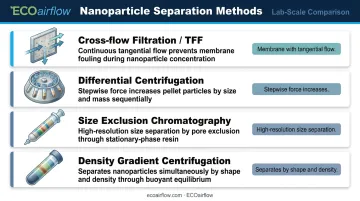
Research and pharmaceutical contexts require high-purity separation rather than bulk removal. Four techniques dominate:
- Cross-flow / tangential flow filtration (TFF) — separates nanoparticles from smaller species while keeping the sample moving across the membrane to prevent filter cake buildup
- Differential centrifugation — fractionates by size using stepwise increases in centrifugal force
- Size exclusion chromatography (SEC) — achieves high-resolution size separation, demonstrated with gold nanoparticles as small as a few nanometres
- Density gradient centrifugation — separates by shape and density, useful when isolating specific nanoparticle morphologies
In practice, two-step workflows (TFF or ultracentrifugation followed by SEC) consistently outperform single-method approaches for high-purity nanoparticle isolation.
Key Applications of Nanoparticle Filtration by Industry
Healthcare and Hospitals
Viral particles sit within the nanoparticle size range. Surgical suites, isolation rooms, and compounding pharmacies require continuous removal of viral aerosols, bacterial particles, and airborne pathogens. CDC infection control guidelines include HEPA filtration in healthcare air management protocols, and ASHRAE/ASHE Standard 170 references high-efficiency filtration within operating room contexts.
ECOairflow's Model 2300 M-Series configuration is designed for medical treatment rooms, maintaining full MERV 13–16 performance whether powered or not, a requirement that matters most when emergency power interruptions occur.
Industrial and Occupational Safety
Workers in nanotechnology manufacturing, carbon nanotube production, and metal nanoparticle synthesis face real inhalation risks. NIOSH has established recommended exposure limits for the most common industrial nanomaterials:
- 1 µg/m³ elemental carbon for carbon nanotubes and nanofibers
- 0.3 mg/m³ for nanoscale titanium dioxide
NIOSH engineering control guidance identifies local exhaust ventilation near contamination sources, paired with high-efficiency filtration, as the primary control strategy. (See the FAQ for respirator guidance.)
Commercial Buildings, HVAC, and Indoor Air Quality
Nanoparticles infiltrate commercial and residential buildings continuously. Traffic-related black carbon correlates strongly with indoor concentrations (R² up to 0.63 in one CDC-hosted study), and cooking sources can spike indoor particle counts dramatically.
Building-level mitigation centers on HVAC upgrades — replacing standard filters with MERV 13+ or electronic filtration. ECOairflow's commercial Model 2300 configurations are drop-in compatible with existing 2-inch filter slots and require only a low-voltage (24V) power connection, consuming just 2 watts of electricity. The low pressure drop design delivers up to 15% annual HVAC energy savings compared to high-MERV pleated alternatives.
Biomedical Research and Laboratory Environments
Biomedical research labs and pharmaceutical manufacturing facilities handle engineered nanoparticles under tightly controlled conditions. Cleanrooms and lab HVAC systems must prevent cross-contamination from airborne particles while maintaining stable temperature and humidity.
High-efficiency electronic filtration in the facility's HVAC system supports these requirements — capturing ultrafine particles before they reach sensitive environments. ECOairflow's MERV 13–16 certified filters, with their low pressure drop design, integrate cleanly into existing commercial HVAC infrastructure without adding equipment stress or energy load.
How to Choose the Right Nanoparticle Filtration Approach
Three questions drive the decision:
- What is the medium? Air, water, or liquid sample each require fundamentally different technologies
- What size range and capture efficiency does the application require? A hospital isolation room has different requirements than a residential HVAC upgrade
- What are the operating constraints? Volume throughput, energy budget, maintenance frequency, and whether the goal is protection/removal or purification/concentration
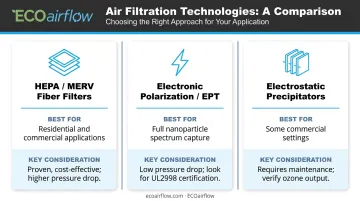
Air Filtration Selection Framework
| Approach | Best For | Key Consideration |
|---|---|---|
| HEPA/MERV fibre filters | Most residential and commercial buildings | Cost-effective; proven; higher pressure drop |
| Electronic polarization (such as ECOairflow's EPT) | Full nanoparticle spectrum capture with low energy use | Low pressure drop reduces HVAC load; look for UL2998 zero-ozone certification |
| Electrostatic precipitators | Some commercial settings | Requires maintenance; verify ozone output |
Look for these certifications as performance benchmarks:
- ASHRAE 52.2 MERV ratings (particle capture efficiency)
- UL2998 (zero ozone emissions verification)
- Appendix J protocol (real-world performance assurance for electronic filters)
Water and Liquid Applications
Choosing the right membrane comes down to matching the filtration cut-off to your target particle size and what you need to retain or remove. Key selection guidance:
- Drinking water: Reverse osmosis provides the most comprehensive nanoparticle removal
- General liquid applications: Select UF membrane molecular weight cut-off (MWCO) based on the nanoparticle's size relative to species you want to retain or reject
- Industrial or biomedical processes: Consult a filtration specialist before committing — once you've built a process around a membrane, errors are expensive to correct
Frequently Asked Questions
What are the methods of nanoparticle filtration?
The three primary method categories are:
- Air filtration: Mechanical fibre filtration (HEPA/MERV) and electronic polarization methods
- Liquid filtration: Ultrafiltration membranes and reverse osmosis
- Lab/biomedical purification: Cross-flow filtration, differential centrifugation, and size exclusion chromatography
High-purity applications typically combine two or more techniques.
What respirator is needed for nanoparticles?
NIOSH-approved N95 respirators are the minimum for occupational nanoparticle exposure — fibre-based media captures sub-100 nm particles efficiently via Brownian diffusion. P100 (or CE-marked FFP3) respirators provide an additional margin of protection. Fit is critical regardless of rating, as penetration rises sharply at high breathing rates.
Can standard HEPA filters capture nanoparticles?
Yes. HEPA filters capture nanoparticles via diffusion (Brownian motion), and efficiency actually increases for particles smaller than the 0.3-micron MPPS benchmark. True nanoparticles are captured at rates equal to or exceeding the rated 99.97% efficiency — the 0.3-micron figure represents the floor, not the ceiling.
What is the most penetrating particle size (MPPS) and why does it matter?
The MPPS (approximately 0.1–0.3 microns) is the hardest size to capture because it's too large for diffusion to dominate and too small for impaction or interception to work reliably. Filter efficiency ratings are benchmarked at this size precisely because it's the worst-case point — filters perform better at sizes both larger and smaller.
Are airborne nanoparticles dangerous to human health?
Yes. Nanoparticles from combustion, industrial processes, and traffic penetrate deep into lung tissue and can enter the bloodstream within an hour of inhalation. Chronic exposure causes measurable respiratory and cardiovascular harm, including inflammation and oxidative stress that extends well beyond the lungs.
What is the difference between ultrafiltration and reverse osmosis for nanoparticle removal from water?
Ultrafiltration uses membranes with pore sizes of 10–100 nm to retain nanoparticles while letting smaller molecules pass through — useful when selectivity matters. Reverse osmosis applies higher pressure through a denser membrane to remove nearly everything, making it more comprehensive but more energy-intensive and less suitable for concentrating specific particles for downstream use.