
Understanding BFE properly — what it tests, what it ignores, and how it relates to MERV ratings and electronic filtration systems — is what separates a well-specified filter from one that looks good on paper and underperforms in the field.
Key Takeaways
- BFE is a percentage measuring how much of a standardized bacterial aerosol a filter material captures in a controlled lab test
- It's a material-level metric — frame gaps, bypass airflow, and installation variables aren't included, so real-world performance is often lower
- HEPA, high-MERV pleated filters, and electronic polarization filters all achieve high BFE through different mechanisms, each with distinct energy trade-offs
- ASTM F2101 governs BFE testing for masks; ASHRAE 52.2 MERV ratings govern HVAC filters — these measure related but distinct things
- Selecting by BFE alone, without checking pressure drop and bypass risk, risks both over-spending and under-protecting
What Bacterial Filtration Efficiency (BFE) Actually Measures
BFE is expressed as a percentage using a straightforward formula:
BFE (%) = [(upstream CFU − downstream CFU) / upstream CFU] × 100
The test aerosolises a standardised bacterial challenge — typically Staphylococcus aureus at a mean particle diameter of 3.0 ± 0.3 µm — through filter material at a controlled flow rate of 28.3 L/min, as defined by ASTM F2101. Colony-forming units are counted upstream and downstream, and the ratio gives the efficiency percentage. Maximum determinable efficiency under ASTM F2101 is 99.9%.
What BFE Doesn't Include
This is the part that causes selection errors. BFE characterises the filter medium itself — the fabric or fibre matrix — not the full assembly including frame, seals, and housing. Air that bypasses the medium entirely doesn't factor into the rating.
Those physical limitations carry over into how BFE gets used. In practice, the same number serves as a design specification, a compliance benchmark, and a procurement comparison tool — all derived from a single particle size at a single flow rate. That gap between what BFE measures and what buyers assume it covers is where specification errors happen.
Key limitations to keep in mind:
- Measures filter media only — not frame, seals, or housing performance
- Uses one particle size (3.0 µm); doesn't reflect sub-micron or larger particle capture
- One flow rate (28.3 L/min); real-world airflow conditions vary
- Does not account for bypass air around the filter assembly
BFE vs. MERV — Not the Same Measurement
MERV (Minimum Efficiency Reporting Value, ASHRAE 52.2) rates HVAC filters across three particle size bins:
| ASHRAE Particle Bin | Size Range | Relevance |
|---|---|---|
| E1 | 0.3–1.0 µm | Sub-micron particles, viral aerosols |
| E2 | 1.0–3.0 µm | Bacteria-sized particles, droplet nuclei |
| E3 | 3.0–10.0 µm | Larger biological particles, dust |
BFE uses particles in the E2–E3 range. A filter can have a high MERV rating and a corresponding high BFE range, but the two are not interchangeable. For HVAC selection, MERV is the applicable metric — no equivalent HVAC-specific BFE framework exists under any major standard.
BFE Performance Across Filter Types
BFE doesn't follow a universal scale. The right target depends entirely on the application. The range runs from below 70% for basic mechanical filters to ≥99.9% for certified medical-grade systems.
Mechanical HEPA and Pleated Filters
HEPA filters capture ≥99.97% of 0.3 µm particles by definition. Because bacteria typically range from 0.5–5 µm — well above the HEPA challenge particle — HEPA achieves very high BFE by default. The tradeoff is pressure drop: the dense fiber matrix that creates this efficiency also resists airflow, increasing HVAC energy consumption.
Standard pleated filters tell a more nuanced story:
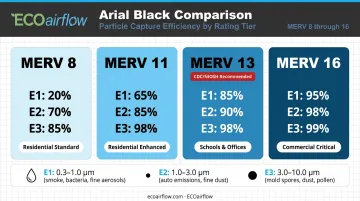
- MERV 8: E3 performance only (≥70% for 3.0–10.0 µm particles); moderate BFE against bacterial-sized particles
- MERV 11: Adds E2 performance (65–79% for 1.0–3.0 µm); suitable for residential settings with some pathogen concern
- MERV 13: Reaches E1 performance (50–74% for 0.3–1.0 µm), with ≥85% E2 and ≥90% E3; CDC/NIOSH recommends MERV 13 or higher for pathogen control in occupied buildings
- MERV 16: ≥95% across all three particle bins; approaches HEPA-level performance but can increase energy use by more than 5% in residential systems, according to Lawrence Berkeley National Laboratory research
Electronic Polarization Filters
Electronic polarization technology (EPT) works differently from mechanical filtration. Rather than relying on a dense fiber matrix to intercept particles by size, EPT generates an electrostatic charge field that attracts particles — including ultrafine particles well below 1 µm — to collector pads (the filter media housed inside the unit frame).
Particles adhere to pad fibers through electrostatic attraction, similar in principle to a magnetic field. The result is high filtration efficiency at significantly lower pressure drop than comparable mechanical filters.
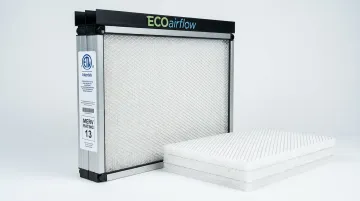
ECOairflow's M-Series filters demonstrate this in testing. The commercial M-Series 2″ Hybrid achieves MERV 13 through MERV 16 certification under ASHRAE 52.2, with pressure drop ranging from 0.09 in.w.c. at 300 FPM (MERV 13) to 0.38 in.w.c. at 500 FPM (MERV 16). MERV 16 mechanical filters typically operate at substantially higher resistance than this.
Key performance characteristics of EPT filters at these ratings:
- Certified MERV 13–16 under ASHRAE 52.2 testing, including Appendix J protocol
- Pressure drop stays below 0.38 in.w.c. even at MERV 16 — well under typical mechanical equivalents
- Rated performance maintained with power on, power off, and under Appendix J conditions
- Operates at 2 watts or less per unit, making electrical draw negligible
Lower pressure drop translates directly to reduced HVAC operating costs. Because the system encounters less resistance moving air through the filter, the blower runs shorter cycles. ECOairflow reports up to a 15% reduction in heating and cooling costs compared to pleated alternatives — a manufacturer-stated figure worth verifying against your system's baseline.
How BFE Is Measured and Certified
ASTM F2101 vs. ASHRAE 52.2
The two main frameworks cover different product categories and shouldn't be conflated:
ASTM F2101 (masks and respirators):
- Aerosolises S. aureus at ~3 µm
- Fixed flow rate: 28.3 L/min
- Reports a single BFE percentage
- Maximum reportable: 99.9%
ASHRAE 52.2 (HVAC filters):
- Tests across E1, E2, and E3 particle size bins
- Derives a MERV rating from the minimum efficiency across bins
- BFE as a standalone percentage isn't the output — MERV is
For HVAC filter buyers, asking for a BFE percentage is asking the wrong question. Ask for the MERV rating, the specific E1/E2/E3 efficiencies, and pressure drop data.
Why Appendix J Matters
ASHRAE 52.2 Appendix J is an optional conditioning protocol that subjects filters to KCl particle loading before efficiency testing. This simulates real-world field conditions rather than the clean, freshly-installed state assumed by standard MERV testing.
A filter that passes standard MERV testing but loses efficiency after particle loading will show a lower MERV-A rating under Appendix J. This is a known risk for filters that rely primarily on electrostatic charge in the media.
ECOairflow's M-Series filters are certified to maintain rated MERV performance across all three test conditions:
- Powered — standard operating state
- Unpowered — passive filtration mode
- Appendix J conditioning — post-KCl particle loading
This matters for specifications in healthcare or commercial settings that require Appendix J compliance. Standard ECOairflow Dynamo commercial filters achieve MERV 13 when powered but do not carry Appendix J ratings, a distinction buyers should note when specifying for critical environments.
Filtration performance is only part of the certification picture. ECOairflow products also carry ETL certification from Intertek for UL 2998 Zero Ozone Verification, confirming ozone output stays below 0.0005 ppm — one-tenth of the standard regulatory threshold. For buyers in healthcare and commercial settings, having both MERV and ozone credentials from an accredited third party removes ambiguity from the specification process.
The Gap Between Stated BFE and Real-World Performance
A filter rated at 95% BFE in a lab can deliver meaningfully less protection in an actual HVAC installation. That gap is a predictable consequence of what the test measures and what it deliberately excludes.
Research published in Scientific Reports found that filtration efficiency depends more on droplet size than on whether the agent is bacterial or viral for the same size range — confirming that lab BFE values are sensitive to test conditions. A separate comparison found that particle filtration efficiency (PFE) values consistently ran 1.33–4.64 percentage points higher than BFE for the same materials, because particle size distributions in calculations differed.
Bypass: The Biggest Real-World Variable
ASHRAE research shows installed filter performance depends heavily on HVAC context, leakiness, and airflow conditions. LBNL documents the mechanism directly: as filter pressure drop increases — whether from a dense mechanical filter or a dirty loaded filter — more air diverts around the filter rather than through it.
Key bypass risk factors in HVAC installations:
- Gaps between filter edge and frame
- Incorrect filter sizing (even a few millimetres of gap matters)
- Damaged or deformed filter media
- Airflow velocity exceeding the filter's rated operating range
- Filter loading over time shifting pressure differential
Even minor bypass paths can push a 95% BFE filter's actual performance well below its rated value. Proper filter sizing, frame sealing, and timely replacement are what close that gap in practice. ECOairflow recommends replacing filter pads every three months to maintain consistent pressure drop and prevent bypass from progressive loading.
Common Misinterpretations of BFE in Filter Selection
BFE ≠ Virus Filtration Rating
BFE tests use bacterial aerosol particles at approximately 3 µm. SARS-CoV-2 virions measure roughly 60–140 nm (0.06–0.14 µm), and influenza A virions are approximately 80–120 nm. That's 20–50 times smaller than the BFE challenge particle.
A filter with 99% BFE may have significantly lower efficiency against viral particles unless it is also validated at sub-micron sizes through MERV E1 testing or dedicated viral filtration standards. Buyers specifying filters for respiratory pathogen control should look at E1 efficiency (0.3–1.0 µm MERV data) rather than BFE alone.
That said, viral particles in real indoor air rarely travel as isolated virions. They're embedded in respiratory fluid droplets that can be considerably larger — a peer-reviewed analysis calculated a minimum respiratory particle carrying SARS-CoV-2 of approximately 9.3 µm before evaporation shrinks it. High-MERV filters capture a significant fraction of these virus-carrying particles, even when individual virions fall below the BFE challenge size.
The BFE rating still matters for bacterial and larger particulate control — it just shouldn't be the only metric when respiratory pathogen filtration is the goal.
High BFE ≠ Low Pressure Drop
This is a direct tradeoff in mechanical filtration — denser media captures more particles and resists more airflow. Specifying maximum BFE or maximum MERV without evaluating pressure drop risks:
- Increased HVAC blower energy consumption
- Reduced total air circulation volume
- Accelerated bypass as pressure differential rises
Electronic polarization filters specifically address this tradeoff. They achieve high particle capture efficiency without relying on the dense media that creates high airflow resistance in mechanical filters — keeping pressure drop low while maintaining effective filtration.
Frequently Asked Questions
What filtration methods remove bacteria?
Three primary methods capture bacteria depending on application:
- Mechanical filters (HEPA, high-MERV pleated) trap bacteria by size interception in dense fibre media
- Electronic/electrostatic systems attract and hold bacteria-sized particles using charge, without dense media
- Membrane filters (0.22 µm pore size) physically retain bacteria from liquids — a pharmaceutical standard, not an air filtration one
What are the four main filtration methods?
The four main categories are:
- Mechanical filtration — fibre media captures particles by size and interception
- Electronic/electrostatic filtration — charge-based attraction without dense media
- Activated carbon filtration — chemical adsorption for gases and VOCs
- UV germicidal irradiation — inactivates microorganisms rather than capturing them
Can bacteria pass through a 0.22 µm filter?
In liquid filtration, 0.22 µm is the sterilising-grade standard validated against Brevundimonas diminuta — bacteria do not pass through it, but this applies to pharmaceutical applications only. In air filtration, HEPA and high-MERV electronic filters achieve comparable bacterial capture through fibre interception and electrostatic mechanisms rather than pore-size exclusion.
What is a bacterial/viral (BV) filter on a CPAP?
A BV filter on a CPAP machine is a disposable inline respiratory filter inserted in the airflow path to capture bacteria and viruses from pressurised air before it reaches the patient. FDA documentation notes that inline bacterial filters can increase airflow resistance and are not recommended for all CPAP configurations. BV filters are typically replaced on a regular maintenance schedule.
What is a good BFE rating for an air filter?
For HVAC filters, MERV is the appropriate metric — no authoritative CDC, EPA, or ASHRAE minimum BFE threshold exists for HVAC. For pathogen control, CDC/NIOSH recommends MERV 13 or the highest efficiency achievable without adverse HVAC effects. Critical environments (medical treatment rooms, immunocompromised patient areas) should target MERV 16 or HEPA-grade performance.
How does MERV rating relate to bacterial filtration efficiency?
MERV and BFE measure different things: BFE tests a single bacterial aerosol at ~3 µm, while MERV covers three particle size bins from 0.3–10 µm. In practice, MERV 13–16 filters typically achieve BFE above 95%; MERV 8 filters may reach 70–85% — though exact results depend on filter design and test conditions.