Introduction
Walk into any home improvement store and you'll find shelves packed with air purifiers, ionizers, and electronic air cleaners — all making bold claims about cleaner air and healthier homes. Most buyers have no idea they're choosing between technologies with dramatically different safety profiles and real-world performance.
The gap matters. The EPA has documented warnings against many ionizers that produce ozone as a byproduct — a lung irritant that worsens asthma and respiratory conditions. Yet certifications like UL2998 Zero Ozone Verification exist precisely because not every electronic air cleaner is the same.
Here's what this guide breaks down:
- How electronic air cleaners work mechanically — and what separates them from basic ionizers
- Why ozone is a genuine health concern, and when it isn't a factor
- Which pollutants these systems can and can't capture
- The health and energy benefits backed by independent certification
Key Takeaways
- Not all electronic air cleaners are safe: standalone ionizers can produce ozone and deposit particles on surfaces rather than capturing them
- Standalone ionizers also struggle with large allergens like pollen and pet dander
- HVAC-integrated systems using Electronic Polarization Technology (EPT) physically trap particles in polarized media pads instead
- Require UL2998 Zero Ozone Verification and MERV 13-16 (ASHRAE 52.2) certification — these are the only independent proof of safe performance
- Certified EPT systems capture particles as small as 0.001 microns, including viruses, bacteria, and ultrafine combustion pollutants
What Is an Electronic Ionizer Air Cleaner?
The category is broader than most people realize. "Electronic air cleaner" covers several distinct technologies:
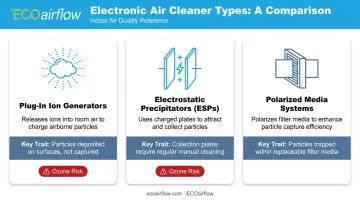
- Plug-in negative ion generators — emit charged ions into room air to make particles clump and settle on surfaces
- Electrostatic precipitators (ESPs) — use high-voltage ionizing wires to charge particles, then collect them on oppositely charged plates
- Polarized media systems — install directly in HVAC ductwork and use an electromagnetic field to charge particles before trapping them in filter media pads
Marketing language compounds the confusion. Products sold as "ionizers," "bipolar ionization systems," "ion generators," and "electronic air cleaners" use overlapping terminology but represent very different technologies, safety profiles, and filtration outcomes.
The EPA groups electrostatic precipitators, ionizers, and plasma air cleaners together as electronic air cleaners that may emit ozone. That's a meaningful warning , but it doesn't apply equally to all designs. A duct-mounted polarized media system with verified zero-ozone certification is a different product entirely than a plug-in ion generator bought at a hardware store.
Knowing which category a product falls into — and what safety certifications it carries — is what separates a useful purchase from an expensive mistake.
How Electronic Polarization Technology Works
The Core Ionization Principle
Every electronic air cleaner starts with the same basic mechanism: generate an electrical charge, apply it to airborne particles, and attract those charged particles to a collection surface. A balloon rubbed against hair creates static electricity and sticks to a wall — same principle at work.
Where systems diverge is in how they apply that charge and where particles end up.
HVAC-Integrated vs. Standalone Systems
Traditional standalone ionizers release ions freely into room air. Charged particles then drift until they land on walls, furniture, floors — or on you. They're not captured. They're relocated.
Electronic Polarization Technology (EPT), used in ECOairflow's product line, works differently. The system installs directly in the HVAC air handler's filter slot. As the blower fan draws air through the system, an electronic corona field charges airborne particles upstream of the filter media. Those charged particles then actively seek out the polarized pad fibers, attracted like a magnet, and bond to the media rather than passing through.
ECOairflow's EPT electronics draw 2 watts or less, meaning continuous operation adds virtually nothing to your energy bill. Hermetically sealed electronics protect the components from moisture and contamination, supporting long-term durability (including a lifetime warranty on Dynamo electronics for original owners).
Multi-Mechanism Capture
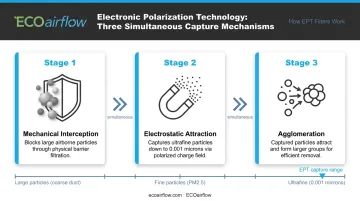
EPT systems achieve MERV 13-16 performance through three simultaneous processes:
- Mechanical interception — particles larger than fiber gaps are physically blocked
- Electrostatic attraction — charged ultrafine particles bond to polarized pad fibers, capturing particles as small as 0.001 microns
- Agglomeration — charged particles attract each other, forming larger clusters that are easier to capture on subsequent passes
This combination explains why ECOairflow's M-Series hybrid filters maintain their rated MERV performance whether powered on, powered off, or tested under the more rigorous ASHRAE Appendix J protocol. The passive pleated component provides a filtration baseline even without power, while EPT enhances performance when energized.
That dual reliability is specifically why the M-Series is designed for medical treatment rooms where consistent, guaranteed performance is non-negotiable.
On the practical side, maintenance is straightforward: swap the replaceable pad sets when they reach capacity. The permanent frame is reusable, and the glass fiber pads can be recycled as post-consumer waste.
The Ozone Problem — and Why Certification Matters
Why the EPA Warns Against Many Ionizers
When ion generators push large quantities of ions into occupied room air, those ions react with oxygen molecules to produce ozone (O₃). According to the EPA, ozone inhalation can cause chest pain, coughing, shortness of breath, and throat irritation — and can worsen chronic respiratory conditions like asthma. No federal agency has approved ozone-emitting air cleaners for use in occupied spaces.
The FDA limits ozone output from indoor medical devices to no more than 0.05 ppm. California's CARB sets the same threshold for certified indoor air cleaners sold in the state.
What UL2998 Zero Ozone Verification Actually Means
UL2998 is an independently administered standard that verifies an air cleaning device produces zero measurable ozone emissions. Verification requires third-party testing by an accredited body — not a self-reported manufacturer claim.
ECOairflow's entire filter line carries UL2998 Zero Ozone Verification, certified by Intertek (ETL). Their products maintain ozone levels below 0.0005 ppm (5 ppb) — one-tenth of the regulatory threshold under UL867, and under the limits set by the FDA, NIOSH, CARB, EPA, and OSHA.
The EPA identifies UL2998 as the relevant zero-ozone certification standard for electronic air cleaning devices. ASHRAE 62.1-2019 Section 5.7.1 now requires this certification for air cleaning devices used in mechanically ventilated spaces.
What to Look for When Evaluating Any Electronic Air Cleaner
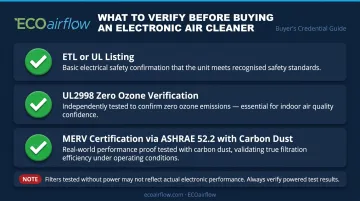
Before buying any electronic air cleaner, verify these three credentials:
- ETL or UL listing — confirms basic electrical safety testing
- UL2998 Zero Ozone Verification — confirms independently tested zero ozone emissions
- MERV certification using ASHRAE 52.2 test dust with a carbon component — confirms real-world performance, not just clean-lab results
That last point matters more than most buyers realize. Many electronic air cleaners are tested unpowered or with non-carbon test dust because their electronics can't handle ASHRAE-certified carbon dust when energized. ECOairflow tests with ASHRAE-certified dust containing a carbon component — the same kind of particulate found in real indoor environments with wildfire smoke, traffic pollution, and combustion byproducts.
What Pollutants Can an Electronic Air Cleaner Capture?
Ultrafine Particles and Pathogens
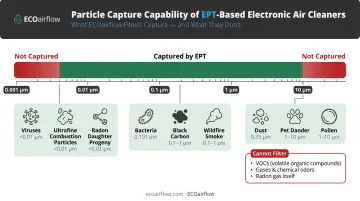
Standard HEPA filters are rated to capture particles down to 0.3 microns — the most penetrating particle size for mechanical filtration. ECOairflow's EPT systems have been independently tested to capture particles as small as 0.001 microns, enabled by electrostatic attraction rather than mechanical blocking alone.
This puts viruses (typically 0.005–0.3 microns) and bacteria within capture range. A 2025 peer-reviewed study testing commercial air ionizer systems in HVAC ductwork reported airborne concentration reductions of over 82% for MS2 bacteriophage, a SARS-CoV-2 surrogate.
Allergens and Common Particulates
Dust, pet dander, and pollen are relatively large particles that fall well within the capture range of a MERV 13-16 system. Unlike standalone ionizers — which the EPA notes "may be relatively ineffective in removing large particles such as pollen and house dust allergens" — HVAC-integrated systems pull these particles through the filter using the existing blower fan, rather than hoping charged particles settle on nearby surfaces.
Black Carbon and Wildfire Smoke
Ultrafine black carbon particles from wildfire smoke and traffic-related air pollution (TRAP) are among the most health-damaging indoor contaminants. Research confirms that wildfire PM includes ultrafine particles associated with respiratory outcomes, particularly in children. ECOairflow's product line explicitly targets black carbon and TRAP as key applications, capturing submicron combustion particles that pass straight through standard pleated filters.
Radon Daughter Progeny (RDP)
Radon gas cannot be filtered. The radioactive decay particles radon produces (radon daughter progeny) attach to airborne dust and are filterable. ECOairflow has conducted independent testing by NRPP-certified radon professionals confirming that their EPT-based systems can reduce RDP to levels deemed safe by the EPA — a meaningful advantage that standard pleated filters simply can't match.
What Electronic Air Cleaners Cannot Do
Particle filtration and gas/odour removal are distinct problems that require separate solutions. No electronic air cleaner — including ECOairflow's systems — removes:
- Volatile organic compounds (VOCs)
- Gases and chemical odours
- Radon gas itself
For spaces where VOC or chemical odour control is needed, activated carbon filtration or dedicated ventilation strategies are required alongside particle filtration.
Health, Energy, and HVAC Benefits
Health Benefits
The EPA reports that Americans spend approximately 90% of their time indoors, where pollutant concentrations are often 2–5 times higher than outdoor levels. Continuous whole-home filtration through the HVAC system addresses this persistent exposure in a way portable units simply can't match.
Key health outcomes from certified HVAC-integrated filtration:
- Reduced allergen load (dust, dander, pollen) for allergy and asthma sufferers
- Lower airborne viral and bacterial concentrations — relevant for immunocompromised individuals and healthcare settings
- Capture of ultrafine combustion particles before they reach the lungs
- Interception of RDP-laden particles in radon-affected homes
ASHRAE's healthcare guidance requires MERV 13 or higher filtration for protective environment isolation units. ECOairflow designed the M-Series specifically for medical treatment rooms, hospitals, and high-occupancy facilities where filtration failures carry direct patient risk.
Energy and HVAC System Benefits
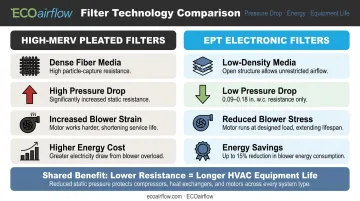
Beyond health outcomes, the way a filter is built affects your energy bills and HVAC lifespan. High-MERV pleated filters achieve their performance through dense fiber weaves, which creates high resistance to airflow (pressure drop). That forces the HVAC blower to work harder, consuming more energy.
ECOairflow's EPT approach uses less dense media because electrostatic attraction does the heavy lifting. Pressure drop across their residential models ranges from 0.09 to 0.18 inches w.c. — well below comparable high-MERV pleated alternatives. This lower resistance translates to:
- Up to 15% reduction in annual heating and cooling costs (ECOairflow internal data, based on pressure drop and reduced blower cycle time)
- Less mechanical stress on blower motors and HVAC components
- Longer equipment life by preventing particle accumulation on coils and fans
For commercial and institutional projects, ECOairflow's Dynamo 2″ and M-Series products qualify for LEED BD+C v4.1 Enhanced Indoor Air Quality credits, along with WELL Building, NGBS, ILFI, and Passivehaus standards — relevant for any facility targeting green building certification.
Frequently Asked Questions
Do electronic ionizer air cleaners really clean the air?
It depends entirely on the design. Traditional standalone ionizers often just deposit charged particles on nearby surfaces rather than capturing them. HVAC-integrated systems using polarized media — certified to MERV 13-16 and UL2998 — physically trap particles in filter media, making them a genuinely effective whole-home solution.
Can an electronic air cleaner help people with influenza, COPD, or those undergoing chemotherapy?
Certified zero-ozone systems rated for ultrafine particle and pathogen capture can reduce airborne viral and bacterial load, which benefits immunocompromised individuals. However, always consult a healthcare provider for medical guidance. Zero-ozone certification is also non-negotiable, since ozone can directly worsen COPD and respiratory conditions.
What's the difference between a basic ionizer and an advanced electronic air cleaner?
Basic ionizers release charged ions into room air; particles land on surfaces, not in a filter. Advanced electronic air cleaners like ECOairflow's EPT-based systems install in the HVAC duct, charge particles in the airstream, and capture them in polarized media pads — no manual surface cleaning required, and performance is independently MERV-rated.
Do all electronic air cleaners produce ozone?
Traditional ion generators and many ESPs do produce ozone as a byproduct. Electronic air cleaners engineered to UL2998 Zero Ozone standards are different — ECOairflow's full product line is independently verified by Intertek ETL to produce no measurable ozone, making them safe for continuous use in homes, offices, and healthcare facilities.
Are electronic air cleaners effective for allergies and asthma?
HVAC-integrated systems rated MERV 13-16 capture allergens like dust, dander, and pollen at high efficiency and are appropriate for allergy and asthma sufferers. Standalone ionizers are generally not recommended for these populations — they may not effectively remove large particles and can produce ozone that worsens symptoms.
What does MERV rating mean for an electronic air cleaner?
MERV (Minimum Efficiency Reporting Value) is an ASHRAE-standardized scale measuring particle capture efficiency by size. A MERV 13-16 rating means the filter captures the vast majority of fine particles, including bacteria-sized particles. For electronic air cleaners, legitimate certification requires ASHRAE 52.2 test dust with a carbon component, not alternate dust types that don't reflect real-world particulate.